
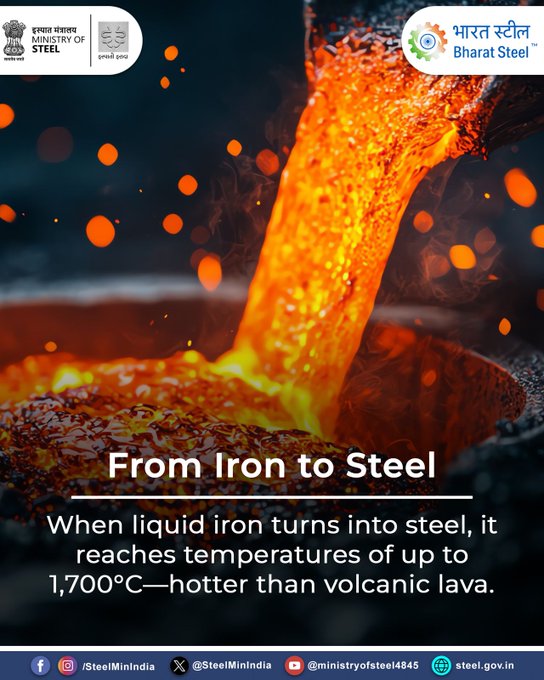
As India prepares to host Bharat Steel 2026, the country is positioning itself at the centre of global deliberations on the future of steelmaking, signalling an ambition to shape the next era of the industry through research and development, digitalisation, innovation and a strong base of skilled engineering and technology talent.
The two day Bharat Steel summit in New Delhi will bring together policymakers, technology pioneers and industry leaders from across the world to address the defining challenges of the decade, including the need to build resilient supply chains and accelerate the transition to low emission steel production. The platform is expected to serve as a global forum for aligning competitiveness with climate responsibility at a time of economic uncertainty, fragmented trade flows and rising protectionist pressures.
Steel continues to underpin modern economies, forming the foundation of infrastructure ranging from skyscrapers and highways to high speed rail, smart cities and industrial corridors. India has set out to leverage the sector as a key driver of growth as it works towards becoming a five trillion dollar economy, while consolidating its position as the world’s second largest steel producer.
This strategic vision forms the core of Bharat Steel 2026, which aims to reimagine a global blueprint for the steel sector in line with net zero commitments and long term sustainability. India’s leadership in this effort rests on both scale and ambition. The country has set a target of 300 million tonnes of steel production capacity by 2030 and 500 million tonnes by 2047, supported by strong domestic demand from infrastructure, housing, railways, defence and energy sectors.
Achieving these targets will require more than capacity expansion. The focus is shifting towards securing raw material supply, reducing dependence on imported coking coal, strengthening domestic beneficiation, improving logistics efficiency, ensuring predictable regulations and accelerating innovation led modernisation. Faster approvals and integrated planning are being emphasised to support this supply side transformation.
The Production Linked Incentive scheme for specialty steel has emerged as a key policy instrument, encouraging a transition from commodity grade output to high value, precision engineered steels required for automotive, aerospace, defence and advanced infrastructure applications.
Green steel development is central to India’s competitiveness strategy. The Green Steel Roadmap released in 2024 outlines a transition anchored in clean energy integration, green hydrogen pilots, carbon capture utilisation and storage, expanded scrap usage and exploration of emerging technologies such as direct electrolysis.
Digitalisation will be a major theme at the summit, with discussions covering the deployment of internet of things based monitoring, robotics, automation and predictive maintenance. Artificial intelligence driven optimisation is expected to play a critical role in improving efficiency, reducing waste and enhancing product quality. This technology push is being reinforced through expanded research and development, deeper industry partnerships, clearer technology transfer mechanisms and pilot scale trials of emerging processes.
As global trade increasingly shifts towards carbon accounting and sustainability based norms, India is aiming to position itself as a reliable exporter of low emission, high grade steel. The National Steel Strategy prioritises joint ventures and collaborations in hydrogen based direct reduced iron, carbon capture technologies and electrolysis, supported by targeted investment incentives.
Bharat Steel 2026 is expected to attract more than 700 global delegates representing the full steel value chain. Partner country and partner state pavilions, public sector enterprises, leading private companies, scale ups, start ups, innovators and investors from the steel and allied sectors will participate in the summit.
The gathering marks a pivotal moment in India’s effort to shape a steel sector that is secure, competitive, climate aligned and future ready, reinforcing steel’s role not only as the backbone of national infrastructure but also as a pillar of sustainable progress and global industrial leadership.