
The conclusion of the India–European Union Free Trade Agreement marks a transformational moment for India’s textile and apparel sector, unlocking zero duty access to one of the world’s largest and most sophisticated import markets valued at USD 263.5 billion. Designed as a modern, rules based trade partnership, the agreement enables deeper market integration between the world’s fourth largest economy, India, and the European Union, the second largest economy, while responding to contemporary global trade and sustainability challenges.
The European Union is India’s second largest export destination for textiles and apparel after the United States. In 2024, the EU’s global imports of textiles and apparel stood at USD 263.5 billion, underscoring the scale and long term potential of the European market for Indian exporters. Over the past five years, India’s textile exports to the EU have recorded steady growth, supported by a diversified and value added export basket dominated by labour intensive segments.
Ready made garments account for nearly 60 percent of India’s textile exports to the EU, followed by cotton textiles at around 17 percent and man made fibre and synthetic textiles at about 12 percent. Handicrafts and carpets contribute roughly 4 percent each, while jute products, woollen textiles, handlooms and silk products together form an important niche segment. This export composition highlights the artisanal, MSME driven and employment intensive character of India’s textile trade with Europe.
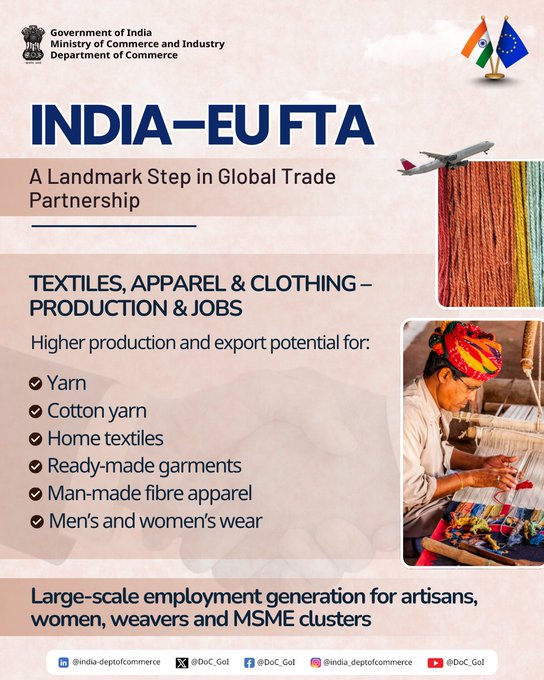
Under the Free Trade Agreement, India secures zero duty access across all tariff lines in textiles and clothing, eliminating tariffs of up to 12 percent that previously constrained competitiveness. This opens the EU’s import market valued at INR 22.9 lakh crore and significantly enhances India’s export prospects across yarn, cotton yarn, man made fibre apparel, ready made garments, men’s and women’s clothing, and home textiles. Building on India’s current global textile and apparel exports of INR 3.19 lakh crore, including exports of INR 62.7 thousand crore to the EU, the agreement is expected to drive substantial expansion in volumes, value addition and market share.
The agreement corrects a long standing tariff disadvantage faced by Indian exporters vis a vis competitors such as Bangladesh, Pakistan and Turkey, which enjoyed preferential access to the EU market. By restoring price parity and improving competitiveness, the FTA delivers a decisive boost to India’s labour intensive textile and apparel sector, particularly in one of the world’s most demanding consumer markets with high standards for quality, sustainability and compliance.
Textiles remain one of India’s largest employment generating sectors, providing direct employment to around 45 million people. Improved market access to the EU is expected to stimulate higher production, improved capacity utilisation and fresh employment across MSME clusters. The FTA is also expected to catalyse new investments, technology transfer and sustainability linked modernisation, especially in man made fibres, technical textiles and green manufacturing processes aligned with European standards, thereby enabling deeper integration into global value chains.
Beyond apparel and fabrics, the agreement also provides enhanced access for home décor, wooden crafts and furniture. Lower duties of up to 10.5 percent are expected to boost the competitiveness of Indian wooden, bamboo and handcrafted furniture, supporting growth in high value, design oriented segments and strengthening India’s position in global furniture supply chains.
The benefits of the India–EU FTA are expected to be geographically widespread. Textile and apparel exports to the EU originate from 342 districts across the country, reflecting broad based participation and regional inclusiveness. The sector is anchored in strong manufacturing clusters, with ready made garments led by Tiruppur, Bengaluru and the Gurugram Faridabad belt, generating large scale employment, particularly for women. Cotton textiles and home furnishings are centred in Karur, Panipat and Ahmedabad, while man made fibre and synthetic textiles are driven by Surat, Dadra and Nagar Haveli and Mumbai.
Traditional and value added segments are supported by handicrafts from Moradabad, Jaipur and Jodhpur, handlooms from Kanchipuram, Karur and Kolkata, carpets from Bhadohi, Mirzapur and Varanasi, jute products from Howrah, North 24 Parganas and South 24 Parganas, and silk and woollen textiles from Bengaluru, Mysuru and Bhagalpur. The agreement is expected to strengthen these clusters by improving export competitiveness, stabilising demand and supporting regional livelihoods.
Beyond tariff liberalisation, the FTA introduces comprehensive measures to address non tariff barriers through enhanced regulatory cooperation, customs facilitation, greater transparency and predictable trade rules. These provisions are expected to reduce compliance costs, improve ease of doing business and provide long term certainty to exporters.
Together with India’s trade agreements with the United Kingdom and the European Free Trade Association, the India–EU FTA effectively opens up the wider European market for Indian businesses. Aligned with the vision of Viksit Bharat 2047, the agreement positions India as a competitive, reliable and forward looking global hub for textiles and apparel, laying the foundation for inclusive, resilient and future ready growth for both India and Europe