
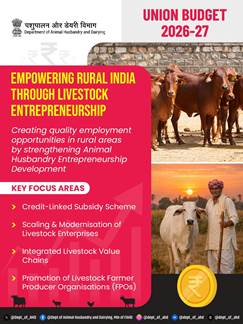
The Union Budget 2026–27 has accorded strong priority to the Animal Husbandry and Dairying sector, reaffirming the Government’s commitment to enhancing farmers’ incomes, strengthening rural livelihoods and ensuring sustainable growth of the livestock economy. The Budget outlines a comprehensive set of measures spanning veterinary infrastructure, dairy value chains, cooperative strengthening, entrepreneurship support and disease control, aimed at improving productivity and resilience across the sector.
A key focus of the Budget is the expansion and modernisation of veterinary infrastructure to ensure timely and accessible animal healthcare. To address the shortage of veterinary professionals, the Government has proposed a credit-linked capital subsidy scheme to increase the number of veterinary and para-veterinary professionals to over 20,000. Under this initiative, support will be provided for the establishment of private-sector veterinary and para-veterinary colleges, animal hospitals, diagnostic laboratories and breeding facilities. The Budget also envisages collaboration between Indian and foreign institutions to enhance quality, skills and global best practices in veterinary education and services.
The Budget places renewed emphasis on doorstep delivery of animal healthcare through the expansion of mobile veterinary units and improved last-mile services. These interventions are expected to significantly reduce animal mortality, improve productivity and protect farmers’ assets, particularly in remote and underserved rural areas.
Strengthening the dairy value chain from farm to market forms another major pillar of the Budget. Measures have been proposed to improve milk collection, processing, storage and value-addition infrastructure, with a special focus on cooperatives and Livestock Farmer Producer Organisations engaged in dairying and allied activities. By enhancing efficiency and market linkages, these initiatives aim to improve price realisation for dairy farmers and reduce post-harvest losses.
Financial and institutional support to Livestock Farmer Producer Organisations has been strengthened to promote aggregation, value addition and collective bargaining. As part of broader cooperative reforms, the Budget extends tax deductions to primary cooperative societies supplying cattle feed and cotton seed produced by their members, in addition to existing deductions for milk, oilseeds, fruits and vegetables. This move is expected to reduce input costs and improve the financial viability of dairy and livestock farmers.
Further relief has been provided through tax measures aimed at strengthening cooperative financial flows. Inter-cooperative dividend income will now be allowed as a deduction under the New Tax Regime to the extent it is further distributed to members. In addition, a three-year exemption has been announced for dividend income received by notified national cooperative federations on investments made in companies up to 31 January 2026, provided the dividends are further distributed to member cooperatives. These steps are expected to enhance liquidity and reinvestment capacity within the cooperative ecosystem.
The Union Budget also proposes a credit-linked subsidy programme for animal husbandry entrepreneurship, covering livestock, dairy and poultry enterprises. This scheme is designed to encourage modernisation, adoption of improved technologies and creation of integrated rural value chains, thereby generating employment and diversifying rural incomes.
Increased funding has been allocated for vaccination and disease-control programmes to safeguard animal health and ensure quality livestock output. Preventive healthcare measures are expected to play a critical role in reducing economic losses due to disease outbreaks and improving productivity.
Sustainability has been integrated into the livestock strategy through fiscal incentives for clean energy adoption. The Budget provides that, while calculating Central Excise Duty on biogas-blended CNG, the entire value of biogas will be excluded. This measure is expected to encourage the setting up of new biogas plants, promote waste-to-energy solutions in dairy operations and support environmentally sustainable growth.
Overall, the enhanced thrust on Animal Husbandry and Dairying in Union Budget 2026–27 reflects a holistic approach to rural development. By combining infrastructure investment, cooperative strengthening, entrepreneurship support, disease control and sustainability measures, the Budget is expected to generate employment, enhance nutritional security and contribute significantly to inclusive and resilient rural economic growth. The Government has reaffirmed its commitment to effective implementation of these initiatives in close collaboration with States and stakeholders.