
The Union Budget 2026–27 has laid a strong and long-term foundation for India’s Electronics, Information Technology, Artificial Intelligence and Semiconductor ecosystem, with a clear focus on global competitiveness, domestic capacity creation and technology leadership. Presenting the Budget in Parliament, Union Finance Minister Smt. Nirmala Sitharaman announced a series of forward-looking measures aimed at positioning India as a preferred global destination for AI data centres, cloud infrastructure and advanced electronics manufacturing.
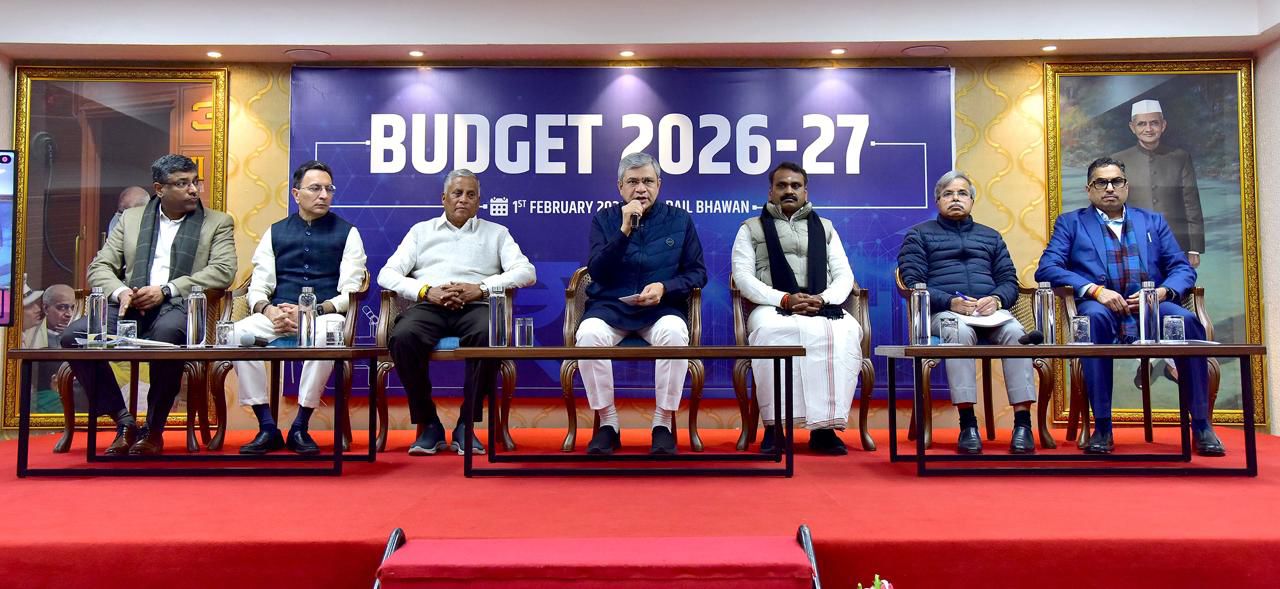
Addressing the media after the Budget presentation, Union Minister for Electronics and Information Technology, Railways and Information and Broadcasting Shri Ashwini Vaishnaw said the Budget builds on the momentum created over the last few years and provides policy certainty, scale and depth to India’s digital and semiconductor ambitions.
Shri Ashwini Vaishnaw underlined the critical role of data centres, particularly AI data centres, in the AI value chain. He noted that data centres form the core infrastructure layer of artificial intelligence architecture and are essential for large-scale computing, data processing and innovation. He said that investments of around USD 70 billion are already underway in India’s data centre ecosystem, with additional investment announcements of nearly USD 90 billion, reflecting growing global confidence in India’s digital infrastructure.
To further accelerate this momentum, the Union Budget 2026–27 proposes a tax holiday till 2047 for foreign companies providing global cloud services using data centre services located in India. Under this framework, such companies will serve global customers while operating through Indian data centre infrastructure, with services to Indian customers routed via Indian reseller entities. In addition, a safe harbour provision of 15 per cent on cost has been proposed where the Indian data centre service provider is a related entity. Shri Ashwini Vaishnaw said this long-term and predictable policy framework positions India among the most attractive global destinations for cloud and AI data centre investments.
The Budget has also announced the launch of India Semiconductor Mission 2.0, marking the next phase of India’s semiconductor journey. Shri Ashwini Vaishnaw said ISM 2.0 builds on the strong foundation laid under ISM 1.0, which created an entirely new semiconductor manufacturing ecosystem in the country. The new phase will focus on domestic manufacturing of semiconductor equipment, production of key materials used in chip fabrication, development of a full-stack semiconductor design ecosystem and further strengthening of talent development and training initiatives. An allocation of ₹1,000 crore has been provided for India Semiconductor Mission 2.0 in the financial year 2026–27.
The Union Minister said these measures will deepen domestic value chains, reduce critical import dependence and enable India to move up the global semiconductor value ladder, while creating high-skilled employment and fostering innovation.
The Budget has also significantly strengthened support for electronics manufacturing through the Electronics Components Manufacturing Scheme. Shri Ashwini Vaishnaw said the allocation for the scheme has been increased from around ₹22,000 crore to ₹40,000 crore in Budget 2026–27. He highlighted the strong industry response to the scheme, which received 149 applications against an initial expectation of 50 to 55 applications. The enhanced allocation, he said, will help sustain momentum, expand component manufacturing capacity and support the broader electronics manufacturing ecosystem.
In the services sector, the Budget has proposed major simplification and tax certainty measures for IT and IT-enabled services, which remain India’s largest exported services segment with exports exceeding USD 220 billion. All IT services, including software development, IT-enabled services, knowledge process outsourcing and contract research and development services, have been proposed to be grouped under a single category of Information Technology Services. A common safe harbour margin of 15.5 per cent has been proposed, along with a substantial increase in the threshold for availing safe harbour from ₹300 crore to ₹2,000 crore. Approvals will be granted through an automated, rule-based process.
Further, the Budget proposes fast-tracking the Unilateral Advance Pricing Agreement process for IT services and extending the facility of modified returns to associated entities entering into such agreements, providing greater certainty and ease of compliance for global and domestic IT firms.
Shri Ashwini Vaishnaw said the Union Budget 2026–27 reflects a clear strategic vision to integrate India’s electronics, semiconductor, AI and IT services ecosystems with global value chains, while building strong domestic capabilities. He said the measures announced will attract long-term investment, support innovation, generate skilled employment and reinforce India’s position as a trusted global technology and digital infrastructure hub.