
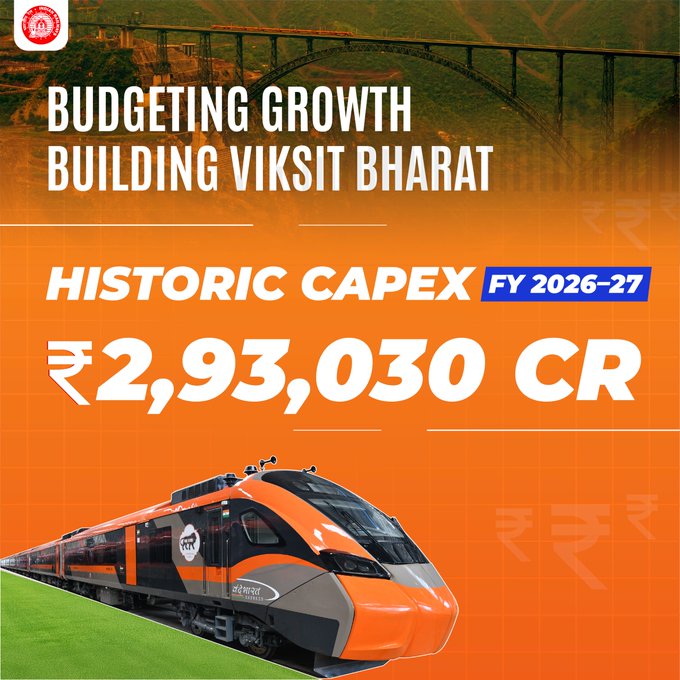
Indian Railways is set for an unprecedented expansion under the Union Budget 2026–27, with a record capital expenditure of ₹2.93 lakh crore, the highest-ever allocation for the national transporter. The scale of investment underlines the Government’s sustained commitment to modernising rail infrastructure, improving passenger mobility, strengthening freight logistics and making safety the foremost priority.
The allocation builds on the momentum of recent years and positions railways as a central pillar of economic growth, regional integration and sustainable transport. Backed by this investment, Indian Railways will focus on high-speed connectivity, new freight corridors, network decongestion, advanced safety systems and indigenous technology development.
A major highlight of the Budget is the announcement of seven new high-speed rail corridors to be developed as growth connectors across the country. These corridors include Mumbai–Pune, Pune–Hyderabad, Hyderabad–Bengaluru, Hyderabad–Chennai, Chennai–Bengaluru, Delhi–Varanasi and Varanasi–Siliguri. Together, the corridors will span nearly 4,000 kilometres and are expected to attract investments of around ₹16 lakh crore.
Addressing the media at Rail Bhawan, Union Minister for Railways, Information and Broadcasting, and Electronics and Information Technology Shri Ashwini Vaishnaw said the new corridors will significantly reduce travel time and bring India’s leading cities much closer. He said the Chennai–Bengaluru journey will take about one hour and thirteen minutes, Bengaluru–Hyderabad around two hours, and Chennai–Hyderabad approximately two hours and fifty-five minutes. This high-speed network will form a South High-Speed Diamond connecting major economic and technology hubs, benefitting Karnataka, Telangana, Andhra Pradesh, Tamil Nadu, Kerala and Puducherry.
In western and central India, the Mumbai–Pune high-speed corridor will cut travel time to around forty-eight minutes, integrating two of the country’s most important urban centres. The Pune–Hyderabad link, with a travel time of about one hour and fifty-five minutes, will further extend high-speed connectivity into southern India. In the north and east, the Delhi–Varanasi corridor will enable travel in under four hours, while the Varanasi–Patna–Siliguri corridor will allow journeys between Varanasi and Siliguri in under three hours, creating a powerful economic spine across Uttar Pradesh, Bihar and West Bengal.
Freight infrastructure has also received a major boost. The Budget announces a new 2,052-kilometre-long Dedicated Freight Corridor between Dankuni in West Bengal and Surat in Gujarat, passing through Odisha, Chhattisgarh, Madhya Pradesh and Maharashtra. This corridor will integrate with the existing Western Dedicated Freight Corridor and strengthen east–west trade flows. Shri Ashwini Vaishnaw noted that the existing Eastern and Western freight corridors are operating close to saturation, handling around 400 freight trains daily, making additional corridors essential to meet future demand. The new corridor will decongest passenger routes, reduce logistics costs and enhance supply chain efficiency for industry and ports.
Safety remains the top priority in the Budget, with nearly ₹1.20 lakh crore earmarked exclusively for safety-related works. The Minister said sustained investment has already reduced railway accidents by nearly 95 per cent, and the Government is intensifying efforts to further improve safety outcomes. Focus areas include track renewal, modern maintenance of locomotives, wagons and coaches, rapid deployment of the Kavach automatic train protection system, installation of CCTV cameras, upgradation of overhead electrification systems, station redevelopment and improved passenger facilities.
Shri Ashwini Vaishnaw also highlighted India’s growing technological capabilities in rail systems. He said propulsion systems designed and developed in India are now being supplied to leading countries including the United States, Germany, France, Switzerland and Spain, reflecting the global competitiveness of Indian railway manufacturing.
The Budget builds on record achievements in recent years, including construction of 35,000 kilometres of new tracks, electrification of 47,000 kilometres and electrification coverage of more than 99.5 per cent of the broad-gauge network. Manufacturing of Vande Bharat sleeper and chair car trains, Amrit Bharat trains, Namo Bharat trains and induction of new wagons is progressing at an unprecedented pace.
Emphasising sustainability, the Minister said rail transport is nearly 95 per cent less polluting than road transport, aligning closely with national climate and environmental commitments. The record allocation in Union Budget 2026–27 reinforces Indian Railways’ role as the backbone of national development, delivering faster connectivity, safer travel and more efficient logistics in line with the vision of Viksit Bharat.