
Artificial Intelligence is rapidly transforming Indian agriculture, driving a decisive shift from conventional practices to a data-driven, precision-based and farmer-centric ecosystem. Backed by a large-scale digital public infrastructure and targeted policy initiatives, India is emerging as a global leader in deploying AI for inclusive agricultural growth.
India ranks third worldwide in AI competitiveness, according to Stanford University’s 2025 Global AI Vibrancy Tool, reflecting its strong capabilities in digital infrastructure, data ecosystems, AI talent, research, startups, investment and governance. This technological momentum is increasingly being channelled into agriculture, where AI-enabled tools are enhancing productivity, resilience and sustainability across the value chain.
Building a Robust Digital Foundation
A cornerstone of this transformation is the Digital Agriculture Mission, launched in 2024 with a total outlay of ₹2,817 crore and ₹54.972 crore allocated for FY 2025–26. The Mission aims to deliver innovative, farmer-centric digital services by leveraging verified datasets and advanced technologies such as artificial intelligence, data analytics and remote sensing.
As of 27 November 2025, over 7.63 crore Farmer IDs have been generated under AgriStack, including 1.93 crore IDs for women farmers, against a target of 11 crore by 2026–27. AgriStack provides farmers with a unique digital identity linked to land records, crops cultivated, livestock ownership and benefits availed, enabling secure and targeted service delivery.
The mobile-based Digital Crop Survey under AgriStack covered 492 districts and more than 23.5 crore plots during Rabi 2024–25, with nationwide expansion planned for FY 2025–26. This large-scale data capture is enabling real-time, plot-level insights to strengthen planning, monitoring and policy implementation.
Complementing AgriStack, the Krishi Decision Support System integrates satellite imagery, weather data, soil and water resources, crop statistics and scheme databases to generate digital crop maps, yield estimates, soil maps and drought and flood monitoring assessments. This evidence-based system supports both crop insurance settlement and strategic policymaking.
Under the Nationwide Soil Resource Mapping project, approximately 29 million hectares have been mapped at a 1:10,000 scale as of September 2024, against a target of 142 million hectares. ₹1,076 crore has been allocated to six states — Uttar Pradesh, Madhya Pradesh, Rajasthan, Maharashtra, Tamil Nadu and Andhra Pradesh — to advance this effort.
AI Enabled Advisory and Farmer Support
AI is converting complex agricultural data into simple, actionable advice for farmers. By analysing satellite imagery, soil data, crop patterns and weather forecasts, AI tools assist in decisions on crop selection, sowing time, irrigation scheduling, fertiliser application and harvesting.
The Kisan e-Mitra chatbot, launched in 2023, exemplifies this outreach. Operating in 11 regional languages, it answers over 8,000 farmer queries daily on schemes such as PM Kisan Samman Nidhi, Kisan Credit Card and Pradhan Mantri Fasal Bima Yojana. As of December 2025, it has responded to more than 93 lakh queries.
The National Pest Surveillance System, launched in 2024, uses AI and machine learning to detect pest infestations and crop diseases at an early stage. Supporting 66 crops and more than 432 pest types, the system is used by over 10,000 extension workers and provides real-time advisories through image analytics and mobile uploads.
An AI-based monsoon onset forecasting pilot during Kharif 2025 reached 3.88 crore farmers across 13 states via SMS in five regional languages. Developed in collaboration with the India Meteorological Department and the Development Innovation Lab India, the model combined NeuralGCM, the ECMWF Artificial Intelligence Forecasting System and 125 years of historical rainfall data. Surveys in Madhya Pradesh and Bihar showed that 31–52 percent of farmers modified sowing and land preparation decisions based on these forecasts.
Bharat VISTAAR And AI Integrated Advisory
The Union Budget 2026–27 proposed Bharat-VISTAAR, a multilingual AI tool designed to integrate AgriStack portals and ICAR agricultural practice packages with AI systems. The initiative aims to enhance productivity, reduce risk and provide customised advisory support to farmers.
Precision Farming And Scalable Innovation
AI is enabling precision farming by integrating data from GPS, sensors, satellites and drones to optimise input use and improve yields. Soil moisture, nutrient levels and crop health are monitored at highly localised levels, ensuring site-specific application of water, fertilisers and pesticides.
The experience of Rajaratnam Kanakarajan in Tamil Nadu demonstrates the practical impact of AI-enabled precision farming. Using a solar-powered sensor system developed by Farm Again, he automated irrigation and fertiliser management via a mobile platform, doubling coconut yields. The system has since benefited more than 3,500 farmers across over 4,000 acres in Tamil Nadu.
The solution has saved over 4,00,000 cubic metres of water annually, approximately 1,75,000 kWh of energy and avoided an estimated 20,000 tonnes of CO₂-equivalent emissions, while costing ₹2.5 lakh compared to ₹25 lakh for imported alternatives.
AI Driven Crop Insurance And Risk Management
The Pradhan Mantri Fasal Bima Yojana has integrated AI-based technologies to improve transparency and efficiency. Farmers pay 2 percent premium for Kharif crops, 1.5 percent for Rabi crops and 5 percent for commercial and horticultural crops, with government subsidy covering the balance.
Between 2016–17 and 2024–25, PMFBY and RWBCIS covered over 78.51 crore farmer applications. Farmers contributed ₹35,919 crore in premiums, while ₹1,90,374 crore in claims were disbursed, benefiting over 23 crore applications.
The YES-TECH system uses remote sensing and AI analytics for yield estimation, assigning at least 30 percent weightage to technology-based assessments. As of January 2025, nine states have adopted the system, with Madhya Pradesh fully transitioning to technology-driven yield estimation.
CROPIC enables geotagged, time-stamped photo uploads for real-time crop validation and damage assessment. The PMFBY WhatsApp Chatbot provides AI-based assistance, while the Weather Information and Network Data System enhances real-time weather monitoring.
Market Intelligence And Price Realisation
AI-driven predictive analytics are improving price discovery by leveraging datasets from e-NAM, AGMARKET, Agricultural Census and Soil Health Card programmes. By assessing price movements, arrival trends and demand patterns, AI tools help farmers make informed decisions on crop selection and sales timing.
AI-enabled agricultural networks have enhanced market access, price discovery and logistics for about 1.8 million farmers across 12 states.
Supporting Agri Tech Startups And Robotics
Since 2018–19, the Innovation and Agri-Entrepreneurship Development programme under Rashtriya Krishi Vikas Yojana has supported AI-driven agri-tech startups. As of January 2026, more than 6,000 startups have received training, and 2,282 have received financial and technical assistance totalling ₹186.55 crore.
The Agricultural Engineering Division of ICAR–Indian Agricultural Research Institute is advancing agricultural robotics for soil sampling, sowing, harvesting and crop surveillance. Autonomous tractors, robotic harvesting systems and AI-enabled crop monitoring tools are expanding India’s agrarian robotics ecosystem.
Future Roadmap Under IMPACT AI Framework
The “Future Farming in India AI Playbook for Agriculture,” released on 22 October 2025 in collaboration with the World Economic Forum, Office of the Principal Scientific Adviser, IndiaAI and BCG X, outlines a scalable roadmap for AI adoption.
The IMPACT AI framework — Enable, Create and Deliver — seeks to build digital infrastructure and policy frameworks, foster innovation through collaboration, and strengthen last-mile delivery through extension systems.
Towards Inclusive And Sustainable Agricultural Growth
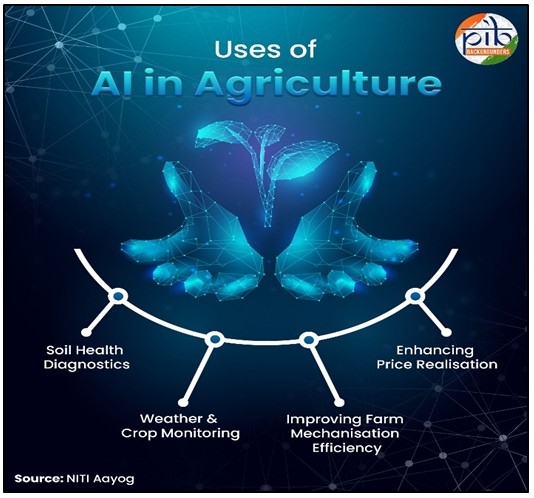
India’s AI-led agricultural transformation reflects a human-centric approach aligned with inclusive development. From soil diagnostics and pest surveillance to crop insurance and digital marketplaces, AI is strengthening resilience, enhancing productivity and reducing risks.
With over 7.63 crore Farmer IDs created, 23.5 crore crop plots surveyed, 93 lakh chatbot queries answered and AI-enabled advisory reaching crores of farmers, India is building a digitally empowered agricultural ecosystem designed to ensure sustainability, food security and improved livelihoods for millions of farming households.