
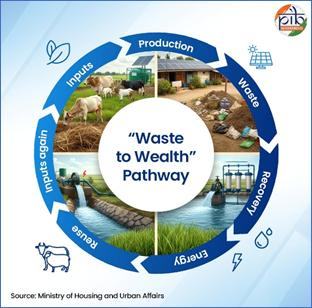
India is accelerating its transition towards a circular economy in agriculture, transforming crop residues, animal waste and food by-products into energy, organic inputs and economic opportunity, while reducing environmental degradation and supporting long-term food security.
With the country generating an estimated 350 million tonnes of agricultural waste annually, including crop residues, husk, straw and food processing by-products, policymakers are positioning waste-to-wealth strategies as both an environmental imperative and an economic opportunity. According to the Ministry of New and Renewable Energy, agricultural residues alone have the potential to generate over 18,000 megawatt of power annually.
Structured Push For Residue Management
Crop residue burning remains a key environmental challenge, particularly during harvest seasons. Under the Crop Residue Management initiative, the government released ₹3,926.16 crore between 2018-19 and 2025-26 to Punjab, Haryana, Uttar Pradesh, NCT of Delhi and ICAR to curb open burning and promote sustainable alternatives.
During this period, more than 42,000 Custom Hiring Centres have been established and over 3.24 lakh crop residue management machines deployed to farmers and centres. These interventions promote in situ management, such as mulching and soil incorporation, as well as ex situ utilisation through composting, bioenergy and fodder applications.
Residue burning not only emits greenhouse gases but also depletes soil nutrients. Redirecting biomass towards productive uses improves soil health, reduces chemical fertiliser dependence and contributes to climate resilience.
GOBARdhan Expands Biogas And Organic Manure Network
The Galvanising Organic Bio-Agro Resources Dhan initiative is central to India’s circular agriculture framework. The scheme integrates cattle dung, crop residues and food waste into compressed biogas and organic manure production.
As of 14 January 2026, 979 biogas plants are operational across 51.4 per cent of India’s districts. The Unified GOBARdhan Portal, launched in 2023, has improved transparency and coordination across ministries. Policy support has included the inclusion of compressed biogas in carbon credit trading, tax relief on CBG blended fuels and simplified norms for organic manure under the Fertiliser Control Order.
ICAR has developed crop specific guidelines for the use of biogas slurry to enhance soil fertility, reinforcing scientific integration within circular practices.
Agriculture Infrastructure Fund Drives Investment
Launched in 2020-21, the Agriculture Infrastructure Fund provides medium and long term credit for post-harvest infrastructure and farm assets. As of 2025, ₹66,310 crore has been sanctioned across 1,13,419 projects, mobilising total investments of ₹1,07,502 crore.
Major projects include 30,202 Custom Hiring Centres, 22,827 processing units, 15,982 warehouses, 3,703 sorting and grading units, 2,454 cold storage projects and approximately 38,251 other post-harvest management assets.
Additionally, 545 organic input production projects have been supported with loan sanctions totalling ₹850 crore, reflecting growing recognition of organic farming as economically viable and environmentally sustainable.
Strengthening Livestock Circularity Through AHIDF
Under the Animal Husbandry Infrastructure Development Fund, launched in 2020 with a ₹15,000 crore corpus, the government is catalysing investment in meat and dairy processing, animal feed manufacturing and waste-to-wealth management.
Three exclusive Multi-State Cooperative Societies have been initiated to supply cattle feed and mineral mixtures, promote organic manure production through cooperative models and ensure scientific management of hides, bones and horns of fallen animals. These measures integrate livestock waste into productive value chains and support natural farming practices.
Water Reuse And Resource Efficiency
The Ministry of Jal Shakti is promoting wastewater treatment and reuse for agriculture, landscaping and horticulture through initiatives including the National Mission for Clean Ganga, PMKSY Watershed Development and Jal Shakti Abhiyan.
Water conservation measures such as rainwater harvesting, watershed development and groundwater recharge improve irrigation sustainability and reduce pressure on natural resources. Complementing these efforts, Jal Jeevan Mission Har Ghar Jal continues to expand rural drinking water access, supplying 55 litres per capita per day through functional household tap connections.
Global Context And SDG Alignment
Globally, food waste reached 1.05 billion tonnes in 2022, with 60 per cent originating from households. Organic waste decomposition in landfills releases methane, intensifying climate change and environmental degradation.
Circular agriculture aligns with Sustainable Development Goal 2, which focuses on ending hunger, improving nutrition and promoting sustainable agriculture. Practices such as composting, biomass recycling and biochar application enhance soil fertility and reduce chemical inputs, contributing to resilient farming systems.
Biochar, produced by heating biomass under low oxygen conditions, and engineered biochar with enhanced properties, are emerging as tools for carbon sequestration, soil improvement and environmental remediation.
Economic Opportunity And Future Outlook
By 2050, India’s circular economy is projected to reach a market value of two trillion dollars and generate 10 million jobs. Circular agriculture, rooted in the six principles of Reduce, Reuse, Recycle, Refurbish, Recover and Repair, seeks to minimise raw material extraction while extending product life cycles and promoting high value resource recovery.
India’s policy architecture, combining infrastructure funding, scientific guidance and institutional coordination, reflects a systemic shift towards resource efficiency. By integrating agricultural residues, livestock waste, wastewater reuse and post-harvest infrastructure into a cohesive framework, the country is converting environmental liabilities into energy, income and soil health gains.
As targeted investments and institutional mechanisms scale up, circular agriculture is emerging as a cornerstone of India’s strategy for climate resilience, rural development and sustainable economic growth.