
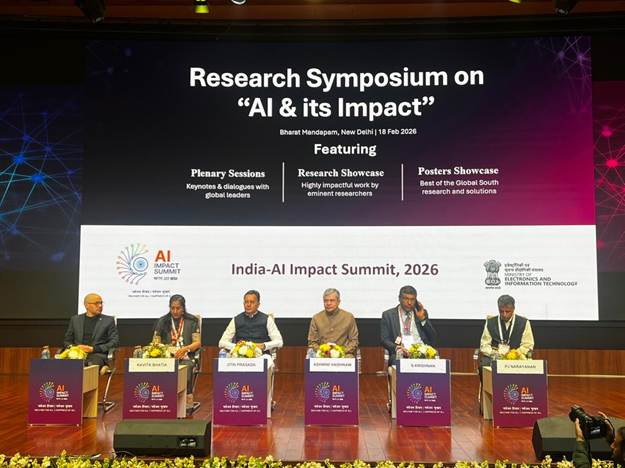
India will champion edge AI solutions that deliver real-world impact at population scale, Ashwini Vaishnaw said while addressing the Research Symposium on AI and Its Impact at the India AI Impact Summit 2026.
Held on the third day of the Summit, the Symposium brought together leading researchers, policymakers, technologists and industry leaders to examine how Artificial Intelligence can drive breakthroughs across science, governance, industry and society, while remaining aligned with safety, inclusivity and public interest.
In his special address, Ashwini Vaishnaw framed India’s AI journey around practical deployment and scalable impact. He said that interactions with thousands of young participants at the AI Expo had reinforced confidence in India’s technological future. He emphasised that India’s focus is on AI at the edge, designed to solve real-world problems, improve enterprise productivity and address large-scale challenges in healthcare, agriculture and climate change. He urged global leaders to provide concrete ideas to ensure AI systems remain safe and beneficial for humanity.
The Symposium was conceived as a bridge between frontier research and applied deployment. Its structure included plenary keynotes, research dialogues on emerging AI challenges, Global South-focused panels and poster presentations by leading international researchers.
Setting the academic context, P J Narayanan, former Director of IIIT Hyderabad, highlighted the rapid rise of AI within global scientific discourse and stressed the importance of engaging diverse perspectives on both opportunity and risk. He described the Symposium as a carefully curated platform intended to spur dialogue on the next frontiers of AI research and its societal implications.
In a keynote address, Demis Hassabis, Co Founder and CEO of Google DeepMind, described the current moment as a threshold in the evolution of artificial intelligence. He said artificial general intelligence is on the horizon and has the potential to transform science, medicine and human health. However, he cautioned that the technology also carries real risks. Hassabis pointed to technical gaps such as continual learning, long-term planning and cross-task consistency, emphasising that while progress has been rapid since the founding of DeepMind in 2010, true AGI remains a work in progress. He called for international dialogue and cooperation to ensure that benefits are widely shared and risks responsibly managed.
Wendy Hall, Professor of Computer Science at the University of Southampton, addressed the future of AI through the lens of governance, inclusion and workforce transformation. Speaking in the context of the Global South, she called for AI systems built for humanity, grounded in safety frameworks, equitable access and sovereign capability. She stressed that national AI strategies must reflect linguistic diversity, local data ecosystems and domestic priorities. Hall urged governments, researchers and young innovators to develop AI models that are locally grounded, globally connected and inclusive by design.
Yoshua Bengio, Professor of Computer Science at Université de Montréal, focused on emerging risks linked to increasingly capable and agentic AI systems. He warned that advances in AI capabilities are outpacing existing evaluation and safeguard mechanisms. Highlighting concerns such as misalignment, deceptive behaviour, bias, jailbreaks, cyber misuse and self-preserving tendencies, Bengio argued that many alignment challenges arise as unintended side effects of current training approaches. He called for a fundamental shift in AI design, advocating models grounded in scientific reasoning rather than purely goal-driven, human-imitative systems.
Yann LeCun, Executive Chairman of AMI Labs and Professor of Computer Science at New York University, challenged prevailing narratives around artificial general intelligence. He argued that current AI systems, including large language models, remain far from human-level intelligence. While acknowledging their strong performance in language and narrow domains, he cited key limitations, including lack of physical world understanding, absence of persistent memory, weak long-term planning and insufficiently robust safety controls. LeCun proposed developing world models, predictive systems capable of simulating how environments evolve in response to actions, enabling AI to anticipate consequences, plan effectively and operate within defined safety guardrails.
Throughout the Symposium, speakers underscored the need for AI systems that are powerful yet trustworthy, innovative yet accountable. Discussions covered alignment, governance, next-generation architectures and the role of international cooperation in shaping global AI norms.
As the Research Symposium concluded, participants reaffirmed a shared commitment to building AI systems that are scientifically robust, socially responsible and aligned with human values. The deliberations reinforced India’s positioning as a nation focused not only on advancing AI capability, but also on ensuring that innovation translates into safe, inclusive and transformative impact.