
India’s demographic strength has emerged as a central pillar of its artificial intelligence transformation, with the India AI Impact Summit 2026 placing youth-led innovation and large-scale skilling at the forefront of national strategy. As the Summit commenced on February 16, 2026, it underscored a decisive shift from viewing AI as a distant frontier technology to positioning it as an immediate engine of employment, productivity, and inclusive economic growth.
With over 65 percent of its population under the age of 35, India possesses one of the largest youth cohorts globally. This demographic dividend is now being systematically aligned with digital public infrastructure, AI skilling ecosystems, and research-driven innovation frameworks. Policymakers, industry leaders, startup founders, educators, and students converging at the Summit collectively emphasised that India’s AI trajectory will be defined not only by technological capability but by the scale, inclusivity, and readiness of its young workforce.
A Structural Shift in Employment Demand
AI is increasingly reshaping India’s labour market, with clear signals emerging from hiring data and enterprise adoption trends. Between January 2023 and March 2025, AI-related job postings in South Asia rose from 2.9 percent to 6.5 percent of all vacancies. Demand for AI skills grew 75 percent faster than non-AI roles, indicating a structural shift rather than a cyclical hiring pattern. This transformation spans sectors including healthcare, manufacturing, fintech, logistics, creative industries, education technology, and climate solutions.
At the Summit, stakeholders highlighted that AI is generating new occupational categories such as prompt engineering, AI ethics auditing, model governance specialists, data annotation experts, robotics integration engineers, and AI product managers. Traditional roles are simultaneously evolving to incorporate AI-assisted workflows, making digital fluency and data literacy foundational skills across industries.
Policy Support Reinforcing Youth Employability
The Union Budget 2026–27 has reinforced AI skilling as a national priority. Particular emphasis has been placed on the Orange Economy, which intersects with AI-driven domains such as Animation, Visual Effects, Gaming, Comics, immersive media, and digital content creation. Support extended to the Indian Institute of Creative Technologies in Mumbai includes the establishment of AI-aligned Content Creator Labs in 15,000 schools and 500 colleges. This initiative is projected to generate approximately 20 lakh jobs by 2030, expanding pathways for youth to transition into AI-centric creative and technical careers.
The Budget also proposed an Education to Employment and Enterprise Standing Committee to systematically assess how AI and emerging technologies are reshaping job markets and skill requirements. The objective is to bridge education curricula with evolving industry needs, ensuring that India’s youth remain aligned with high-growth sectors.
Democratising Access to AI Infrastructure
Access to high-performance computing and datasets has historically been concentrated within metropolitan research hubs and large enterprises. Under the IndiaAI Mission, over ₹10,300 crore has been allocated to expand national AI capabilities and scale compute infrastructure. The current base of 38,000 GPUs is being augmented by an additional 20,000 high-end GPUs, bringing total planned capacity to over 58,000 GPUs.
Subsidised compute access at ₹65 per hour significantly lowers entry barriers for startups, public institutions, and young innovators. By decentralising infrastructure, the government aims to ensure that AI opportunity extends beyond metropolitan centres into Tier-2 and Tier-3 cities. This inclusive approach is reinforced by the establishment of 27 Data and AI Labs through NIELIT and approvals for 174 additional labs in Industrial Training Institutes and polytechnics across 27 States and Union Territories.
Building a Multi Tier AI Talent Pipeline
India’s AI talent development architecture spans foundational literacy to advanced research.
At the school level, the National Education Policy 2020 integrates digital literacy, computational thinking, and AI awareness into curricula. The Artificial Intelligence and Computational Thinking initiative introduces AI concepts from Grade 3 onwards, gradually progressing toward real-world problem-solving and “AI for Public Good.”
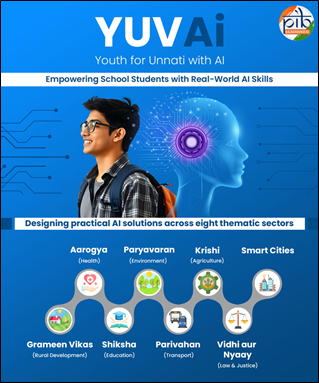
The YUVAi programme, implemented by MeitY with the National e-Governance Division, empowers students from Classes 8 to 12 to design AI solutions across eight thematic sectors. Complementing this, YUVA AI for All provides a free national AI literacy course in eleven Indian languages through platforms such as DIKSHA, iGOT Karmayogi, and FutureSkills Prime, targeting one crore citizens.
In vocational and professional domains, the Skill India Mission integrates AI modules through the SOAR initiative, enrolling 1.34 lakh students and teachers by December 2025 in collaboration with Microsoft, HCL Technologies, and NASSCOM. The FutureSkills Prime platform has registered over 25.3 lakh learners and offers more than 3,000 courses aligned with National Occupational Standards and the National Skills Qualification Framework. The Skill India Digital Hub consolidates AI and machine learning courses across proficiency levels, supporting lifelong learning and career transitions.
At the advanced research tier, IndiaAI FutureSkills supports 500 PhD scholars, 5,000 postgraduates, and 8,000 undergraduates through fellowships and specialised training. By December 2025, over 200 fellowships had already been awarded across 73 institutions, reinforcing India’s ambition to anchor frontier AI research domestically.
Youth Leadership at the AI Impact Summit
The India AI Impact Summit 2026 showcased youth engagement across multiple platforms.
The YUVAi Global Youth Challenge attracted over 2,500 applications from 38 countries. Seventy shortlisted teams presented AI solutions addressing healthcare access, agriculture productivity, climate resilience, digital trust, accessibility, and smart mobility. Winners received financial awards alongside structured mentorship and incubation support.
The AI by HER Global Impact Challenge highlighted women-led AI innovation through startup showcases and rapid pitches. A dedicated capacity-building programme for 150 women-led AI startups was announced, reinforcing gender inclusion within the AI ecosystem.
The session titled From Algorithms to Outcomes emphasised translating compute capacity and research into deployable public sector solutions. More than 600 startups and companies demonstrated AI applications across sectors, exposing young innovators to scalable use cases.
The launch of the AI Impact Startup Book compiled over 100 AI solutions developed across India, creating a structured pathway for ministries and states to adopt validated innovations at population scale.
Global Indicators Strengthening India Position
India’s AI leadership is reflected in global benchmarks. According to the Stanford Global AI Index Report 2025, India’s relative penetration of AI skills is 2.5 times higher than the global average across comparable occupations. The NASSCOM AI Adoption Index indicates that 87 percent of Indian enterprises are actively using AI solutions, sustaining demand for AI-ready talent.
More than 50 percent of startups are now emerging from beyond metropolitan cities, reinforcing the decentralisation of innovation. During the Summit, India set a Guinness World Record with over 2.5 lakh AI Responsibility Pledges within 24 hours, mobilising youth and citizens to commit to ethical and accountable AI use under the IndiaAI Mission in collaboration with Intel India.
Shaping a Responsible and Inclusive AI Future
The Summit consistently reinforced that AI’s long-term success depends on ethical governance, transparency, explainability, and equitable access. Youth were positioned not merely as beneficiaries of AI adoption but as architects of responsible innovation. Sessions examining labour market resilience and differentiated impacts across sectors highlighted the need for adaptive policy frameworks to manage transition risks.
Conclusion
India’s youth dividend is being strategically converted into an AI dividend. Through integrated policy design, infrastructure expansion, inclusive skilling frameworks, and global engagement, the country is building a future-ready talent ecosystem anchored in demographic strength. The India AI Impact Summit 2026 demonstrated that youth leadership, gender inclusion, decentralised infrastructure, and industry alignment are converging to define India’s next phase of AI-driven growth. As the nation advances toward the vision of Viksit Bharat 2047, empowering young Indians with AI capability will remain central to economic resilience, productivity gains, and global technological leadership.