
As India continues to expand its highway network at an unprecedented pace, the Ministry of Road Transport and Highways has initiated a technology driven shift from mere construction scale to measurable quality assurance. In a decisive move to strengthen transparency, durability and safety standards, the Ministry has launched a pilot project deploying Mobile Quality Control Vans across select National Highway projects.
The pilot has been implemented in Rajasthan, Gujarat, Karnataka and Odisha. The objective is clear: enable rapid, on site diagnosis of construction quality and ensure that National Highways are built on evidence based standards rather than post construction rectifications.
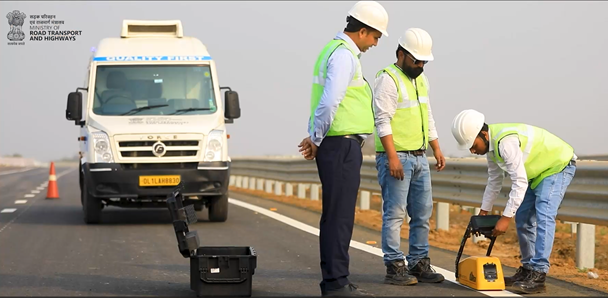
Each Mobile Quality Control Van functions as a fully equipped mobile laboratory. The vans are fitted with advanced non destructive testing instruments, enabling real time evaluation of materials and workmanship without disrupting ongoing construction activities.
The equipment suite includes ultrasonic pulse velocity meters, rebound hammers, asphalt density gauges, light weight deflectometers and reflectometers. These instruments collectively allow engineers to verify structural integrity, compaction levels, material strength and road safety parameters at the construction site itself.
Rebound hammers are used to assess the surface hardness and estimate the compressive strength of hardened concrete structures. Ultrasonic pulse velocity meters transmit sound waves through concrete to detect internal cracks, voids or inconsistencies that are not visible externally. Asphalt density gauges allow fast, portable, non nuclear testing to ensure correct asphalt compaction, which is critical for pavement longevity. Light weight deflectometers assess the density and load bearing capacity of compacted soil and granular sub base layers, ensuring a stable foundation for long lasting highways. Reflectometers evaluate the visibility and reflectivity of road markings and signage, ensuring that safety indicators remain clearly readable for motorists during day and night conditions.
By integrating these technologies, the Ministry is converting quality control from a reactive inspection mechanism into a proactive and data driven monitoring system. The approach allows early detection of deficiencies, reduces lifecycle maintenance costs and enhances structural reliability.
Test results generated by the Mobile Quality Control Vans are shared with field offices of the Ministry. In cases where deficiencies are identified, corrective action is initiated immediately at the project level. This closed loop monitoring mechanism strengthens accountability among contractors and implementing agencies.
As part of the next phase of the initiative, the Ministry is developing a National Highway Quality Monitoring Portal. The portal will host test reports generated by the vans and provide real time GPS tracking of their movement. This will enable centralised oversight, transparent monitoring and digital documentation of quality checks across the highway network.
The programme is set to expand significantly. The next phase of deployment will cover 11 additional states including Uttar Pradesh, Maharashtra, Bihar, Jharkhand, Andhra Pradesh, Telangana, Tamil Nadu, Madhya Pradesh, Chhattisgarh, Assam and Meghalaya. Tenders for the expanded phase have already been invited, and commissioning is expected by June 2026.
The introduction of Mobile Quality Control Vans represents a structural shift in highway governance. By embedding scientific diagnostics into the construction process, the Ministry of Road Transport and Highways is reinforcing a core principle that infrastructure must be built not only quickly but also with measurable integrity, durability and public accountability.