
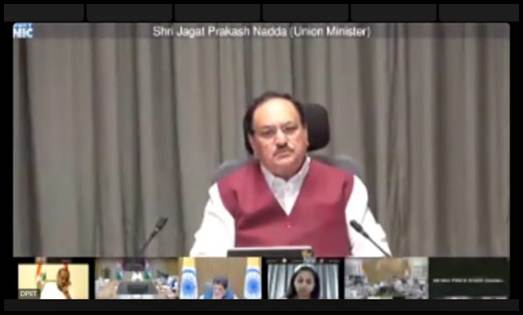
A budgetary provision of 13000 crore rupees for the BioPharma SHAKTI initiative and the establishment of three dedicated chemical parks marks a strategic investment in India’s future growth in the pharmaceutical and chemical sectors, Chemicals and Fertilisers Minister J P Nadda said on 3 March 2026 while addressing a post Budget webinar on sustaining and strengthening economic growth.
Speaking at the national consultation, J P Nadda emphasised that the government’s financial commitment is aimed at strengthening India’s position in emerging segments such as biologics, biosimilars and advanced chemical manufacturing while building resilient industrial infrastructure. The minister said India’s chemical sector currently contributes output worth about 19.4 lakh crore rupees but accounts for only about three percent of the global market, highlighting the need for targeted policy support and infrastructure development to enhance competitiveness.
The minister noted that India had earned global recognition as the pharmacy of the world through the production of affordable generic medicines. However, the global pharmaceutical landscape is rapidly shifting towards biologics. By 2035, nearly forty percent of medicines worldwide are expected to be biologics, creating new opportunities for countries with strong biotechnology and pharmaceutical capabilities. He pointed out that patents worth approximately 300 billion dollars are expected to expire by 2030, opening the door for new biosimilar production.
To capitalise on this opportunity, the government has launched the BioPharma SHAKTI initiative under the broader BioPharma Mission, allocating 10000 crore rupees over the next five years to strengthen research, development and manufacturing in advanced biologics. According to the minister, even a one percent share in the global biosimilars market could generate an annual economic opportunity of around two lakh crore rupees for India.
J P Nadda also stressed the importance of strengthening national institutions involved in pharmaceutical research and education. Institutions such as the National Institute of Pharmaceutical Education and Research will be integrated more closely with national talent and skill development initiatives to support innovation in biotechnology and drug development. Plans are also underway to establish one thousand clinical trial sites across the country, significantly expanding India’s research capacity and facilitating faster drug development and testing.
The minister underlined the need to strengthen regulatory frameworks to support innovation and faster approvals. The Central Drugs Standard Control Organization will be further strengthened to facilitate efficient regulatory approvals for biosimilars and fermentation based drug manufacturing, ensuring that India remains globally competitive in advanced pharmaceutical production.
In addition to the pharmaceutical push, the government has allocated 3300 crore rupees to establish three dedicated world class chemical parks across the country. These parks will provide plug and play infrastructure, integrated logistics networks, advanced effluent treatment systems and built in safety mechanisms to support large scale chemical manufacturing.
According to J P Nadda, the new chemical parks are expected to reduce production costs by twenty to forty percent through industrial symbiosis, where industries share infrastructure, resources and utilities. The parks are also designed to promote a circular economy approach by encouraging efficient resource utilisation, recycling and waste management across industrial units.
The minister outlined an ambitious long term vision for India’s chemical industry, targeting an increase in the country’s global share from the current three percent to five to six percent by 2030. The sector is expected to grow significantly and achieve a turnover of one trillion dollars by 2040 if infrastructure gaps are addressed and policy support continues.
Highlighting the broader policy framework, J P Nadda said that Free Trade Agreements are opening new avenues for Indian industries to expand globally and strengthen export competitiveness. He noted that deeper integration with global supply chains will be essential for achieving the vision of Viksit Bharat.
The minister also emphasised the importance of a coordinated approach among government institutions, industry and financial stakeholders. He described the post Budget webinar as an example of the whole of government approach, bringing together policymakers, industry leaders, financial institutions and domain experts to discuss effective implementation of Budget 2026 27 announcements.
The consultation was the second session in a series of post Budget webinars aimed at accelerating India’s growth trajectory through collaborative policy implementation. Participants deliberated on strategies to strengthen industrial infrastructure, promote technological innovation and ensure that budgetary announcements translate into measurable economic outcomes.
The government expects that the BioPharma SHAKTI mission and the development of dedicated chemical parks will create new opportunities for research, manufacturing and exports, while positioning India as a major global hub for biotechnology, pharmaceuticals and chemical production in the coming decades.