

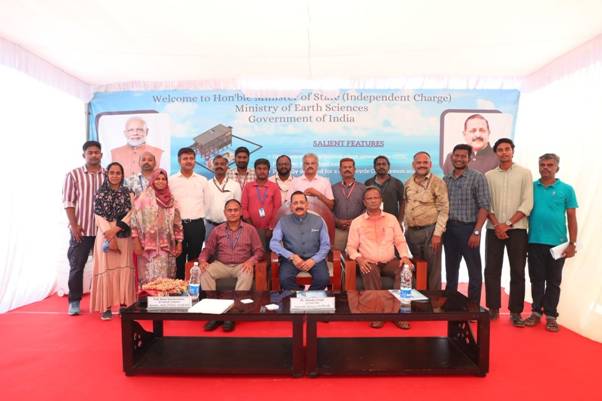
Progress of major ocean based desalination and renewable energy projects in Lakshadweep was reviewed on 7 March 2026 during a high level meeting with scientists and officials of the National Institute of Ocean Technology. The review focused on strengthening drinking water security in the island territory and advancing indigenous ocean technology solutions for sustainable development.
Jitendra Singh held detailed discussions with scientists and technical experts in Kavaratti to assess the operational performance of the Low Temperature Thermal Desalination plants functioning across the islands and to evaluate the progress of the upcoming Ocean Thermal Energy Conversion powered desalination facility being developed in the region.
Officials informed the Minister that Low Temperature Thermal Desalination plants established by the Ministry of Earth Sciences through the National Institute of Ocean Technology are currently operational on eight islands in Lakshadweep. These facilities provide a reliable source of potable water in an island region that has historically faced water scarcity due to limited freshwater resources, saline groundwater and dependence on seasonal rainfall.
The desalination technology works by converting seawater into drinking water through the natural temperature difference between warm surface seawater and cold deep sea water drawn from depths of approximately 350 to 400 metres. This temperature gradient allows seawater to evaporate and condense in a controlled system to produce potable water without relying heavily on conventional energy sources.
During the review, Jitendra Singh examined the operational performance and maintenance practices of the existing desalination plants. Officials explained that trained local manpower working with the Union Territory administration is supporting the operation and upkeep of these facilities. The desalination plants have significantly improved the availability of safe drinking water for residents and have reduced reliance on rainwater harvesting systems that were previously the primary source of freshwater.
The Minister also reviewed progress on the country’s first Ocean Thermal Energy Conversion powered desalination plant being constructed at Kavaratti. The facility is designed to generate electricity and produce drinking water simultaneously by utilising the temperature difference between warm surface water and cold deep ocean water.
Scientists informed the Minister that civil construction for the plant is nearing completion and major process equipment has already been fabricated. Installation of equipment is progressing in phases as part of the overall project schedule.
A key component of the Ocean Thermal Energy Conversion system is a deep sea pipeline that will transport cold seawater from depths exceeding 1,000 metres. Officials explained that a high density polyethylene pipeline measuring nearly 3.8 kilometres in length is being deployed for this purpose.
The review meeting examined the progress of this pipeline installation. Scientists reported that welding of the pipeline sections is currently underway on the southern side of the Kavaratti lagoon and approximately 250 metres of the pipeline has already been assembled. Once completed, the pipeline will enable the transport of cold deep sea water to the onshore facility, supporting both desalination and power generation processes.
According to officials, the Ocean Thermal Energy Conversion plant will have a desalination capacity of approximately 100 cubic metres of potable water per day after commissioning. The facility is designed to operate independently of diesel powered electricity systems that currently supply much of the island’s infrastructure.
By utilising ocean thermal energy, the project aims to reduce dependence on imported fossil fuels and support sustainable energy and water supply solutions for the island population. The initiative is expected to strengthen long term water security while promoting clean energy technologies suitable for tropical island environments.
During the meeting, Jitendra Singh emphasised the importance of developing indigenous ocean technologies to address the unique challenges faced by island territories and coastal regions. He also interacted with scientists and engineers working on the project and reviewed timelines for the remaining phases of construction and commissioning.
Officials of the Ministry of Earth Sciences said the combined progress of Low Temperature Thermal Desalination facilities and the upcoming Ocean Thermal Energy Conversion project represents a major step toward integrating ocean science with sustainable development objectives in India’s island territories.
Once the Ocean Thermal Energy Conversion facility becomes operational, the technology is expected to demonstrate the potential of ocean based renewable energy systems to provide clean power and drinking water in remote coastal regions.