
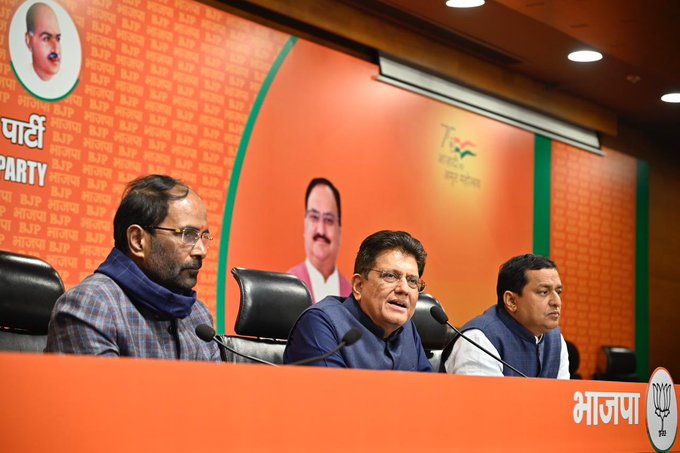
Design will play a decisive role in shaping India’s economic and technological future during what the government describes as the country’s crucial decade of development, Union Minister of Commerce and Industry Piyush Goyal said while addressing the Post Budget Webinar 2026 on the New National Institute of Design.
Piyush Goyal emphasised that design must be treated not merely as a cosmetic enhancement but as a strategic national capability that connects technology with people and transforms ideas into meaningful systems, products and experiences. He said India’s growth trajectory in the coming years will increasingly depend on how effectively design thinking is integrated into industry, governance, technology and social innovation.
Highlighting the country’s demographic advantage, the Minister noted that India’s average age is around 28 and a half years, while nearly 2.3 million STEM graduates enter the workforce every year. These factors, he said, provide a powerful foundation for innovation and technological advancement that can drive economic growth across the country and expand India’s global engagement.
Piyush Goyal said that India’s cultural diversity represents one of the country’s greatest design strengths. Across the country, culture, languages, textiles, crafts and food traditions change every few kilometres. Integrating this diversity with contemporary design practices, he said, can enable India to create products and experiences that are unique in global markets and difficult to replicate.
Referring to the evolution of the National Institute of Design, he said that over the past decade the institution has grown from a single premier institute into a national network recognised as an Institution of National Importance. The institute, he added, has expanded its focus beyond aesthetic design and is increasingly contributing to solutions for technical and social challenges.
The Minister highlighted that the Union Budget has announced the establishment of a new National Institute of Design in the eastern region of India. While the design industry in the country is expanding rapidly, he said, there remains a shortage of trained designers capable of meeting the needs of India’s growing economy and contributing to global design discourse. The new institute aims to bridge this gap and expand access to world class design education.
Piyush Goyal noted that eastern India possesses a rich heritage of crafts, textiles, culture and industry. However, the absence of a strong design ecosystem in the past limited the region’s ability to realise its full economic and creative potential. The new institute is expected to connect traditional craft clusters, MSMEs and emerging industries with modern design education and innovation systems. It will also help artisans move up the value chain while enabling MSMEs to diversify their products and improve global competitiveness.
The Minister emphasised that design education in India must place civilisational knowledge and cultural heritage at its core rather than treating them as optional elements. He said design will play a central role in strengthening the vision of Atmanirbhar Bharat and building a strong Brand India recognised worldwide for quality, innovation and technological advancement.
Referring to global technological shifts driven by artificial intelligence, immersive media and robotics, Piyush Goyal said technology without thoughtful design can increase inequality and reduce accessibility. He stressed the need to prepare society to adopt new technologies responsibly so that innovation benefits all citizens while creating opportunities for the country’s youth.
Addressing students and young designers, the Minister said they are not merely preparing for professional careers but contributing directly to the process of nation building. He said the design choices made in products, services and digital interfaces will influence how citizens experience India’s institutions, services and technologies.
During the webinar, Piyush Goyal outlined a five point roadmap to strengthen the role of design in India’s development journey.
First, he proposed positioning National Institutes of Design as knowledge hubs that promote design innovation and awareness across different regions of the country.
Second, he emphasised deeper collaboration between industry, particularly MSMEs, and academic institutions. He suggested establishing design clinics and developing live cluster projects so that artisans, handicraft workers, handloom weavers and local industries can directly engage with design innovation.
Third, he recommended establishing service and Brand India design laboratories aimed at improving citizen experience in sectors such as governance, tourism and healthcare.
Fourth, he proposed the creation of joint artificial intelligence and frontier technology design laboratories in collaboration with technical institutes to strengthen links between industry and students.
Fifth, he said the new National Institute of Design in eastern India should be developed as a model campus that promotes public private partnerships and supports not for profit organisations working with artisans and traditional craft sectors.
Piyush Goyal expressed confidence that the discussions during the Post Budget Webinar would help create a clear roadmap for positioning design as a central pillar in India’s journey towards becoming a developed nation by 2047. He said the new National Institute of Design should emerge as a global symbol of innovation rooted in India’s traditions and cultural strengths.