
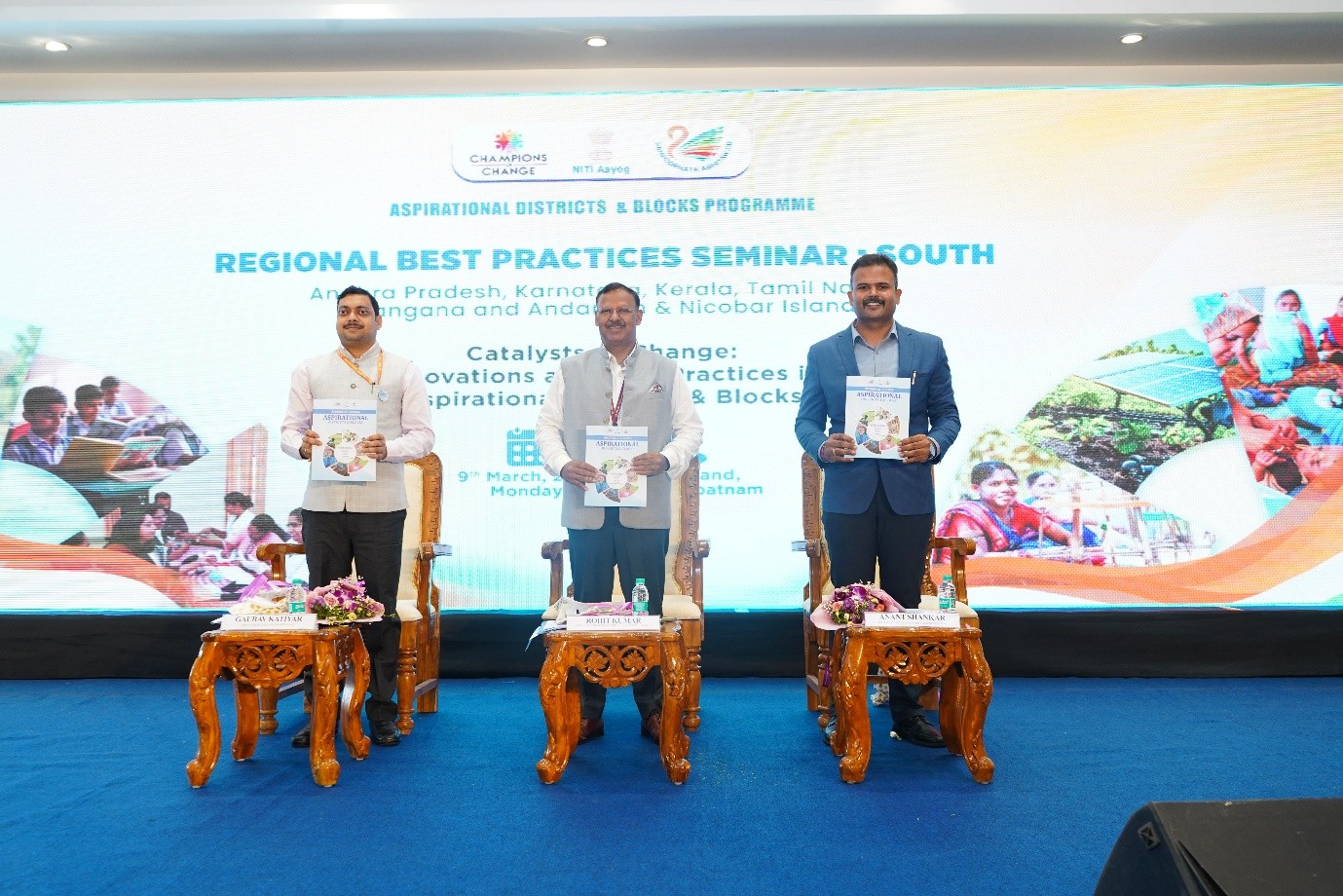
NITI Aayog convened the Regional Best Practices Seminar South under the Aspirational Districts Programme and Aspirational Blocks Programme at Visakhapatnam on Monday, bringing together senior officials from the Central Government, state governments and district administrations across southern India to discuss replicable governance models and development innovations.
The seminar served as a platform for sharing district led initiatives that have contributed to improved development outcomes in Aspirational Districts and Aspirational Blocks. Officials from Andhra Pradesh, Telangana, Tamil Nadu, Karnataka, Kerala and the Andaman and Nicobar Islands participated in the discussions along with representatives from the central government.
In his keynote address, Rohit Kumar, Additional Secretary and Mission Director for the Aspirational Districts Programme and Aspirational Blocks Programme at NITI Aayog, highlighted the progress achieved under the programmes and praised the efforts of district and block level officials who are implementing development initiatives on the ground.
Rohit Kumar emphasised that the success of the Aspirational Districts and Blocks Programme depends on community participation, administrative convergence and continuous innovation at the district level. He said that several development indicators in participating districts are approaching saturation levels and commended the strong performance of southern states in improving outcomes across key sectors.
The seminar brought together senior officials including Anant Shankar, Joint Secretary in the Planning Department of the Government of Andhra Pradesh, along with district collectors and administrative officers from multiple southern states.
The programme included three thematic technical sessions that focused on sharing innovative district led interventions in the areas of education, health, nutrition, social development and skill development.
Technical Session One focused on education and skill development and featured presentations on innovative initiatives implemented by districts to improve learning outcomes and promote entrepreneurship among youth. Alluri Sitarama Raju district presented the NIRMAN initiative, which aims to strengthen foundational learning outcomes among students. The programme focuses on improving core academic skills and building strong educational foundations in early schooling.
NTR district showcased its Rural Incubation Centre model, an initiative designed to encourage innovation and entrepreneurship among rural youth. The model provides support systems, mentorship and opportunities for young individuals in rural areas to develop innovative ideas and build sustainable enterprises.
Technical Sessions Two and Three focused on health, nutrition and skill development initiatives. Bidar district presented the Anaemia Mukt initiative, which is designed to address anaemia among women and children through targeted interventions aimed at improving nutrition, awareness and healthcare access.
Nirmal district presented the Amma Rakshitha programme, which focuses on improving maternal health outcomes by strengthening healthcare services and ensuring better monitoring and support for pregnant women and mothers.
The District Collector of Kurnool district also shared innovative district level initiatives aimed at strengthening skill development among young people. These initiatives highlight the role of district administrations in designing locally relevant programmes that improve employment opportunities and skill capabilities.
Participants at the seminar emphasised the importance of peer learning among districts, allowing successful development models to be shared and replicated in other regions facing similar challenges. Officials also discussed the need to systematically document district level innovations and scale them up through coordinated implementation.
During the event, a Best Practices Compendium was unveiled, documenting impactful initiatives implemented across Aspirational Districts in southern states. The compendium is intended to serve as a repository of replicable models that can guide districts and blocks in strengthening service delivery and improving development outcomes.
The Aspirational Districts Programme and Aspirational Blocks Programme aim to accelerate development in relatively underdeveloped regions by focusing on key indicators related to health, nutrition, education, agriculture, infrastructure and financial inclusion.
Officials noted that the exchange of best practices and district level innovations can play a crucial role in improving governance outcomes and ensuring that development initiatives reach communities effectively.