

NITI Aayog released the second annual edition of the Fiscal Health Index 2026 while also hosting a visiting German delegation to showcase India’s flagship development initiatives aimed at strengthening governance and improving service delivery at the district and block levels.
The announcements were made during two separate engagements at NITI Aayog headquarters in New Delhi involving senior officials and international representatives.
Fiscal Health Index 2026 Released
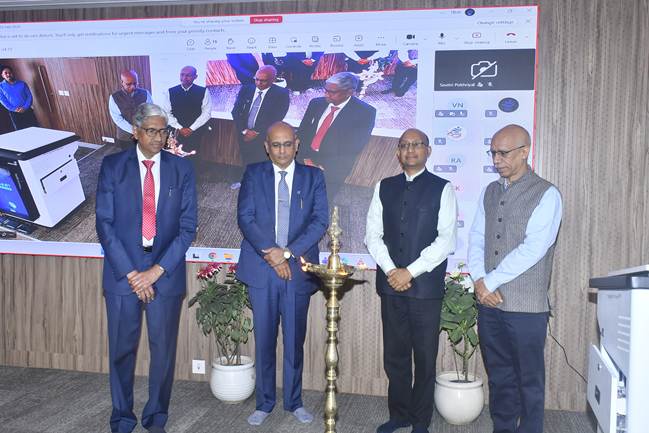
Vice Chairman NITI Aayog Suman Bery and Chief Executive Officer NITI Aayog Nidhi Chhibber released the Fiscal Health Index 2026 in New Delhi in the presence of senior officials.
The Fiscal Health Index provides a comprehensive and comparable assessment of the fiscal performance of Indian states. It has been designed as a data driven framework to evaluate fiscal soundness, guide fiscal reforms and promote evidence based policymaking across states.
The report comes at a time when global public finances are facing increasing pressure, making the sustainability of sub national government finances an important policy concern. The Index aims to strengthen fiscal governance by providing a transparent mechanism for benchmarking fiscal performance across states.
Expanding Scope Of The Index
The second edition of the Fiscal Health Index expands the coverage of the framework. While the first edition evaluated the fiscal performance of 18 major states, the latest edition includes the 10 North Eastern and Himalayan states.
To account for structural differences in fiscal capacity and development patterns, the North Eastern and Himalayan states have been assessed and ranked separately from the major states.
The expanded scope makes the Index more inclusive and reflective of the diverse fiscal landscape across different regions of the country.
Importance Of State Finances
State governments play a central role in India’s fiscal system. States currently account for nearly one third of the country’s general government debt.
Given the significant role of state governments in delivering public services and implementing development programmes, maintaining fiscal discipline and sound financial management at the state level is essential for overall macroeconomic stability.
The Fiscal Health Index seeks to support this objective by enabling systematic benchmarking of fiscal indicators across states and identifying areas requiring policy attention.
Key Findings Of The Report
The report indicates that fiscal performance varies significantly across states.
Among the 18 major states, most recorded moderated Fiscal Health Index scores in the financial year 2023 24 compared with the previous year. The North Eastern and Himalayan states also showed considerable variation in fiscal outcomes.
The report identifies several policy priorities to strengthen fiscal resilience across states.
These include improving revenue mobilisation and enhancing the capacity of states to generate their own tax revenues. The report also recommends rationalising committed expenditures to restore fiscal flexibility and improve the composition and quality of capital expenditure.
Other recommendations include adopting medium term fiscal planning frameworks to better manage deficits and public debt levels.
The report also emphasises strengthening public financial management systems, improving transparency through verified fiscal data and closely monitoring off budget borrowings.
Strengthening Fiscal Governance
Vice Chairman NITI Aayog Suman Bery said that strengthening fiscal governance at the state level will be essential for maintaining macroeconomic stability and sustaining India’s economic growth trajectory.
Suman Bery noted that benchmarking tools such as the Fiscal Health Index enable states to identify structural fiscal challenges and adopt targeted reforms.
Chief Executive Officer NITI Aayog Nidhi Chhibber said the Index represents a comprehensive and analytically robust framework for evaluating state finances.
Nidhi Chhibber added that improving fiscal resilience across states will be critical for sustaining long term development, reducing regional disparities and supporting India’s development goals.
Officials said the Fiscal Health Index 2026 is intended to serve as an important reference for policymakers, researchers and stakeholders by providing a transparent and data driven assessment of fiscal conditions across states.
German Delegation Visits NITI Aayog
Separately, NITI Aayog hosted a delegation from Global Bridges Germany that visited the institution to study India’s flagship governance initiatives including the Aspirational District Programme and the Aspirational Blocks Programme.
The interaction was chaired by Rohit Kumar, Additional Secretary and Mission Director for the Aspirational District Programme and Aspirational Blocks Programme at NITI Aayog.
Rohit Kumar provided an overview of the design, implementation framework and impact of the two programmes which aim to accelerate development outcomes and improve service delivery in districts and blocks across the country.
Framework Of Development Programmes
Rohit Kumar explained that the Aspirational District Programme and Aspirational Blocks Programme are built on the principles of convergence collaboration and competition referred to as the 3C framework.
The initiatives also emphasise the 3F framework which includes funds functions and functionaries, enabling coordinated action between central ministries, state governments and district and block administrations.
The programmes focus on improving key development indicators in sectors such as health, education, agriculture, financial inclusion and basic infrastructure through targeted interventions and continuous monitoring.
Data Driven Monitoring And Governance
Rohit Kumar highlighted that the programmes rely on data driven monitoring systems including real time dashboards and regular field level engagement.
These tools help track progress, identify development gaps and support evidence based decision making at district and block levels.
The German delegation, led by Stefan Traeger, appreciated the progress achieved under the Aspirational District Programme and Aspirational Blocks Programme and acknowledged the strong monitoring framework and governance model used in the initiatives.
Visit To Viksit Bharat Strategy Room
During the visit, the delegation also toured the Viksit Bharat Strategy Room at NITI Aayog.
Officials demonstrated how advanced data analytics and visualisation tools are used to generate insights, identify development gaps and support evidence based policymaking for the central government, state governments and district administrations.
The interaction highlighted India’s growing use of digital governance tools and data analytics in public policy planning and development monitoring.