

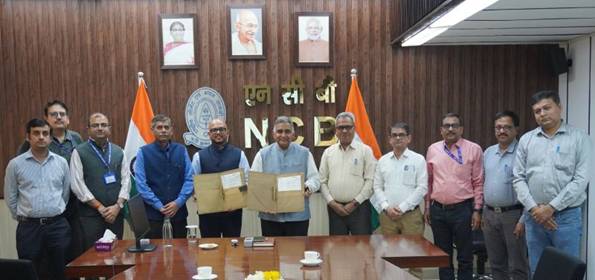
The National Council for Cement and Building Materials has entered into a collaboration with TraceXero Technologies Private Limited to advance the development of carbon capture technologies aimed at reducing emissions from the cement sector, one of the most carbon-intensive industries globally.
The collaboration focuses on supporting the development, technical validation and potential commercialisation of advanced Carbon Capture and Utilisation technologies for the cement and construction materials sector. The partnership brings together the research capabilities of the National Council for Cement and Building Materials with the innovation-driven approach of TraceXero Technologies, an Indian technology start-up working in the field of industrial decarbonisation.
The National Council for Cement and Building Materials is an apex research and development organisation functioning under the Department for Promotion of Industry and Internal Trade, Ministry of Commerce and Industry. Through its research laboratories, pilot facilities and industrial service capabilities, the organisation provides scientific, technical and technological support to the cement and construction materials industry in India.
The agreement was signed on 10 March 2026 at the National Council for Cement and Building Materials campus in Ballabgarh. The collaboration agreement was signed by S. K. Chaturvedi, Joint Director and Secretary of the National Council for Cement and Building Materials, and Reetam Chaudhury, Co founder of TraceXero Technologies Private Limited. The signing ceremony took place in the presence of L. P. Singh, Director General of the National Council for Cement and Building Materials, along with Heads of Centres and Service Groups of the organisation.
Addressing Emissions In A Hard To Abate Sector
The cement industry is a critical pillar of infrastructure development and economic growth. However, it is also one of the largest industrial sources of carbon dioxide emissions globally. The sector is responsible for approximately seven percent of total global carbon dioxide emissions.
Unlike several other industries where emissions arise primarily from energy consumption, the cement industry generates substantial emissions directly from the chemical processes involved in cement production. These process-related emissions make the sector particularly difficult to decarbonise, often categorised as a hard to abate sector.
In this context, Carbon Capture and Utilisation technologies are increasingly recognised as a key pathway for achieving Net Zero targets within the cement industry. By capturing carbon dioxide emissions at the source and converting them into useful materials or products, these technologies can significantly reduce the environmental footprint of industrial operations.
Innovative Carbon Capture Solution
TraceXero Technologies has been developing an innovative carbon capture technology based on a proprietary solvent process. The technology captures carbon dioxide emissions from industrial sources and converts the captured carbon dioxide into graphitic carbon.
The captured carbon can subsequently be processed into graphene, a high value advanced material widely used in electronics, energy storage, composites and other high technology applications.
This approach transforms carbon dioxide emissions from a waste stream into a valuable resource, potentially creating new economic opportunities while reducing industrial emissions.
By integrating carbon capture with value creation, the technology has the potential to contribute to both environmental sustainability and industrial competitiveness.
Research And Technical Support From NCB
Through the collaboration, the National Council for Cement and Building Materials will provide technical support, research expertise and validation infrastructure for the development of the carbon capture technology.
The organisation’s laboratories and pilot facilities will play an important role in testing, validating and refining the technology to ensure that it can be effectively deployed in the cement and construction materials sector.
The National Council for Cement and Building Materials has long been engaged in research, technology development and industrial services related to cement manufacturing and construction materials. Its work includes improving process efficiency, developing sustainable construction materials and supporting the industry in addressing environmental challenges.
The collaboration with TraceXero Technologies reflects the organisation’s broader strategy of working with start-ups and emerging technology developers to accelerate innovation in industrial sustainability.
Supporting Technology Startups And Industrial Innovation
TraceXero Technologies is an Indian technology start-up incubated at the National Council for Cement and Building Materials. The start-up focuses on industrial decarbonisation technologies, particularly carbon capture and carbon utilisation solutions for heavy industries.
By collaborating with research institutions such as the National Council for Cement and Building Materials, start-ups working on emerging technologies gain access to specialised laboratories, pilot facilities and scientific expertise required for technology development and validation.
Such partnerships help bridge the gap between laboratory scale innovation and industrial deployment, enabling promising technologies to move towards commercial adoption.
Advancing Sustainability In Construction Materials Sector
Officials said that the collaboration is expected to contribute to the development of next generation solutions for reducing emissions in the cement and construction materials sector.
The initiative also aligns with broader national and global efforts to promote sustainable industrial development and reduce carbon emissions in hard to abate sectors.
By combining advanced research capabilities with entrepreneurial innovation, the partnership aims to accelerate the development of technologies that can help the cement industry transition toward a lower carbon future while maintaining productivity and competitiveness.
The collaboration also reflects growing efforts by research institutions to actively engage with technology start-ups in addressing complex industrial and environmental challenges through innovation driven solutions.