

The Government of India has undertaken a wide range of policy initiatives to strengthen the Micro Small and Medium Enterprises ecosystem across the country, with a particular focus on rural and semi urban enterprises. The measures are aimed at improving access to credit, promoting entrepreneurship, accelerating digitalisation, strengthening market linkages and supporting traditional artisans and village industries.
The information was provided by Sushri Shobha Karandlaje, Minister of State for Micro Small and Medium Enterprises, in a written reply in the Lok Sabha.
Credit Support And Risk Capital For MSMEs
One of the major initiatives to strengthen the MSME sector is the Credit Guarantee Scheme for Micro and Small Enterprises implemented by the Ministry of MSME through the Credit Guarantee Fund Trust for Micro and Small Enterprises. The scheme provides credit guarantee support for loans extended by financial institutions to micro and small enterprises. The ceiling for guarantee coverage under the scheme has been enhanced to ₹10 crore.
To further strengthen capital availability for MSMEs, the Government established the Self Reliant India Fund with a total corpus of ₹50,000 crore. The fund includes a contribution of ₹10,000 crore from the Government of India while the remaining ₹40,000 crore is mobilised through private equity and venture capital funds. The Union Budget 2026-27 has also announced an additional ₹2,000 crore to further strengthen the Self Reliant India Fund and support micro enterprises by ensuring continued access to risk capital.
In addition, the Emergency Credit Line Guarantee Scheme was launched in May 2020 under the Aatmanirbhar Bharat economic package to support MSMEs affected by disruptions during the COVID-19 pandemic. According to data reported by the Department of Financial Services, the scheme provided 1.13 crore guarantees with a total value of ₹2.42 lakh crore to MSMEs from its launch until 31 March 2023.
Strengthening Payment Discipline And Dispute Resolution
The Government has also strengthened the legal framework to ensure timely payments to micro and small enterprises. Under the provisions of the Micro Small and Medium Enterprises Development Act 2006, payments to micro and small enterprises must be made within 45 days.
To address cases of delayed payments, Micro and Small Enterprises Facilitation Councils have been established in states and union territories. These councils are responsible for resolving disputes related to delayed payments between buyers and micro and small enterprises.
The Government has also launched the SAMADHAAN Portal to enable micro and small enterprises to file and monitor cases of delayed payments. Cases submitted through the portal are referred to the relevant Micro and Small Enterprises Facilitation Councils for resolution.
Expanding MSME Access To Priority Sector Lending
In an important policy move, retail and wholesale traders have been included under the MSME category for the purpose of priority sector lending with effect from 2 July 2021. This step allows traders to access institutional credit under priority sector lending guidelines.
To bring informal micro enterprises into the formal financial system, the Government launched the Udyam Assist Platform on 11 January 2023. The platform helps informal enterprises obtain recognition and become eligible for benefits under priority sector lending.
The Government has also extended non tax benefits for three years in cases where enterprises move to a higher classification within the MSME category.
Digital Platforms And Technology Integration
Under the Digital India programme, the Ministry of Electronics and Information Technology provides digital infrastructure services that support MSME digitalisation. These services include digital infrastructure as a utility, governance and services on demand and digital empowerment of citizens and enterprises.
The Ministry of MSME has also implemented several digital platforms and technology initiatives to support MSMEs across the country. These include the Udyam Portal, MSME Champions Portal, Government e Marketplace, Trade Receivables Discounting System, MSME Trade Enablement and Marketing Scheme, MSME SAMBANDH Portal, Prime Minister Employment Generation Programme Portal, Khadi and Village Industries Commission online platform, PM Vishwakarma Portal and an online dispute resolution system.
Digital payments and e commerce platforms have also helped MSMEs integrate technology into business operations and improve their access to markets.
Financial Support For New Micro Enterprises
The Prime Minister Employment Generation Programme provides financial support to entrepreneurs setting up new micro enterprises in the non farm sector. Under the scheme, a margin money subsidy of up to 35 percent is provided for establishing micro enterprises.
The scheme supports projects with a maximum cost of ₹50 lakh for manufacturing enterprises and ₹20 lakh for service enterprises.
Support For Artisans Under PM Vishwakarma Scheme
The Government launched the PM Vishwakarma Scheme on 17 September 2023 to provide comprehensive support to artisans and craftspeople engaged in 18 traditional trades.
The scheme offers financial assistance including loans up to ₹3 lakh with interest subvention of up to eight percent. It also provides skill training, modern tools, digital support and market access to traditional artisans.
Village Industry Development Through KVIC
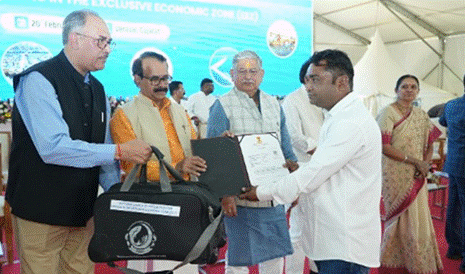
The Khadi and Village Industries Commission is implementing the Gramodyog Vikas Yojana to promote rural industries and provide livelihood opportunities to traditional artisans.
Under the scheme, training programmes and toolkits are provided across various sectors including mineral based industries, agro based and food processing industries, wellness and cosmetic industries, handmade paper and fibre industries, leather products industry, rural engineering and new technology industries and service sector activities.
In Maharashtra, multiple training programmes have been conducted under the scheme during the past five years across several verticals including Honey Mission, Kumhar Sashaktikaran Programme, agro based food processing and rural engineering industries.
At the national level, the number of training programmes has increased significantly in recent years. For example, Honey Mission programmes increased from 75 in 2020-21 to 115 in 2024-25 while Kumhar Sashaktikaran Programme trainings increased from 324 programmes in 2020-21 to 436 programmes in 2024-25.
Impact Of Honey Mission And Kumhar Sashaktikaran Programme
An independent evaluation study conducted by the Khadi and Village Industries Commission in 2021 assessed the impact of the Honey Mission and Kumhar Sashaktikaran Programme.
The study found that the Kumhar Sashaktikaran Programme increased the average annual income of potters by 37 percent and average annual profits by 55 percent across six zones.
The programme also encouraged product diversification among potters, with 79 percent of participants producing at least three different pottery products after receiving support.
Similarly, the Honey Mission increased the average annual income of beekeepers by around 33 percent. More than 84 percent of beneficiaries expanded their bee box capacity to up to 14 boxes.
The programme also contributed to improved crop yields through enhanced cross pollination.
Financial Support For Village Industries In Maharashtra
Financial assistance under Gramodyog Vikas Yojana in Maharashtra increased significantly over the past five years.
Total expenditure under the scheme increased from ₹203.87 lakh in 2020-21 to ₹545.36 lakh in 2022-23 before moderating to ₹287.66 lakh in 2023-24 and ₹265.39 lakh in 2024-25.
The scheme operates as a central sector programme without fixed state wise budget allocations. Funds are utilised based on training programmes conducted and toolkits provided to beneficiaries.
NSIC Support For MSMEs In Andhra Pradesh
The National Small Industries Corporation Limited provides integrated support services to MSMEs across India including Andhra Pradesh.
Branch offices located in Vijayawada and Visakhapatnam provide assistance to MSMEs including those located in Konaseema district through schemes such as Raw Material Assistance, Raw Material Distribution, Marketing Support, Credit Facilitation, ICT Digital Services, Skill Development and Entrepreneurship Development.
During the last three years and the current financial year up to 28 February 2026, a large number of MSMEs in Andhra Pradesh have benefited from NSIC programmes including the Single Point Registration Scheme, Global MSME Mart B2B platform and Raw Material Assistance Scheme.
Financial Assistance Through NSIC Schemes
Under the Raw Material Assistance Scheme, funds amounting to ₹26,143.34 lakh were sanctioned in 2022-23, ₹22,334.37 lakh in 2023-24, ₹23,159.96 lakh in 2024-25 and ₹28,244.08 lakh during 2025-26 up to 28 February.
The Bank Tie up Scheme and Bill Discounting Scheme also provided financial support to MSMEs, helping them improve liquidity and manage working capital requirements.
Entrepreneurship Development And Skill Training
The NSIC Technical Service Centre in Hyderabad has conducted several entrepreneurship and skill development programmes for entrepreneurs in Andhra Pradesh.
The number of training programmes increased from one programme with 20 participants in 2022-23 to nine programmes with 1,161 participants in 2025-26 up to 28 February.
Support For SC ST Entrepreneurs
The National Small Industries Corporation Limited is also implementing the National SC ST Hub Scheme to promote entrepreneurship among Scheduled Castes and Scheduled Tribes.
Under the scheme, 1,446 SC ST entrepreneurs from Andhra Pradesh have benefited during the last three years and the current year.
The scheme provides multiple forms of support including capital subsidy of up to ₹25 lakh for procurement of plant and machinery, skill development and capacity building programmes, market linkage support and reimbursement of testing fees and membership fees for export promotion councils and government supported e commerce platforms.
Raw Material Supply Partnerships
To support MSMEs engaged in manufacturing activities, the National Small Industries Corporation Limited has entered into agreements with several major companies for supply of raw materials.
These include partnerships with Steel Authority of India Limited, Rashtriya Ispat Nigam Limited, BITARA Private Limited, Shree Cement and Sri Kanya Steel Corporation to supply raw materials to MSMEs in Andhra Pradesh for commercial operations.
Expanding Outreach To MSMEs
Several outreach initiatives have been undertaken to expand awareness and accessibility of MSME support programmes.
These include awareness campaigns, workshops and seminars, entrepreneurship development programmes, trade fairs and exhibitions and collaboration with state agencies and district authorities.
Officials said the Government continues to strengthen institutional mechanisms, financial support systems and digital infrastructure to support MSMEs across rural and semi urban regions and enhance their contribution to employment generation, industrial growth and inclusive economic development.