
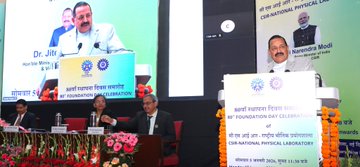
India marked a major milestone in its scientific and technological journey with the inauguration of two apex national facilities at the Council of Scientific and Industrial Research National Physical Laboratory in New Delhi during its 80th Foundation Day celebrations. The new National Environmental Standard Laboratory and the National Primary Standard Facility for Solar Cell Calibration place India among a select group of countries with advanced capabilities in environmental governance and solar metrology.
Inaugurating the facilities, the Union Minister of State for Science and Technology said the National Environmental Standard Laboratory represents a decisive leap in India’s approach to environmental monitoring and governance. The facility will enable accurate, traceable and India specific calibration and certification of air pollution monitoring instruments, ensuring that environmental data reflects real climatic and operating conditions prevalent across the country. This will directly support regulators, industries, startups and urban bodies in enforcing air quality standards and strengthening initiatives such as the National Clean Air Programme.
The National Primary Standard Facility for Solar Cell Calibration positions India in an elite global league of solar metrology. Developed in collaboration with Germany’s PTB, the facility uses advanced laser based Differential Spectral Responsivity technology to achieve one of the lowest calibration uncertainties globally. This will significantly reduce dependence on foreign certification agencies, cut costs, shorten calibration timelines and enhance confidence among domestic and international investors in India’s rapidly expanding solar energy sector.
Addressing the gathering, the Minister described institutions such as CSIR NPL as living monuments of modern India, reflecting the country’s scientific evolution from the pre Independence era to global leadership. He recalled that for decades, a large part of the nation synchronised its daily life with Indian Standard Time maintained by the atomic clocks housed at NPL, underscoring the laboratory’s quiet but profound contribution to national integration and everyday governance.
The Minister emphasised that science and technology reforms will be central to shaping India’s socio economic future. He noted that scientific institutions, despite limited financial resources, possess immense intellectual and infrastructural strengths that can be leveraged through deeper collaboration with industry, startups and MSMEs, allowing research outcomes to translate directly into economic growth and public benefit.
During the celebrations, several important additions were made to India’s quality and metrology ecosystem. Fourteen phytochemical Bharatiya Nirdeshak Dravya reference materials developed jointly by CSIR CIMAP and CSIR NPL were released, along with two gas reference materials and one silica fume reference material. Multiple memoranda of understanding and technology transfer agreements were also signed to support indigenous manufacturing and innovation.
The Director General of CSIR highlighted that the laboratory now hosts one of the world’s largest environmental calibration facilities and one of the top global solar cell calibration facilities. She underlined the strategic importance of NPL’s atomic clocks, noting their critical role in maintaining national timekeeping even in scenarios where satellite based systems are unavailable.
The inauguration of these two national facilities reinforces India’s commitment to data driven environmental policy, renewable energy leadership and scientific self reliance. As the country advances towards its development goals for 2047, CSIR NPL is set to remain a cornerstone of India’s metrological excellence, technological credibility and global scientific standing.