
India’s rich tribal heritage, cultural diversity and growing entrepreneurial ecosystem will take centre stage as Bharat Tribes Fest 2026 opens in the national capital on March 18, bringing together artisans, performers and policymakers on a single platform to celebrate and strengthen tribal livelihoods.
Organised by the Tribal Cooperative Marketing Development Federation of India in collaboration with the Ministry of Tribal Affairs, the festival will be inaugurated by Union Minister for Tribal Affairs Jual Oram in the presence of Minister of State for Tribal Affairs Durgadas Uikey and other dignitaries at Sunder Nursery, New Delhi.
Scheduled from March 18 to March 30, the festival will remain open to the public daily from 11 am to 8 pm, offering an immersive experience of tribal art, handicrafts, handlooms, cuisine and cultural traditions from across the country.
The event will feature more than 200 curated stalls representing 78 Van Dhan Vikas Kendras and 310 master artisans, showcasing a wide spectrum of indigenous craftsmanship and forest based products. The festival will also highlight the Forest to Plate concept, with participation from 120 tribal cuisine entrepreneurs presenting traditional food systems rooted in sustainability and local knowledge.
Visitors will have the opportunity to witness 17 live craft demonstrations, offering insight into traditional techniques and processes, while over 400 artists will present daily performances of tribal music and dance, creating a vibrant cultural environment throughout the festival.
A key component of the event is the Bharat Tribes Business Conclave, to be held from March 19 to March 27, which will bring together policymakers, industry leaders, researchers and tribal entrepreneurs for structured dialogue on critical themes such as sustainable textiles, tribal food systems, ethical markets, innovation and protection of indigenous knowledge.
The conclave will also focus on skilling, particularly for tribal youth and women, and explore pathways for strengthening community led enterprises and tourism models. A dedicated Corporate Social Responsibility conclave on March 24 will aim to build partnerships between corporate institutions and tribal enterprises to support long term livelihood generation and market access.
The festival will also feature the RISA initiative, which brings together leading designers including Anju Modi, Manish Tripathi, Gaurav Jai Gupta, Sandeep Khosla and Sameera Dalvi with tribal artisans. The collaboration seeks to integrate traditional textiles such as Eri silk, Kotpad cotton and Dongria embroidery into contemporary fashion, thereby connecting indigenous craftsmanship with global markets.
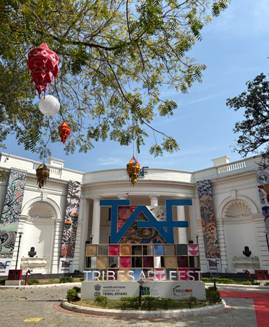
The Bharat Tribes Fest builds on the momentum created by the recently concluded Tribes Art Fest 2026 held at Travancore Palace in New Delhi from March 2 to March 13, which showcased the depth and diversity of India’s tribal artistic traditions.
The Tribes Art Fest featured over 75 tribal artists and nearly 1000 artworks representing more than 30 art forms, including Warli, Gond, Bhil, Dokra, Sohrai, Saura, Bodo and Kurumba, among others. The exhibition highlighted the strong cultural continuity across regions and the deep connection between tribal art and nature, rituals and community life.
The festival also underscored the central role of women in preserving and transmitting cultural traditions. Women artists emerged as key custodians of indigenous knowledge, using art to narrate stories of ecology, spirituality and community life while adapting traditional forms to contemporary platforms.
Artists such as Sumitra Ahake, a Warli practitioner from Maharashtra, reflected the deep spiritual bond between tribal communities and nature through geometric patterns depicting farming cycles and social rituals. Gond artist Nankushiya Shyam highlighted the importance of preserving artistic traditions across generations, while younger artists like Sudha Kumari from Jharkhand used their work to raise awareness about environmental conservation and sustainable living.
The Tribes Art Fest also facilitated direct engagement between artists and markets by connecting them with collectors, galleries, corporates and design institutions, ensuring fair valuation of their work and transforming cultural expression into sustainable livelihoods.
The event included panel discussions on tribal art revival, contemporary relevance and market linkages, along with workshops, live demonstrations and inclusive programmes designed to engage diverse audiences, including persons with special needs.
A notable feature was Project Khum, a collaborative installation by tribal women artists symbolising creativity, growth and cultural expression. The initiative highlighted the leadership and creative agency of women in sustaining and evolving indigenous traditions.
Government initiatives such as PM JANMAN for Particularly Vulnerable Tribal Groups, DAJGUA for benefit saturation, expansion of Eklavya Model Residential Schools and strengthened market linkages through TRIFED have provided institutional support to these efforts, creating a policy framework for tribal empowerment and economic inclusion.
The Bharat Tribes Fest 2026 is positioned as a continuation of these efforts, aiming to create a comprehensive ecosystem that combines cultural preservation with economic opportunity. By providing direct market access, encouraging design innovation and facilitating partnerships, the festival seeks to enhance the visibility and viability of tribal enterprises.
Officials stated that such initiatives are aligned with the broader vision of inclusive growth, where cultural heritage is not only preserved but also leveraged as a driver of sustainable development and livelihood generation.
With large scale participation, curated exhibitions and structured policy dialogue, the festival is expected to strengthen the integration of tribal communities into mainstream economic frameworks while retaining the authenticity of their traditions.