
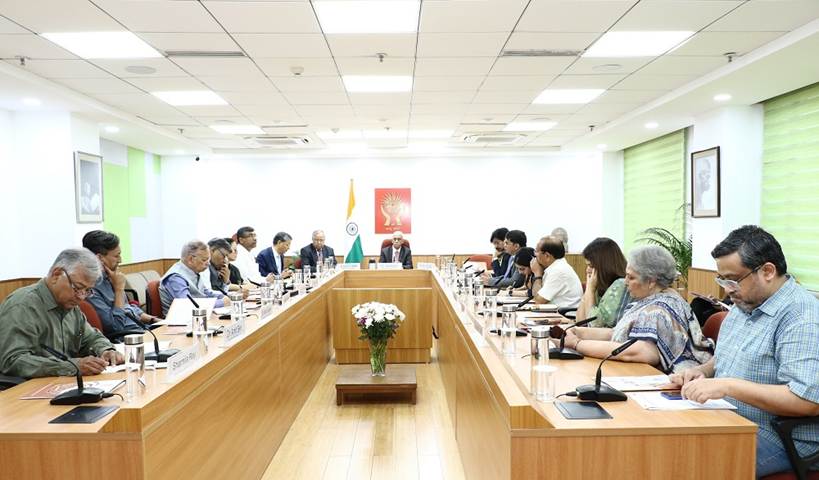
The National Human Rights Commission organised an open house discussion on access to social media by children, bringing together policymakers, experts, civil society representatives and government officials to deliberate on the growing concerns around online safety, digital behaviour and regulatory frameworks for minors.
The discussion, held in hybrid mode at the Commission’s premises in New Delhi, was chaired by NHRC Chairperson Justice V. Ramasubramanian. It was attended by NHRC Member Justice Bidyut Ranjan Sarangi, Secretary General Bharat Lal, Secretary Ministry of Electronics and Information Technology S. Krishnan, Director General Investigation Anupama Nilekar Chandra, Registrar Law Joginder Singh, Joint Secretaries Samir Kumar and Saidingpuii Chhakchhuak, along with representatives from central and state governments, statutory bodies, academia, United Nations organisations and civil society groups.
The deliberations were held against the backdrop of rising concerns among parents, educators and policymakers regarding excessive social media usage among children and inadequate safeguards against harmful content. The issue has gained global attention, with several countries exploring age based restrictions and accountability frameworks for digital platforms.
Opening the discussion, Justice V. Ramasubramanian framed three key questions for stakeholders. These included whether children’s access to social media should be banned or regulated, whether such regulation should be undertaken by Parliament or state legislatures, and what should be the appropriate threshold for restricting access. He emphasised that while India has strong legal frameworks, enforcement remains a challenge, and the focus must be on practical, enforceable and uniform solutions across the country.
He highlighted that while there is increasing discourse around digital addiction, digital hygiene and digital devotion, there is insufficient attention on digital discipline. He called for actionable recommendations that can strengthen implementation mechanisms and ensure responsible use of technology by children.
Justice Bidyut Ranjan Sarangi underlined that regulation rather than prohibition would be a more pragmatic approach. He stated that in a technology driven world, children cannot be deprived of digital access, and a uniform central law would be essential to ensure equitable protection and opportunity for children across regions and socio economic backgrounds.
Providing a broader perspective, Bharat Lal outlined the structure of the discussion, which included three technical sessions focused on understanding the impact of social media on children, assessing the existing regulatory framework in India and evaluating the feasibility of age based restrictions. He cited the Annual Status of Education Report 2024, noting that 76 percent of children aged 14 to 16 use smartphones for social media, while 57 percent use them for educational purposes.
He pointed out that while social media offers opportunities for learning and connectivity, it also poses risks such as cyber bullying, data privacy breaches, online exploitation, child sexual abuse material and cyber fraud. He stressed the need for a balanced and holistic approach that addresses both benefits and risks, with particular attention to children’s mental health and privacy.
Bharat Lal also referred to the Commission’s 2023 advisory on protection of children against child sexual abuse material, which focused on strengthening legal, technological and institutional mechanisms to curb online exploitation and has received a positive response from governments.
S. Krishnan highlighted ongoing government efforts to regulate digital spaces while maintaining access and innovation. He noted that recent measures include mandatory labelling of synthetically generated content and restrictions on unlawful social media posts. He emphasised the need to treat digital access as a form of public infrastructure while ensuring appropriate regulatory safeguards.
During the discussions, Aishwarya Dongre raised concerns about the proliferation of inappropriate content, particularly in animated formats, and highlighted ongoing efforts to detect and combat such material. Muktesh Chander suggested regulating internet gateways for improved monitoring and control.
Sanjeev Sharma emphasised the importance of awareness campaigns for children and parents alongside legislative measures. Sneha from Karnataka informed that the state is in the process of finalising guidelines on children’s access to social media, while Kabir K. Shirgaonkar and Syed Mohsin Ali indicated that similar regulatory considerations are underway in Goa and Delhi.
Experts from civil society and international organisations offered varied perspectives. Laxmi Vijay Kumar suggested that a temporary restriction could help build protective frameworks, while Zaffrin Chowdhury supported age based restrictions developed through inclusive consultations. Sharmila Ray stressed addressing behavioural issues linked to digital usage, and Swagata Raha highlighted the role of social media as an equaliser that bridges social and geographic divides.
Rakesh Senger called for stronger accountability of internet service providers and social media platforms, while Manoj Sharma advocated a behavioural and lifestyle based approach rather than outright bans. Anuradha Joshi emphasised the need for safety mechanisms in mobile devices, noting the risk of social isolation. Sourabh Ghosh highlighted the need for continuous awareness and capacity building among children, parents and educators.
Karnika Seth supported regulated access over prohibition, citing children’s rights as citizens, while Hasina Kharbhih emphasised strengthening regulatory frameworks. Amit Sen suggested a centralised policy with flexibility to accommodate India’s diversity.
The discussion also raised concerns about declining empathy, emotional regulation challenges among children and the long term impact of digital exposure following increased online engagement during the pandemic. Participants highlighted the need for parental awareness, digital discipline and encouraging children to engage more with the physical world.
Key recommendations emerging from the deliberations included defining social media clearly, adopting evidence based policy approaches, avoiding top down regulatory models, ensuring children’s rights are protected, establishing a central policy framework with state level implementation, fixing accountability of digital platforms, promoting digital literacy in schools and enhancing training for law enforcement agencies.
Additional suggestions included implementing default safety features on platforms, regulating app store approvals, monitoring use of VPNs, addressing automated bot driven content and ensuring continuous behavioural interventions to guide responsible usage.
The Commission will further examine these inputs and stakeholder perspectives before finalising its recommendations aimed at safeguarding children’s rights while enabling responsible access to digital platforms.