
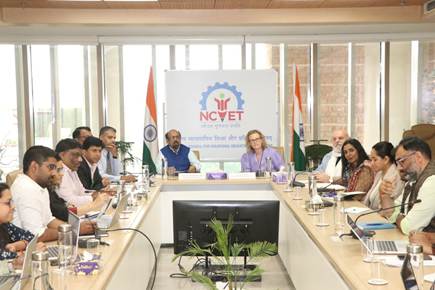
India and Australia have taken a significant step towards strengthening cooperation in vocational education and training, with the National Council for Vocational Education and Training holding a bilateral meeting with the Australian Skills Quality Authority to enhance collaboration, regulatory alignment and quality assurance in the skilling ecosystem.
The meeting, held in New Delhi, was chaired by Ashok Kumar Gaba, Executive Member, National Council for Vocational Education and Training under the Ministry of Skill Development and Entrepreneurship. The Australian delegation was led by Saxon Rice, Chief Executive Officer, Australian Skills Quality Authority, and included George Thiveos, Minister Counsellor Education and Research, Priya Raja, Senior Policy Officer, and Sonali Singh, Policy and Administration Officer from the Australian Government Department of Education at the Australian High Commission.
The engagement focused on exploring avenues for deeper cooperation and knowledge exchange in the vocational education, training and skilling sector, with both sides presenting detailed overviews of their respective regulatory frameworks, operational systems and institutional challenges.
Discussions centred on strengthening regulatory systems and ensuring robust quality assurance mechanisms to enhance the credibility and global recognition of vocational qualifications. Both sides examined risk based monitoring approaches, compliance frameworks, audit mechanisms and methods to improve assessment integrity across training institutions.
A key focus area was the alignment of qualification frameworks and processes related to qualification approval. The two sides also deliberated on benchmarking systems to ensure comparability of vocational certifications, which is expected to facilitate mobility of skilled workforce and improve international acceptance of qualifications.
The meeting highlighted the growing importance of integrating technology and data driven systems in regulatory oversight. Participants discussed the use of digital tools for monitoring training providers, ensuring compliance and improving transparency within the vocational training ecosystem.
Both India and Australia emphasised the need to adopt best practices in training and assessment quality assurance, recognising that strong regulatory frameworks are essential to build trust among employers, institutions and learners in an increasingly globalised skills market.
The dialogue also underscored the importance of collaboration in addressing common challenges such as maintaining training standards, ensuring consistency in assessments and adapting to evolving industry requirements.
A key outcome of the meeting was the decision to initiate mutual qualification mapping on a pilot basis. The initial focus will be on sectors such as healthcare, particularly caregiver roles, and agriculture. This step is expected to lay the foundation for greater alignment of skill standards and facilitate workforce mobility between the two countries.
The initiative is also aimed at enhancing the employability of skilled professionals by ensuring that their qualifications are recognised across borders, thereby strengthening international cooperation in the skilling domain.
Both NCVET and ASQA reiterated their commitment to continued engagement and collaboration, with an emphasis on building a resilient, transparent and globally aligned vocational education system. The partnership is expected to contribute to capacity building, institutional strengthening and the exchange of best practices in vocational training and regulation.
The meeting reflects India’s ongoing efforts to align its skilling ecosystem with global standards and to build partnerships that support workforce development, economic growth and international competitiveness in emerging sectors.