
The Bharat Electricity Summit 2026 concluded with strong global participation, substantive policy deliberations, and a clear roadmap for building a resilient, future-ready power sector, reinforcing India’s position as a leading force in the global energy transition. The maiden edition of the Summit brought together policymakers, industry leaders, global experts, investors, innovators, and state representatives for comprehensive discussions on the evolving dynamics of the power ecosystem.
The scale of participation underscored the Summit’s significance, with more than 35,000 exhibition attendees, participation from 28 States and Union Territories, over 200 exhibiting companies including more than 80 startups, upwards of 6,000 delegates, 300 speakers, and more than 100 conference sessions. The breadth of engagement reflected the increasing global and domestic interest in India’s rapidly transforming power sector.
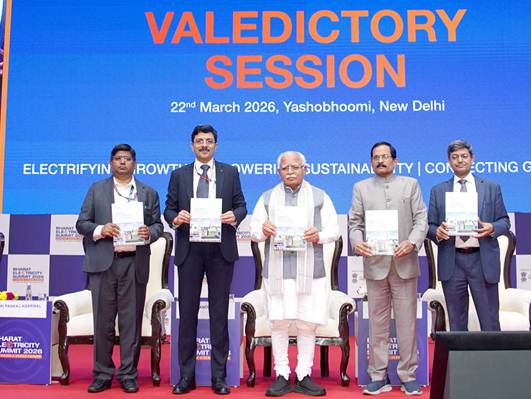
Delivering the valedictory address, Manohar Lal, Union Power Minister, described the Summit as a highly successful platform that enabled meaningful dialogue among stakeholders across the power value chain. He noted that despite being its inaugural edition, the Summit witnessed unprecedented participation and generated actionable insights, particularly highlighting the strong presence of startups and their role in driving innovation within the sector.
He emphasised that electricity remains a foundational resource for achieving the vision of Viksit Bharat by 2047, touching every segment of the economy and society. Referring to the success of Saubhagya Yojana, he noted that electricity access has now reached even the remotest parts of the country, marking a major milestone in inclusive development.
Highlighting India’s commitment to renewable energy expansion and global cooperation, Manohar Lal invoked the principle of One Sun One World One Grid, underlining the need for collaborative international efforts to achieve sustainable energy goals. He pointed out that discussions during the Summit, particularly with African nations, revealed strong opportunities for mutually beneficial cooperation in power sector development, technology exchange, and capacity building.
He further stressed the importance of strengthening electricity distribution companies through structural and operational reforms. He noted that DISCOMs have shown willingness to undertake corrective measures, including the adoption of smart metering systems, implementation of cost-reflective tariffs, and improvement in operational efficiency. These reforms are critical for ensuring financial sustainability and reliable power supply.
Announcing future plans, Manohar Lal stated that the next edition of the Bharat Electricity Summit will be held in 2028 in Gandhinagar, Gujarat, signalling continuity and long-term commitment to institutionalising the platform.
Shripad Naik, Minister of State for Power and New and Renewable Energy, highlighted that the Summit demonstrated the strength of India’s coordinated federal approach, where national policy direction aligns seamlessly with state-level execution. He identified three key insights emerging from the deliberations: states are increasingly becoming drivers of innovation, distribution sector reforms are gaining momentum, and the energy transition is evolving into an integrated system combining renewables, storage, transmission, and digital technologies.
Pankaj Agarwal, Secretary Power, noted that interactions with industry stakeholders indicated a potential capital expenditure pipeline of approximately ₹32,000 crore in the power sector. He stressed the importance of evaluating power costs from a system-wide perspective to ensure affordability, while also highlighting the urgent need to scale up energy storage capacity to support renewable integration and grid stability.
Piyush Singh, Additional Secretary, Ministry of Power, acknowledged the successful execution of the Summit and commended the collaborative efforts that contributed to its scale and impact.
Three key reports were released during the valedictory session, including Rating Regulatory Performance of States and Union Territories 2025 by Power Foundation of India, Ash Generation and Utilisation at coal and lignite-based grid-connected thermal power stations for 2024-25 by Central Electricity Authority, and Establishing a Sodium ion Battery Ecosystem in India by Council on Energy Environment and Water. These reports are expected to inform policy, regulatory improvements, and technology adoption in the sector.
The Summit highlighted India’s remarkable progress in power sector development. Installed capacity has crossed 520 GW, with one of the fastest expansion rates globally. The transmission network has grown to over five lakh circuit kilometres, ensuring improved connectivity and grid reliability. Renewable energy capacity has witnessed exponential growth, with solar capacity increasing from 2.8 GW in 2014 to over 143 GW currently. Electricity demand is projected to grow by more than 30 percent by 2030, driven by emerging sectors such as artificial intelligence-based data centres, electric mobility, and industrial expansion.
The discussions reaffirmed that while thermal power will continue to play a critical role in maintaining grid stability, renewable energy will drive long-term sustainability, supported by advancements in energy storage, grid modernisation, and regulatory reforms.
A high-level ministerial meeting with States and Union Territories outlined priority action areas, including strengthening DISCOM financial viability, ensuring cost-reflective tariffs with targeted subsidies, accelerating nationwide smart metering rollout, securing future generation capacity, and advancing nuclear power development for long-term energy security.
Strategic sessions during the Summit covered a wide spectrum of themes shaping the future of the power sector. These included centre-state policy coordination, development of green hydrogen and emerging fuels, application of artificial intelligence in power systems, expansion of nuclear energy, evolution of power markets, financing mechanisms for large-scale investments, scaling up energy storage solutions, and strengthening domestic manufacturing under the Make in India for the world approach.
Infrastructure and investment requirements emerged as key focus areas. India will need to add over 1.37 lakh circuit kilometres of transmission lines by 2030, with investments estimated at around ₹9 lakh crore. Energy storage demand is expected to increase significantly, with pumped storage potential exceeding 200 GW and battery energy storage systems playing a critical role in peak demand management and renewable integration. It was also highlighted that India’s long-term energy transition may require investments exceeding USD 22 trillion by 2070.
The Summit also underscored the importance of digital transformation in the power sector. Technologies such as artificial intelligence, machine learning, and digital twins are enabling predictive maintenance, enhanced grid management, and improved operational efficiency. The concept of an India Energy Stack, inspired by digital public infrastructure, aims to create interoperable and consumer-centric energy systems. Initiatives such as smart metering and rooftop solar are empowering consumers to become active participants or prosumers in the energy ecosystem.
States presented ambitious energy transition roadmaps, reflecting regional leadership in the sector. Gujarat outlined a target of 190 GW renewable capacity by 2047. Andhra Pradesh highlighted plans for an integrated clean energy hub with investments exceeding ₹6 lakh crore. Maharashtra projected electricity demand of 280 terawatt hours by 2030, necessitating large-scale capacity expansion. Bihar emphasised investment in storage and grid infrastructure, while Delhi outlined its transition towards a renewable-intensive, storage-integrated urban energy system.
The Summit facilitated multiple bilateral engagements with countries including Malawi, Tajikistan, Mauritius, Kyrgyzstan, and Russia, along with global institutions such as Africa50. These interactions focused on cross-border electricity trade, renewable energy partnerships, transmission infrastructure development, and capacity building. The India Africa Strategic Meet further strengthened cooperation, particularly in expanding renewable energy deployment, modernising grids, and enhancing last-mile connectivity across African nations.
The launch of the Indian Carbon Market Portal during the Summit marked another significant development, with carbon trading expected to commence shortly, positioning India at the forefront of climate finance and emissions management.
The Bharat Electricity Summit 2026 concluded with a strong consensus on the need for integrated, technology-driven, and investment-backed growth of the power sector. The outcomes of the Summit are expected to guide policy, accelerate reforms, and strengthen India’s journey towards a sustainable, secure, and globally competitive energy future.