
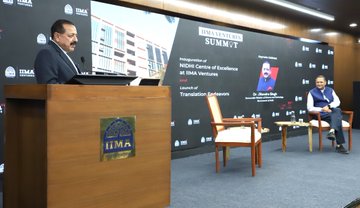
India took a decisive step in its transition from technology adoption to global technology leadership with the inauguration of a Department of Science and Technology funded NIDHI Centre of Excellence at the Indian Institute of Management Ahmedabad on January 12, 2026. The ₹40 crore initiative establishes a national deep tech nerve centre aimed at accelerating technology translation, venture creation and startup-led innovation.
The Centre of Excellence has been dedicated to the nation as a flagship platform to advance deep science driven entrepreneurship. Housed in a newly developed facility within the IIM Ahmedabad campus, the centre spans nearly 59000 square feet and has been designed as an integrated ecosystem bringing together technology innovators, management professionals, industry leaders and investors under one roof.
The facility has been conceived as a comprehensive venture creation space, equipped with advanced laboratories, collaborative workspaces, training and mentoring zones, boardrooms and networking areas. It is expected to support early stage startups, deep tech founders, students and institutional partners by enabling seamless movement of ideas from laboratory research to market ready solutions.
Addressing the gathering, the Minister of State for Science and Technology and Earth Sciences highlighted that India has moved beyond incremental growth based on technology adoption and is now firmly positioned on a path of deep tech transformation. Over the past decade, the focus has shifted to science led development where breakthroughs in fundamental research are translated into scalable products and services that strengthen economic growth, strategic autonomy and global competitiveness.
The Minister underlined that scientific excellence alone is not sufficient for startup success, stressing that innovation must be supported by strong management and commercialisation capabilities. Institutions with deep expertise in management education and national development, such as IIM Ahmedabad, were described as critical enablers in building sustainable and globally competitive deep tech ventures.
The Centre of Excellence has been established under the National Initiative for Developing and Harnessing Innovations framework of the Department of Science and Technology. It aims to bridge long standing gaps between academia, industry and investors by providing shared infrastructure, structured incubation and industry aligned innovation pathways.
A key highlight of the launch was the unveiling of Translation Endeavours, a collaborative platform bringing together leading academic and research institutions to address challenges in technology translation across deep tech domains. The initiative is expected to foster coordinated action across government, research organisations and the private sector to ensure that scientific discoveries lead to tangible societal and economic impact.
The Minister also drew attention to the changing geography of innovation in India, noting that nearly half of the country’s startups are now emerging from Tier Two and Tier Three cities. Improved digital access, expanded incubation networks and supportive policy frameworks have enabled innovators from smaller towns to actively participate in the national startup ecosystem.
Referring to India’s global standing, the Minister noted that the country now ranks among the top three startup ecosystems worldwide, with strong growth in patent filings, scientific publications and resident led innovation. These gains were attributed to sustained public investment in science, research infrastructure and ecosystem development.
Government initiatives such as the Research Development and Innovation Fund and the Anusandhan National Research Foundation were highlighted as critical enablers providing patient and risk tolerant capital for deep tech ventures. These mechanisms are designed to support early stage innovation and help startups scale responsibly over the long term.
Concluding the event, the Minister called for close collaboration among researchers, students, industry and investors, emphasising that India’s innovation future depends on effective translation of ideas into real world solutions. He reiterated that the country is backing its innovators with policy support, funding and institutional strength to build globally relevant technologies with lasting societal impact.