
India took significant steps toward strengthening the quality credibility and global competitiveness of Ayurveda and medicinal plant raw materials with two major national initiatives held in January 2026, focusing on standardization, farm gate quality assurance, and technology enabled traceability across the value chain.
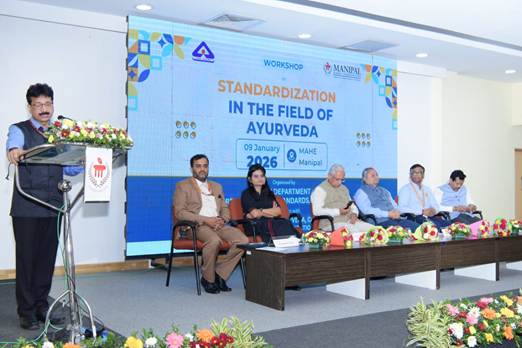
A national level workshop on standardization in Ayurveda was organised on 9 January 2026 at Manipal Academy of Higher Education Manipal by the Bureau of Indian Standards under the Ministry of Consumer Affairs Food and Public Distribution in collaboration with the Division of Ayurveda Centre for Integrative Medicine and Research at MAHE. The programme brought together nearly 180 faculty members researchers startups and industry representatives from across the country, marking a key milestone in the collective effort to enhance quality safety and global trust in Ayurveda.
The workshop was designed to harmonise classical Ayurvedic wisdom with modern scientific regulatory and quality frameworks. Drawing inspiration from the BIS guiding motto Manakah Patha Pradarshaka the discussions underscored the central role of standards in building confidence among practitioners industry regulators and international markets. Speakers emphasised that robust standardization is essential not only for domestic quality assurance but also for positioning Ayurveda as a globally trusted healthcare system.
The inaugural session highlighted the responsibility of academia industry and standards bodies to work together to translate traditional knowledge into reproducible safe and compliant products. Participants examined how structured standards can support innovation enable startup growth and ensure consistency across manufacturing and research. The deliberations reinforced the need for institutional commitment interdisciplinary research and inclusive standard setting processes aligned with national priorities.
Expert sessions addressed the role of standards in nurturing Ayurveda based startups strengthening compliance driven manufacturing and ensuring that quality is embedded at every stage from research to market delivery. The workshop concluded with a forward looking roadmap focusing on academia industry partnerships capacity building and sustained engagement between policymakers scientists and practitioners to create a collaborative ecosystem for Ayurveda standardization.
Parallel to this effort experts from across Ministry of Ayush institutions scientific bodies and industry called for rapid adoption of artificial intelligence and digital technologies to strengthen the medicinal plant supply chain at the point of origin. This call emerged from a two day national seminar held on 8 and 9 January 2026 at IIT Delhi on design and development of tools for quality assessment of medicinal plants at farm gates.
The seminar brought national attention to the urgent need for assured quality traceability and standardisation of medicinal plant raw materials at the farm gate as the foundation for sustainable growth of the Ayush sector. Policymakers scientists technologists industry leaders and researchers deliberated on how digital tools can address long standing challenges such as adulteration variability and lack of documentation in medicinal plant sourcing.
Key discussions examined the entire value chain from sustainable cultivation and regenerative agriculture to AI enabled quality assessment digital phenotyping and supply chain integration. Experts highlighted that India is institutionally and technologically prepared to deploy AI based diagnostics portable testing devices and decision support systems to verify quality at the farm gate. Such interventions were seen as critical for reinforcing credibility in domestic markets and meeting international pharmacopoeial and export requirements.
Day two of the seminar focused on building a national roadmap through structured brainstorming on integration of artificial intelligence and use of blockchain technology for end to end traceability. There was strong consensus that digital traceability platforms and blockchain based systems are no longer optional but essential for authenticity safety and global competitiveness of Indian herbal raw materials.
Participants unanimously stressed that quality must be built at the point of origin empowering primary producers and collectors while reducing farmer losses and supply chain inefficiencies. The discussions validated the integration of traditional knowledge systems such as Vriksha Ayurveda with modern quality control and digital documentation frameworks demonstrating how India’s heritage can be scientifically validated and globally accepted.
Together the two initiatives reflect a coordinated national push to strengthen quality infrastructure across Ayurveda and the medicinal plant sector. By aligning standardization policy digital innovation and capacity building these efforts directly support the goals of Atmanirbhar Bharat and Make in India while reinforcing India’s leadership in the global Ayush ecosystem. The outcomes lay a strong foundation for future pilot projects technology deployment and farmer level empowerment positioning quality standardization and traceability as cornerstones of India’s traditional medicine economy.