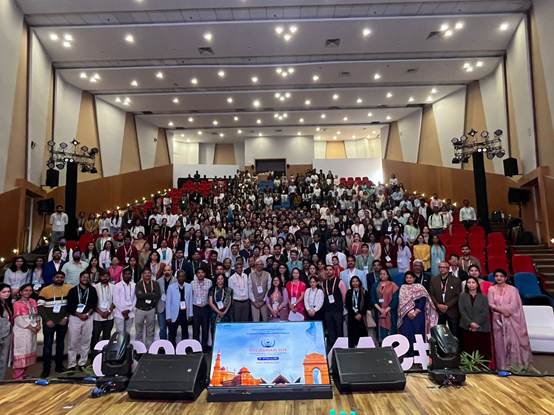

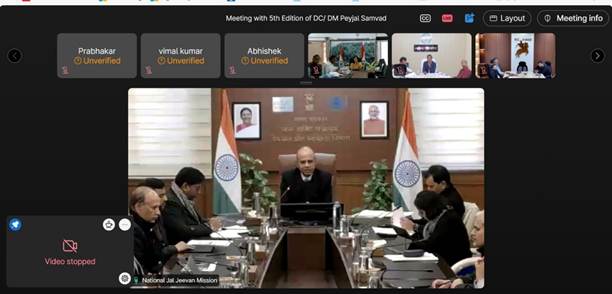
The Department of Drinking Water and Sanitation under the Ministry of Jal Shakti held the fifth edition of the District Collectors Peyjal Samvad on 15 January 2026, bringing together district administrations, state mission teams and sector experts to review progress and strengthen service delivery under Har Ghar Jal of the Jal Jeevan Mission. The virtual interaction focused on the transition from infrastructure creation to sustained, community led drinking water services in rural India.
The session was chaired by the Secretary of the Department of Drinking Water and Sanitation and witnessed wide participation from District Collectors, Deputy Commissioners, District Magistrates and officials from across the country. The interaction served as a national platform for districts to share experiences, innovations and challenges in ensuring reliable, safe and adequate tap water supply to rural households.
Addressing the gathering, the Secretary commended district teams for their efforts and emphasised that the next phase of the Jal Jeevan Mission must be firmly anchored in service delivery and community ownership. He highlighted that under the constitutional framework, operation and maintenance of rural drinking water systems rests with Gram Panchayats, and effective decentralised implementation is essential for long term sustainability. The growing participation of communities, including migrant and inter state workers, was noted as a positive indicator of ownership and accountability at the local level.
Two priority initiatives were highlighted as critical to sustaining Har Ghar Jal outcomes. The first was Jal Arpan, a structured handover of completed rural water supply schemes to Gram Panchayats and communities after a trial run of fifteen days. Districts were encouraged to institutionalise Jal Arpan as an annual maintenance fortnight to reinforce preventive maintenance and renew community ownership. The second was Jal Seva Aankalan, a systematic, Gram Panchayat led self assessment of service functionality in villages declared fully covered under Har Ghar Jal, aimed at maintaining quality and reliability of services.
Officials were urged to document and share best practices for replication across states. The focus of the fifth Peyjal Samvad was Jal Seva Aankalan, which was launched in December 2025 as a digital tool to assess drinking water service delivery at the village level.
A detailed presentation on Jal Seva Aankalan explained that the assessment is led by Gram Panchayats and evaluates drinking water systems on three key parameters, regularity of supply, adequacy of availability and water quality. The process is carried out through a structured digital workflow on the e Gram Swaraj platform and the Jal Jeevan Mission information system.
Five Step Jal Seva Aankalan Process
Village Water and Sanitation Committee led discussion on service functionality
Endorsement by the Gram Sabha to ensure transparency and collective ownership
Data entry on the Jal Jeevan Mission Panchayat dashboard by Panchayat Secretaries
Public display of assessment results through the Nari Panchayat App with a thirty day feedback window
Consolidated reporting at district and state levels for planning and corrective action
The current cycle of Jal Seva Aankalan applies to Gram Panchayats declared Har Ghar Jal on or before 31 December 2020, covering around one lakh seventeen thousand Panchayats with at least one year of operational experience. The assessment framework comprises twenty three questions covering infrastructure condition, service gaps, source sustainability and operation and maintenance preparedness. The first cycle is to be completed by 26 January 2026.
District officials were advised to ensure adequate training of Panchayat Secretaries, timely Gram Sabha meetings and accurate data entry so that the assessment generates actionable insights for evidence based planning.
District Innovations And Field Practices
Several districts presented field level innovations and experiences highlighting diverse approaches to strengthening rural water services.
Niuland, Nagaland
The district administration highlighted how, prior to Jal Jeevan Mission, women and girls traversed difficult hilly terrain to fetch water. With strong Water and Sanitation Committee engagement, communities now take ownership of piped water schemes. Villages such as Padala Yehokhu showcased active youth and women participation, Hokhezhe demonstrated community contribution towards pipeline costs, and Izhevi village adopted a monthly user charge model for operation and maintenance.
Palwal, Haryana
The district presented the adoption of Ranney Wells technology for bulk water supply to address fluoride contamination. The technology has ensured reliable quality water while reducing electricity consumption and land requirements, offering a cost effective solution for water stressed areas.
Sarangarh Bilaigarh, Chhattisgarh
The district emphasised intensive information education and communication campaigns to sustain public participation. Innovative practices included night chaupals across village clusters to resolve grievances, regular water quality testing by trained Jal Bahini members using field testing kits, and groundwater conservation initiatives led by self help groups through construction of soak pits and magic pits in convergence with sanitation and employment programmes.
Mahabubnagar, Telangana
The district shared progress under Mission Bhagiratha, ensuring round the clock water supply through treated surface water sources. Third party inspections verify scheme commissioning, while Gram Panchayats ensure coverage of newly formed households. A digital colour coded monitoring system tracks per capita supply levels, with a majority of villages recording optimal performance, reflecting strong implementation and community monitoring.
These presentations highlighted both achievements and challenges, underscoring the diversity of local solutions adopted to advance Har Ghar Jal goals.
In concluding remarks, the Additional Secretary and Mission Director of the Jal Jeevan Mission noted that learnings from each Peyjal Samvad are being documented in the monthly Jal Jeevan Samvad newsletter to promote cross learning among districts. He reiterated that the mission has entered a decisive phase focused on service delivery rather than infrastructure creation, with District Collectors playing a pivotal role in sustaining outcomes.
The importance of completing Jal Seva Aankalan within January was stressed, along with the need for accurate data, trained Panchayat functionaries and effective use of dashboards for decision making. District leadership was identified as central to empowering Gram Panchayats and ensuring long term functionality of rural drinking water systems.
The session concluded with a vote of thanks and reaffirmation of the department’s commitment to supporting states and districts in delivering safe and adequate drinking water to every rural household. More than fifteen hundred participants, including district officials, mission directors and state teams from across the country, attended the fifth District Collectors Peyjal Samvad.