
Artificial Intelligence agents are poised to reshape Software as a Service and enterprise services models, but industry leaders asserted that the transformation will be evolutionary rather than disruptive overnight, with agility, enterprise readiness and customer-centric innovation determining long-term success.
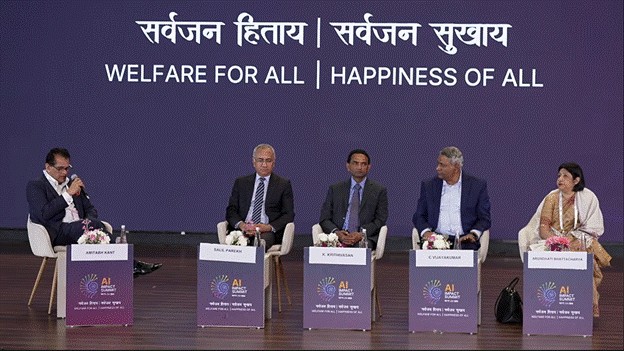
At the India AI Impact Summit, a high-level panel featuring Salil Parekh, Chief Executive Officer of Infosys; K Krithivasan, Chief Executive Officer of Tata Consultancy Services; C Vijayakumar, Chief Executive Officer and Managing Director of HCL Technologies; and Arundhati Bhattacharya, Chairperson and Chief Executive Officer of Salesforce India, examined the implications of AI agents on traditional SaaS architectures and enterprise business models. The discussion was moderated by Amitabh Kant.
The panel addressed growing speculation around whether AI-driven coding, automation and agentic systems could render conventional SaaS models obsolete. Arundhati Bhattacharya cautioned against simplistic conclusions, noting that market reactions often overstate immediate disruption. She said that SaaS is not merely about application creation but about understanding enterprise workflows, addressing customer pain points and ensuring governance, observability, auditability and adoption.
Bhattacharya emphasised that while AI will change the way applications are built and deployed, the sustainability of SaaS platforms will depend on delivering measurable customer value. She highlighted that enterprise customers demand reliability, compliance frameworks and integration capabilities that go far beyond experimental AI deployments.
From a services transformation perspective, K Krithivasan described AI as fundamentally shifting the role of software engineers. He noted that engineers are increasingly moving toward high-level architecture design, validation, oversight and integration rather than routine coding tasks. While AI can significantly improve productivity, he stressed that enterprise readiness requires foundational work including data rationalisation, application modernisation and secure integration frameworks.
Krithivasan rejected the notion of sector contraction, arguing instead that AI will expand the scope of what enterprises can produce and the complexity of problems they can address. He suggested that the scale of opportunity will grow as businesses adopt AI to reimagine processes across industries.
C Vijayakumar focused on the gap between foundational AI models and enterprise-grade performance. He pointed out that large language models cannot yet be directly applied across most enterprise use cases without specialised adaptation. According to him, meaningful enterprise adoption requires domain-specific models, strong governance frameworks and integration with legacy systems.
He noted that HCL Technologies is investing in building intellectual property and specialised capabilities in areas such as physical AI and agentic AI to bridge this gap. He acknowledged that adapting to AI may require evolving existing business lines but said that proactive transformation is essential to remain competitive.
Salil Parekh highlighted the scale of economic opportunity created by AI, describing it as a $300 billion services market in the making. He explained that AI makes previously uneconomical or technically complex projects, such as large-scale legacy system modernisation, viable at scale. Parekh said that orchestration platforms can integrate foundational models with specialised AI agents to generate measurable business value for enterprises.
Throughout the discussion, panelists underscored that AI agents will not eliminate SaaS or enterprise services but will reshape operating models. Businesses will need to prioritise agility, robust governance frameworks, enterprise-grade validation systems and continuous innovation.
The panel concluded that the AI era demands a shift from isolated model experimentation to integrated enterprise orchestration. Organisations that combine foundational AI capabilities with customer-centric design, regulatory compliance and scalable architecture will be best positioned to succeed in increasingly complex digital ecosystems.