
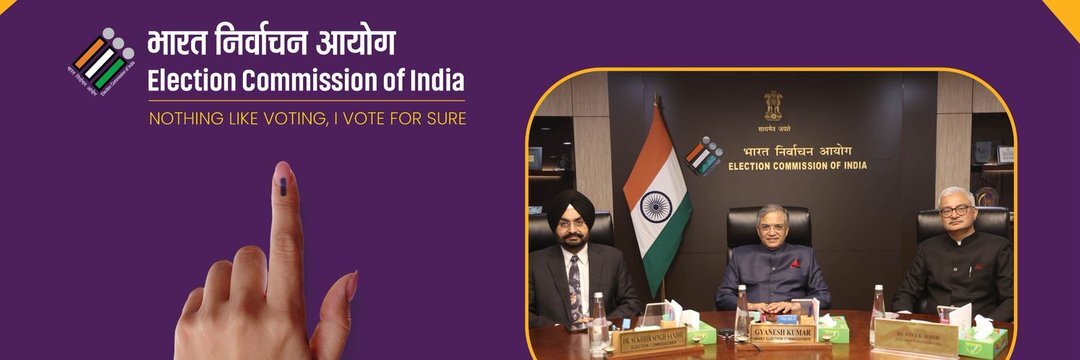
The Election Commission of India has announced the schedule for the 2026 General Elections to the Legislative Assemblies of Assam, Kerala, Tamil Nadu, West Bengal and the Union Territory of Puducherry, initiating one of the largest electoral exercises in the country this year. The elections will be conducted across 824 assembly constituencies with an electorate of around 17.4 crore voters.
According to the schedule announced by the Election Commission on March 15, 2026 in New Delhi, polling in Assam, Kerala and Puducherry will take place in a single phase on April 9, 2026. Tamil Nadu will vote in a single phase on April 23, while West Bengal will go to the polls in two phases on April 23 and April 29. Counting of votes for all five assemblies will be held on May 4, 2026.
The elections are being conducted as the terms of the existing legislative assemblies approach completion. The term of the Assam Legislative Assembly will end on May 20, 2026, Kerala on May 23, 2026, Tamil Nadu on May 10, 2026, West Bengal on May 7, 2026 and Puducherry on June 15, 2026.
Together, the five assemblies comprise 824 constituencies. Assam has 126 assembly constituencies, Kerala 140, Tamil Nadu 234, West Bengal 294 and Puducherry 30. Out of the total seats, 140 are reserved for Scheduled Castes and 37 for Scheduled Tribes across the five states and the Union Territory.
The electoral rolls have been updated with January 1, 2026 as the qualifying date. Following the Special Intensive Revision and Special Revision exercises, the total number of electors across the five electoral units stands at around 17.4 crore.
Assam has 2,49,58,139 electors, including 63,269 service voters. Kerala has 2,70,62,007 electors with 54,052 service voters. Tamil Nadu has 5,67,07,380 electors including 67,056 service voters. West Bengal has the largest electorate among the five with 6,44,52,609 voters including 1,08,543 service voters. Puducherry has 9,44,211 electors including 328 service voters.
Young voters in the age group of 18 to 19 years form a significant segment of the electorate. Assam has 5,75,258 electors in this category, Kerala 4,24,518, Tamil Nadu 12,51,749, West Bengal 5,23,229 and Puducherry 23,033 young voters.
The data also reflects participation from diverse social groups. Electors with disabilities number 2,03,709 in Assam, 2,44,250 in Kerala, 4,63,398 in Tamil Nadu, 4,16,089 in West Bengal and 12,204 in Puducherry. The number of third gender electors is 343 in Assam, 273 in Kerala, 7,617 in Tamil Nadu, 1,152 in West Bengal and 139 in Puducherry. Senior citizens aged above 85 years number 1,04,238 in Assam, 2,04,317 in Kerala, 3,99,668 in Tamil Nadu, 3,78,979 in West Bengal and 6,034 in Puducherry.
For the conduct of the elections, a total of 2,18,807 polling stations will be established across the five states and the Union Territory. Assam will have 31,486 polling stations, Kerala 30,471, Tamil Nadu 75,032, West Bengal 80,719 and Puducherry 1,099.
The Election Commission has ensured that polling stations are designed to provide accessible and comfortable voting facilities. Assured Minimum Facilities will be available at all polling stations, including drinking water, toilets, ramps, wheelchair access, signage, adequate lighting, help desks and proper seating arrangements for voters.
Special measures have been introduced to facilitate participation of senior citizens and persons with disabilities. These include ground floor polling stations, priority entry, wheelchair assistance, volunteers and transport facilities wherever required. The Saksham module of the ECINET digital platform will help persons with disabilities access election related services and assistance.
The Commission has also introduced the optional facility of voting from home through postal ballot for voters above 85 years of age, persons with disabilities with benchmark disability and electors engaged in essential services, subject to prescribed procedures under the Conduct of Elections Rules.
To ensure smoother voting operations, the Commission has decided that no polling station will have more than 1,200 electors. Voter Information Slips containing polling station details, polling date and voter serial number will be distributed to electors by Booth Level Officers ahead of polling. However, these slips will not serve as identity proof.
Electors will be required to present their Elector Photo Identity Card or any one of the alternative photo identity documents approved by the Commission. These include Aadhaar Card, MGNREGA Job Card, Passbook with photograph issued by bank or post office, Health Insurance Smart Card issued under the Ministry of Labour scheme, Driving Licence, PAN Card, Smart Card issued by the Registrar General of India under NPR, Indian Passport, Pension document with photograph, service identity cards issued by government or public sector units and Unique Disability Identity Card issued by the Ministry of Social Justice and Empowerment.
Electronic Voting Machines and Voter Verifiable Paper Audit Trail systems will be used in all polling stations. The machines will undergo a strict two stage randomisation process before allocation to assembly constituencies and polling stations. Commissioning of EVMs and VVPATs will be carried out in the presence of candidates or their representatives to ensure transparency and credibility in the voting process.
Extensive voter awareness campaigns on EVM and VVPAT usage have been conducted. EVM Demonstration Centres have been set up at district and sub division headquarters. Mobile demonstration vans have covered more than 1,24,172 polling station locations. Over 28.7 lakh citizens have participated in EVM awareness programmes and more than 25 lakh voters have cast mock votes during demonstrations.
Nearly 25 lakh election officials will be deployed across the five states and the Union Territory to conduct the elections. This includes approximately 15 lakh polling personnel, around 8.5 lakh security officials, nearly 49,000 micro observers for polling, about 21,000 sector officers, around 40,000 counting officials and nearly 15,000 micro observers for counting operations.
The Election Commission will deploy Central Armed Police Forces along with state police to ensure a peaceful, secure and transparent polling process. Vulnerable areas and sensitive polling stations will be closely monitored through coordinated security arrangements and route patrols.
Observers from the Indian Administrative Service and Indian Police Service will be deployed as General Observers and Police Observers to supervise the electoral process and ensure adherence to election laws and guidelines. Additional Counting Observers and Expenditure Observers will also be deployed where necessary.
Strict monitoring of election expenditure will be undertaken through Flying Squads, Static Surveillance Teams, Video Surveillance Teams, Video Viewing Teams, Accounting Teams and Media Certification and Monitoring Committees. Coordination will be maintained with enforcement agencies including Income Tax Department, Enforcement Directorate, Central Board of Indirect Taxes and Customs, Central Bureau of Investigation and state enforcement authorities to prevent illegal distribution of cash, liquor or inducements to voters.
Advanced digital systems and applications under the ECINET platform will be used extensively to enhance transparency, monitoring and service delivery. These include the cVIGIL mobile application for reporting Model Code of Conduct violations, the SUVIDHA portal for candidates to obtain campaign permissions, the Know Your Candidate module providing information on candidate backgrounds and the Polling Trends application for real time turnout updates.
The Model Code of Conduct has come into immediate effect following the announcement of the election schedule. All political parties, candidates and governments of the concerned states and Union Territory are required to strictly comply with the provisions of the code. This includes restrictions on new policy announcements, transfers of officials, use of government machinery for campaigning and other actions that could influence voters.
The Election Commission has also directed that campaigning should adhere to environmental guidelines, encouraging the use of eco friendly campaign materials and discouraging plastic based publicity materials.
To maintain the secrecy and integrity of voting, standardized voting compartments will be used in all polling stations. Public address systems and loudspeakers will not be permitted between 10 PM and 6 AM during the campaign period.
Media organisations have been advised to follow election guidelines regarding reporting during the silence period and exit poll restrictions. Exit polls will not be permitted during the period between the commencement of polling in the first phase and half an hour after the conclusion of polling in the final phase.
The Commission has undertaken extensive training programmes for election officials through the India International Institute of Democracy and Election Management to ensure preparedness for the large scale electoral exercise. Training programmes have been conducted for Returning Officers, Assistant Returning Officers, District Election Officers, police officials and other field level functionaries.
Through the Systematic Voters’ Education and Electoral Participation programme, the Commission has also undertaken outreach initiatives to improve voter awareness and participation, particularly among women, youth, persons with disabilities and marginalised communities.
The 2026 assembly elections in Assam, Kerala, Tamil Nadu, West Bengal and Puducherry are expected to witness intense political competition. The results, to be declared on May 4, 2026, will determine the composition of the new legislative assemblies and the formation of governments in the five states and the Union Territory for the next five years.