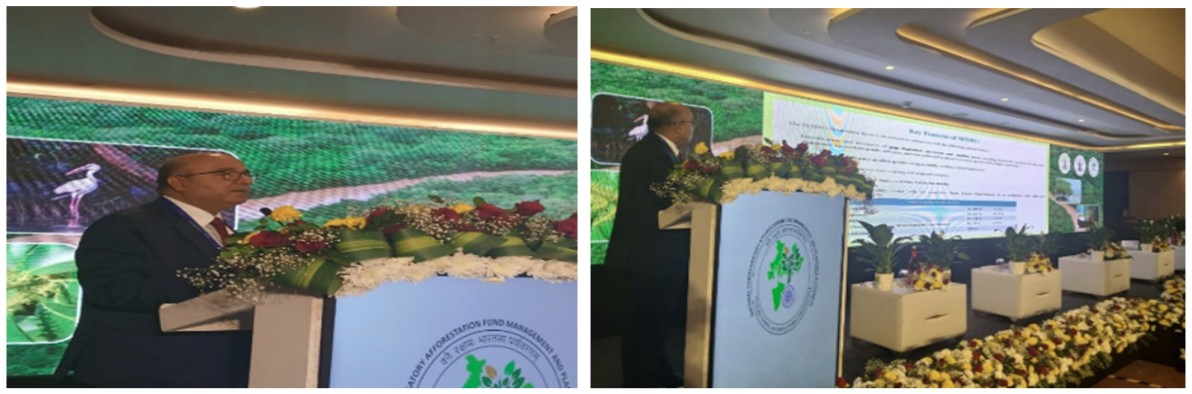


The second day of the Bharat Electricity Summit 2026 witnessed an intensive series of eight high-impact strategic sessions, bringing together policymakers, global experts, industry leaders and innovators to deliberate on the future trajectory of India’s power sector and its role in the global energy transition.
The sessions focused on critical themes including hydrogen economies, artificial intelligence in power systems, nuclear energy, energy storage, financing frameworks and global supply chains. The discussions underscored the importance of policy alignment, technological innovation and international collaboration in building a resilient and future-ready energy ecosystem.
The first session on aligning Centre and State strategies for energy transition highlighted the need for coordinated planning and faster execution of projects to accelerate India’s energy transformation. Shripad Yesso Naik, Minister of State for Power and New and Renewable Energy, set the context, while Chowna Mein, Deputy Chief Minister of Arunachal Pradesh, RM Dhavalikar, Minister for Power of Goa, Gaurav Gupta, Additional Chief Secretary Energy Department Karnataka, Narendra Bhooshan, Additional Chief Secretary Energy Uttar Pradesh and Arun Goyal, Former Member CERC, contributed to discussions on strengthening policy coherence and investor confidence.
The second session focused on hydrogen, ammonia and green molecules, emphasising the development of a competitive global value chain. Abhay Bakre, Mission Director Green Hydrogen Mission, Ministry of New and Renewable Energy, S Shaswattam, Executive Director NTPC and Head NETRA, BC Tripathi, Vice Chairman AM Green Ammonia, RR Sonde, Professor IIT Delhi and Sangeet Jain, Managing Director Lanzatech highlighted the importance of global partnerships, supply chain investments and advanced technologies.
In the third session, experts examined the transformative role of artificial intelligence in power systems, focusing on grid intelligence, cybersecurity and operational efficiency. Participants included Gerhard Salge, Global Chief Technology Officer Hitachi Energy, VK Singh, Member Power System Central Electricity Authority, CY Chung, President IEEE Power and Energy Society, Kwok Wai Ma, Senior Director Infineon Technologies and Rajiv Ranjan Mishra, Managing Director Apraava Energy.
The fourth session underscored the importance of nuclear power in ensuring long-term energy security. K Shanmugha Sundaram, Director Projects NTPC Limited, Thierry Advocat, Nuclear Counsellor Embassy of France and Prateek Agarwal, Executive Director Corporate Planning and Communication NPCIL, highlighted nuclear energy as a reliable and scalable clean energy source to meet growing demand.
The fifth session explored electrification at scale and the evolving role of power trading systems in a low carbon future. Sonam Tobjey, Chief Executive Officer Bhutan Power Corporation, Harish Saran, Managing Director Hindustan Power Exchange, Neha Aggarwal, Managing Director Arunachal Pradesh Power Corporation Private Limited, Shailendra Shukla, Managing Director Mobility Group India Eaton Industrial Systems and Vishal Vij, Head Energy Services Tata Power Trading Company Limited discussed emerging demand patterns driven by electric mobility and the need for efficient market mechanisms.
The sixth session focused on financing the global power transition, highlighting the need to convert ambitions into bankable projects. Parminder Chopra, Chairman and Managing Director Power Finance Corporation Limited, Kaniaru Wacieni, Senior Investment Director Africa 50, Katan Hirachand, Chief Executive and Chief Country Officer Societe Generale Bank, Ravisankar Ganesan, Director Finance Power Grid Corporation of India Limited and Shashank Joshi, Deputy Chief Executive Officer MUFG India and Head Global Corporate Banking MUFG Bank Limited discussed blended finance models, risk mitigation and investment strategies.
The seventh session addressed the energy storage revolution, emphasising its critical role in enabling large scale renewable integration. Chris Fitzgerald, Group Director International Affairs Octopus Energy Group, Pratyush Thakur, Investment Director and Country Head Blueleaf Energy, Madhusudhan Rao, Founder and Chief Executive Officer Oorja Energy Limited and Vishal Mittal, Founder and Chief Executive Officer Delectrik Systems Private Limited highlighted deployment strategies, localisation and reducing import dependence.
The final session focused on India’s potential to become a global manufacturing hub for clean energy technologies. Pankaj Agarwal, Founder and Chief Executive Officer Panitek Green Ventures, Sunil Das, Director Hyosung T and D India Private Limited and Atul Choudhari, Chief Technology Officer Tata Consulting Engineers Limited discussed strategies to strengthen domestic capabilities, scale exports and position India as a key player in global energy supply chains.
The second day of the summit reinforced India’s growing leadership in the global energy ecosystem, with discussions highlighting the need for integrated policy frameworks, technological advancement and strong international partnerships to achieve a sustainable and low carbon future.