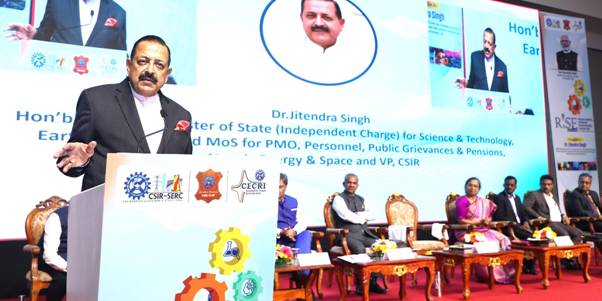

Union Minister of State Independent Charge for Science and Technology and Earth Sciences and Minister of State in the Prime Minister’s Office Jitendra Singh has said that the Union Budget 2026–27 announcement of the Biopharma Shakti initiative will catalyse India’s role in the next phase of the global industrial revolution and firmly establish the country as a leading global biomanufacturing hub.
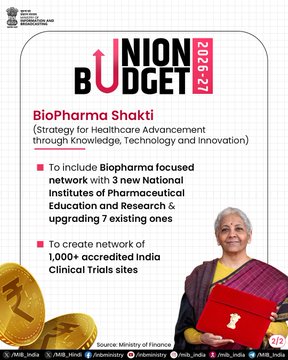
Welcoming the Budget, Jitendra Singh said the ₹10,000 crore Biopharma Shakti programme represents a decisive shift from conventional pharmaceutical production to advanced biomanufacturing, covering biologics, biosimilars, vaccines, medical devices and emerging bio-based technologies. He said the initiative is designed to help India move up the global value chain by combining innovation, large-scale manufacturing and cost-effective indigenous technologies.
The Minister said Biopharma Shakti builds on the strong foundation created under the National Biopharma Mission of the Department of Biotechnology, which has already supported the development of vaccines, biologics, biosimilars and indigenous diagnostics through an expanding network of clinical trial sites, manufacturing facilities and technology transfer offices. He noted that India has emerged as one of the world’s top ten bioeconomies and among the top three in the Asia-Pacific region, and said the new Budget outlay would consolidate this position by accelerating both research and industrial-scale production.
According to the Minister, the focus on efficient resource use, process innovation and value addition under Biopharma Shakti also aligns with circular economy principles, ensuring that growth in the bioeconomy remains environmentally sustainable while generating high-value employment for skilled youth.
Jitendra Singh said the Union Budget’s science and technology provisions go beyond biopharma to strengthen India’s broader innovation ecosystem. In a major boost to mega-science infrastructure, the Budget has announced the setting up or upgradation of four major telescope facilities. These include the National Large Solar Telescope, the National Large Optical Infrared Telescope, the Himalayan Chandra Telescope and the Cosmos 2 Planetarium. He said these facilities will enhance India’s capabilities in astronomy, astrophysics and space science, strengthen global scientific collaborations and inspire the next generation of researchers.
The Minister also highlighted Budget provisions aimed at strengthening the nuclear energy ecosystem. Customs duty exemptions have been extended on the import of components and equipment required for nuclear power projects. He said this step is aligned with ongoing SHANTI Act reforms, which seek to widen the scope for private sector participation in the nuclear sector. By enabling access to globally competitive equipment and technologies, the measure is expected to improve efficiency, accelerate capacity creation and attract credible private investment in nuclear power generation.
On clean and emerging technologies, Jitendra Singh welcomed the Budget proposal to allocate ₹20,000 crore over five years for Carbon Capture, Utilisation and Storage technologies. He said this support would help advance technology readiness levels, enable pilot and commercial-scale projects and support industrial growth while addressing climate and environmental concerns. He noted that biotechnology-enabled carbon utilisation and conversion pathways are gaining relevance as India seeks growth models that integrate industrial expansion with sustainability.
The Minister described the National Geospatial Mission announced in the Budget as a foundational reform with wide-ranging implications for governance and infrastructure development. He said the Mission will create robust geospatial infrastructure and high-quality datasets, to be implemented through the PM Gati Shakti platform. According to him, this will significantly strengthen urban planning, modern infrastructure design, land record modernisation and inter-ministerial coordination. He added that reliable geospatial data will also serve as a critical base for the application of artificial intelligence and advanced analytics in governance and public service delivery.
Jitendra Singh said the science-linked measures in the Union Budget 2026–27 reflect a shift towards coordinated and mission-oriented policymaking, where research, manufacturing and deployment are closely aligned. He added that the emphasis on biopharma, geospatial systems, clean technologies, nuclear energy and mega-science infrastructure demonstrates India’s preparedness to compete in technology-intensive sectors that are expected to shape global economic growth in the coming decades.
He said the Budget, driven by a strong focus on youth, innovation and advanced science, sends a clear signal that India is positioning itself not only as a manufacturing destination but as a global technology and knowledge leader.