
The Union Budget 2026–27 has announced a comprehensive and far-reaching package of measures to strengthen India’s fisheries sector, covering inland and marine fisheries, export competitiveness, coastal livelihoods and value chain integration. The Budget proposes the highest-ever annual budgetary support of ₹2,761.80 crore for fisheries, underscoring the sector’s growing importance as a driver of employment, exports, nutrition and the blue economy.
Of the total allocation, ₹2,530 crore has been earmarked for scheme-based interventions, ensuring targeted and direct support to fishers, fish farmers and allied stakeholders. The Pradhan Mantri Matsya Sampada Yojana remains the central pillar of fisheries development, with an allocation of ₹2,500 crore for 2026–27 to support production, infrastructure, technology adoption and market access across the fisheries value chain.
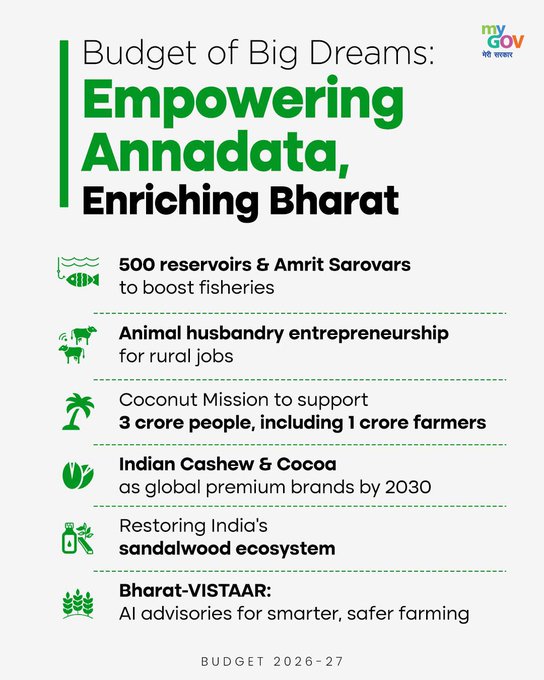
Presenting the Budget in the Lok Sabha, Finance Minister Nirmala Sitharaman announced that the Government will undertake the integrated development of 500 reservoirs and Amrit Sarovars to strengthen the fisheries value chain, particularly in coastal and inland areas. The initiative aims to enhance fish production, improve water conservation and create stronger market linkages by involving start-ups, women-led groups and Fish Farmer Producer Organisations. The measure is designed to integrate primary production with processing, marketing and export channels, thereby reducing post-harvest losses and improving price realisation for fishers.
India has one of the largest networks of inland reservoirs in the world, spanning around 31.5 lakh hectares, offering vast potential for inland fisheries development. Under Mission Amrit Sarovar, 68,827 Amrit Sarovars have already been developed, including 1,222 water bodies linked to fisheries, supporting fish farming, aquatic biodiversity and rural livelihoods. The Budget’s focus on reservoir-based fisheries builds on these efforts, combining water conservation with income generation.
To drive innovation and entrepreneurship, the integrated fisheries value chain initiative will support around 200 start-ups in the sector, with domain experts onboarded to promote technology adoption, enterprise development and modern business practices. In addition, 34 production and processing clusters designated by the Department of Fisheries will benefit directly, enabling cluster-based growth, improved efficiency and stronger linkages between producers and markets. These measures, along with ongoing support to cooperatives and Fish Farmer Producer Organisations under existing schemes, are expected to benefit nearly 50 lakh individuals in coastal areas.
A major export-oriented reform announced in the Budget is the proposal to make fish catch by Indian vessels in the Exclusive Economic Zone and on the high seas duty-free. The landing of such catch at foreign ports will be treated as export of goods, creating new income and market opportunities for Indian fishers operating beyond territorial waters. Safeguards will be put in place to prevent misuse during transit or transshipment. The measure is expected to encourage deep-sea fishing, enhance foreign exchange earnings and expand India’s presence in global seafood markets.
India, with a coastline of over 11,099 kilometres and an Exclusive Economic Zone of approximately 24 lakh square kilometres, supports the livelihoods of more than 50 lakh members of the fishing community across 13 maritime States and Union Territories. Marine fisheries play a critical role in the blue economy, seafood exports and national nutritional security. To ensure sustainability, the Government has already notified the Rules for Sustainable Harnessing of Fisheries in the Exclusive Economic Zone and the Guidelines for Sustainable Harnessing of Fisheries in the High Seas by Indian-flagged Fishing Vessels, 2025, providing a regulatory framework for responsible exploitation of marine resources.
The Budget has also introduced targeted measures to enhance the competitiveness of India’s seafood processing and exports. The limit for duty-free import of specified inputs used for processing seafood products for export has been raised from 1 per cent to 3 per cent. This is expected to reduce input costs for processing units, support compliance with stringent international food safety and quality standards, and improve efficiency across the processing sector. Exporters will gain better access to high-quality inputs required to meet buyer specifications in key markets such as the European Union, the United Kingdom, Japan and South Korea, strengthening India’s position in value-added seafood exports.
Collectively, these Budget measures are expected to promote value addition, product diversification and export growth in the fisheries sector, while generating employment and supporting the socio-economic development of coastal and inland communities. At the same time, the emphasis on sustainability, cluster-based development and regulatory safeguards aims to ensure resilient and responsible growth.
The fisheries sector plays a vital role in India’s economy, supporting nearly three crore livelihoods, particularly among marginalised and coastal communities. Recognised as a sunrise sector, fisheries has recorded sustained growth through focused policy interventions. Since the creation of a dedicated Ministry of Fisheries, Animal Husbandry and Dairying in 2019, cumulative investments of ₹39,272 crore have been made through major schemes including the Blue Revolution, the Fisheries and Aquaculture Infrastructure Development Fund, the Pradhan Mantri Matsya Sampada Yojana, the Pradhan Mantri Matsya Samridhi Sah Yojana and the Kisan Credit Card programme.
The sector has registered an average annual growth rate of 7.87 per cent since 2014–15, the highest among agriculture and allied sectors. Gross Value Added has increased from ₹98,190 crore in 2013–14 to ₹3.41 lakh crore in 2023–24. Fish production has more than doubled over the last decade, reaching a record 197.75 lakh tonnes in 2024–25, driven largely by inland fisheries and aquaculture. Seafood exports have also doubled to ₹62,408 crore, while shrimp production has nearly quadrupled, reflecting rising participation of entrepreneurs, youth and women.
With the Union Budget 2026–27, the Government has signalled a decisive push to unlock the full potential of India’s fisheries sector through investment, reform and sustainability, positioning it as a key contributor to economic growth, exports and livelihoods.