
The Union Budget 2026–27 has announced a comprehensive set of measures to position India as a leading global destination for Medical Value Tourism while significantly strengthening the country’s AYUSH ecosystem through enhanced infrastructure, research, education and international outreach.
Presenting the Budget in Parliament, Union Minister for Finance and Corporate Affairs Nirmala Sitharaman outlined a strategy aimed at integrating traditional systems of medicine with modern healthcare delivery, improving patient experience, generating employment and expanding India’s global footprint in holistic and evidence-based healthcare.
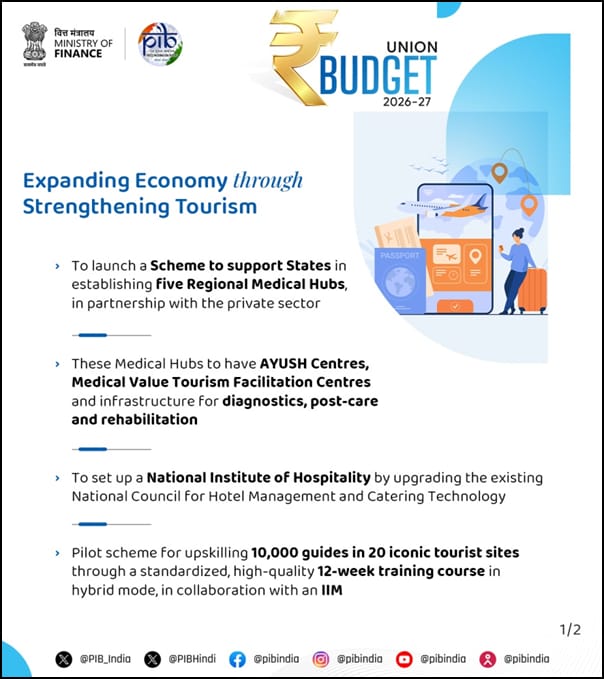
A central feature of the Budget is the proposal to establish five Regional Medical Hubs across the country, to be developed by States in partnership with the private sector. These hubs are envisaged as integrated healthcare complexes that will combine medical services, education and research facilities under a single framework. Designed to cater to both international and domestic patients, the hubs will support India’s growing Medical Value Tourism segment by offering comprehensive treatment and post-treatment solutions.
Each Regional Medical Hub will include dedicated AYUSH Centres, Medical Value Tourism Facilitation Centres and advanced infrastructure for diagnostics, rehabilitation and follow-up care. By bringing multiple healthcare services together, the hubs are expected to improve ease of access, quality of care and overall patient confidence. The initiative is also projected to create wide-ranging employment opportunities for doctors, nurses, allied health professionals and support staff, thereby strengthening the healthcare workforce.
Emphasising the growing global acceptance of India’s traditional systems of medicine, the Finance Minister noted that Yoga gained worldwide recognition after being taken to the United Nations by the Prime Minister, while Ayurveda has seen renewed global interest in the post-pandemic period. Rising international demand for AYUSH products and services has also generated economic benefits for farmers cultivating medicinal plants and for young entrepreneurs engaged in processing and value addition.
To consolidate this momentum, the Budget has announced several targeted initiatives for the AYUSH sector. Three new All India Institutes of Ayurveda will be established to expand capacity in education, clinical services and research, ensuring a steady pipeline of skilled practitioners and researchers. In addition, AYUSH pharmacies and drug testing laboratories will be upgraded to improve quality standards, certification processes and regulatory compliance, thereby enhancing credibility in global markets.
A key institutional measure announced is the upgradation of the WHO Global Traditional Medicine Centre. The enhanced centre will focus on strengthening evidence-based research, training and international collaboration in traditional medicine systems, while promoting greater global awareness and acceptance of AYUSH practices.
Together, these initiatives underline the Government’s intent to integrate traditional knowledge with modern healthcare systems, reinforce quality and research, and leverage India’s strengths in holistic medicine. The measures are expected to enhance India’s soft power, expand medical tourism revenues and establish the country as a trusted global destination for comprehensive, patient-centric and sustainable healthcare.