
The Commission for Air Quality Management has invoked Stage Three of the Graded Response Action Plan across the entire National Capital Region with immediate effect, following a sharp deterioration in air quality and forecasts indicating further worsening conditions in the coming days.
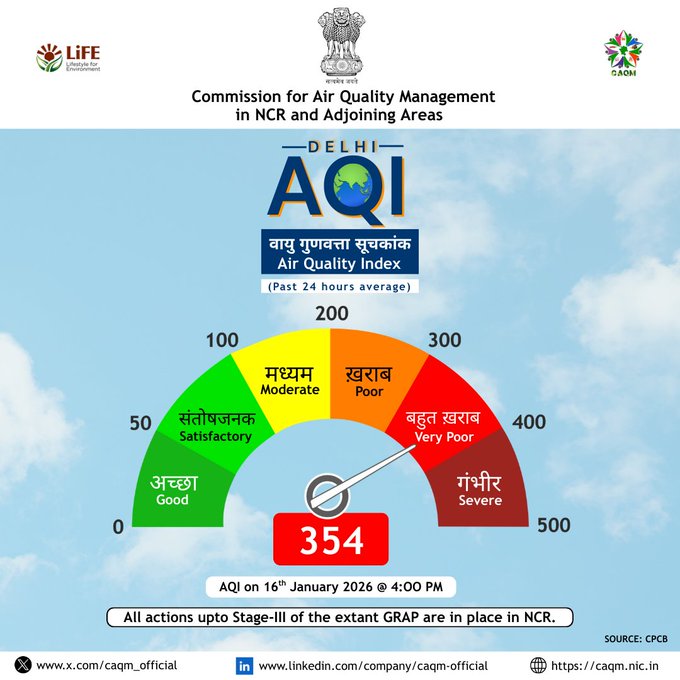
Delhi’s Air Quality Index was recorded at 354 at 4 pm on 16 January 2026, up from 343 at the same time a day earlier, placing it firmly in the very poor category. Forecasts issued by the India Meteorological Department and the Indian Institute of Tropical Meteorology indicate that unfavourable weather conditions, coupled with slow and variable wind speeds, are likely to push average AQI levels beyond 400, entering the severe category.
In view of this rising trend, the Sub Committee on GRAP under the Commission convened a review meeting to assess the prevailing air quality scenario and future outlook. Based on the assessment, the Sub Committee decided to invoke all actions prescribed under Stage Three of the extant GRAP as a preventive measure to arrest further deterioration. These measures are in addition to the actions already in force under Stages One and Two.
All implementing agencies, including Pollution Control Boards across NCR and the Delhi Pollution Control Committee, have been directed to ensure strict and uniform enforcement of Stage Three measures throughout the region.
A nine point action plan under Stage Three of GRAP has come into force across NCR with immediate effect. The measures are as follows:
Construction and demolition activities
(i) Strict restrictions shall be enforced on the following dust generating and air pollution causing activities across NCR:
• Earthwork for excavation and filling including boring and drilling
• Piling works
• All demolition activities
• Laying of sewer lines water lines drainage and electric cabling through open trench systems
• Brick and masonry works
• Operation of ready mix concrete batching plants
• Major welding and gas cutting operations except minor welding for mechanical electrical and plumbing works
• Painting polishing varnishing and similar works
• Cement plaster and other coatings except for minor indoor repairs and maintenance
• Cutting grinding and fixing of tiles stones and flooring materials except for minor indoor repairs
• Road construction activities and major repairs
• Transfer loading and unloading of dust generating materials such as cement fly ash bricks sand murram pebbles and crushed stone
• Movement of vehicles carrying construction materials on unpaved roads
• Transportation of demolition waste
(ii) Construction activities not listed above and which are relatively less polluting may continue subject to strict compliance with dust control norms and construction and demolition waste management rules.
(iii) All construction activities shall be permitted only for the following categories of projects subject to strict compliance with prescribed norms:
(a) Railway services and stations
(b) Metro rail services and stations
(c) Airports and inter state bus terminals
(d) National security and defence projects of national importance
(e) Hospitals and health care facilities
(f) Linear public projects such as highways roads flyovers bridges power transmission distribution pipelines and telecommunications
(g) Sanitation projects including sewage treatment plants and water supply projects
(h) Ancillary activities supporting the above categories
Closure of stone crushers across the entire NCR.
Closure of all mining and associated activities across NCR.
Imposition of strict restrictions on plying of BS Three petrol and BS Four diesel light motor vehicles in Delhi and in Gurugram Faridabad Ghaziabad and Gautam Buddh Nagar.
Persons with disabilities may continue to use such vehicles if specifically adapted for them and used only for personal mobility.
Restriction on plying of Delhi registered diesel medium goods vehicles of BS Four standard or below except those carrying essential commodities or providing essential services.
Prohibition on entry of BS Four diesel light commercial vehicles registered outside Delhi except those carrying essential commodities or providing essential services.
(i) Mandatory conduct of classes for students up to Class Five in hybrid mode in Delhi and in Gurugram Faridabad Ghaziabad and Gautam Buddh Nagar.
(ii) Other NCR states may also consider adopting hybrid classes for students up to Class Five.
The option to attend online classes shall rest with students and guardians wherever available.
NCR state governments and the Delhi government to take a decision on allowing public municipal and private offices to operate at fifty per cent strength with the remaining staff working from home.
The Central Government may take appropriate decisions regarding work from home for its employees.
The Commission has also urged citizens across NCR to cooperate fully with the implementation of GRAP measures and to follow the Citizen Charter advisories. Residents are encouraged to walk or cycle for short distances use public transport or carpool reduce non essential travel avoid use of coal or wood for heating and opt for work from home wherever feasible.
The Sub Committee will continue to closely monitor air quality levels and review the situation periodically to take further decisions based on real time data and forecasts.