
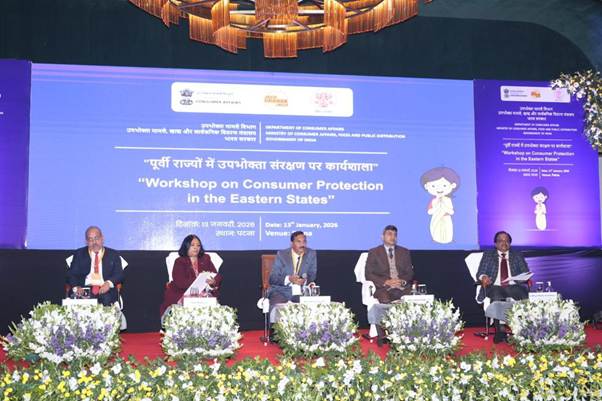
The Department of Consumer Affairs, Government of India, convened a Regional Workshop on Consumer Protection in Patna on 13 January 2026, bringing together senior officials and stakeholders from Bihar, West Bengal, Jharkhand and Odisha to strengthen consumer grievance redressal mechanisms and enhance the functioning of Consumer Commissions through digital transformation.
The workshop focused on reducing case pendency, improving compliance with Consumer Commission orders, leveraging digital tools for faster justice delivery, and addressing emerging challenges such as dark patterns and unfair trade practices in digital markets. The deliberations underscored the Government’s emphasis on building a technology-enabled, transparent and citizen-centric consumer justice system, particularly for eastern states with large rural and geographically dispersed populations.
Delivering the keynote address, Secretary, Department of Consumer Affairs, Nidhi Khare outlined the major reforms undertaken to modernise consumer grievance redressal across the country. She highlighted the expanding role of the National Consumer Helpline NCH 2.0 as a robust pre-litigation platform offering multilingual access, online complaint filing and faster resolution through technology-enabled processes. The platform, she noted, has significantly reduced the need for formal litigation by facilitating early dispute resolution.
She also detailed the nationwide rollout of E Jagriti, the upgraded CONFONET 2.0 platform, which serves as a single integrated digital ecosystem for Consumer Commissions. E Jagriti integrates e Daakhil, online case management, video conferencing, data dashboards and artificial intelligence-based tools to create an end-to-end digital workflow for consumer cases. According to the Secretary, the platform marks a decisive shift from fragmented systems to a transparent, efficient and real-time digital environment, enabling improved monitoring, accountability and quicker disposal of cases.
Emphasising the relevance of digital platforms for eastern states, she noted that tools such as video hearings, automated case management and performance dashboards can substantially improve access to consumer justice in rural and remote districts of Bihar, Jharkhand and Odisha. She urged State and District Consumer Commissions to fully adopt these technologies to minimise delays and ensure timely execution of consumer orders.
The workshop also addressed broader policy issues linked to consumer welfare and price stability. Nidhi Khare highlighted the growing shift in household consumption from cereals to pulses and stressed the need to strengthen domestic production and procurement. Referring to Bihar’s agricultural potential, she pointed to opportunities for expanding pulses cultivation and structured procurement, including dalhan procurement. She noted that India continues to import pulses such as arhar, chana and urad from countries including Myanmar, Australia and Brazil, underlining the importance of building domestic capacity while safeguarding farmer interests through MSP-based procurement mechanisms.
Chief Secretary of Bihar Pratyaya Amrit, in his address, welcomed the focus on digital governance reforms and said such initiatives are essential for future-ready administration. He emphasised that citizens should be viewed not only as beneficiaries but as informed consumers entitled to transparency, fair treatment and timely redressal. He expressed confidence that initiatives like E Jagriti and discussions on emerging issues such as dark patterns would translate into tangible improvements on the ground. He assured that the recommendations of the workshop would be implemented by the Government of Bihar and reaffirmed the State’s alignment with the national vision of Viksit Bharat 2047.
The workshop featured four focused technical sessions addressing key aspects of consumer protection and justice delivery:
Technical Session I: E Jagriti Advancing Consumer Justice Through Digital Innovation
This session examined the digital transformation of Consumer Commissions, highlighting technology-enabled case management, hybrid hearings, real-time dashboards and performance monitoring to enhance efficiency and transparency.
Technical Session II: Ensuring Speedy Disposal Best Practices for Minimizing Adjournments
Participants discussed procedural reforms, judicial time management and technology-driven scheduling mechanisms aimed at expediting case disposal and reducing avoidable adjournments.
Technical Session III: Ensuring Compliance Effective Execution of Consumer Commission Orders
The session focused on strengthening post-order enforcement through institutional coordination, improved monitoring mechanisms and inter-departmental collaboration to ensure effective execution of consumer judgments.
Technical Session IV: Dark Patterns and Consumer Protection in Digital Markets
This session addressed emerging risks in e-commerce and digital services, including misleading user interfaces and manipulative practices, stressing the need for regulatory preparedness and adjudicatory capacity to protect consumers in digital markets.
Parallel sessions were also conducted on Legal Metrology reforms, including E Maap and the Jan Vishwas Bill, as well as on procurement strategies and market intervention measures for price stabilisation.
The workshop was inaugurated by Chief Secretary of Bihar Pratyaya Amrit and Secretary, Food and Consumer Protection Department, Government of Bihar Abhay Kumar Singh. The inaugural session concluded with a vote of thanks by Additional Secretary, Department of Consumer Affairs Anupam Mishra.
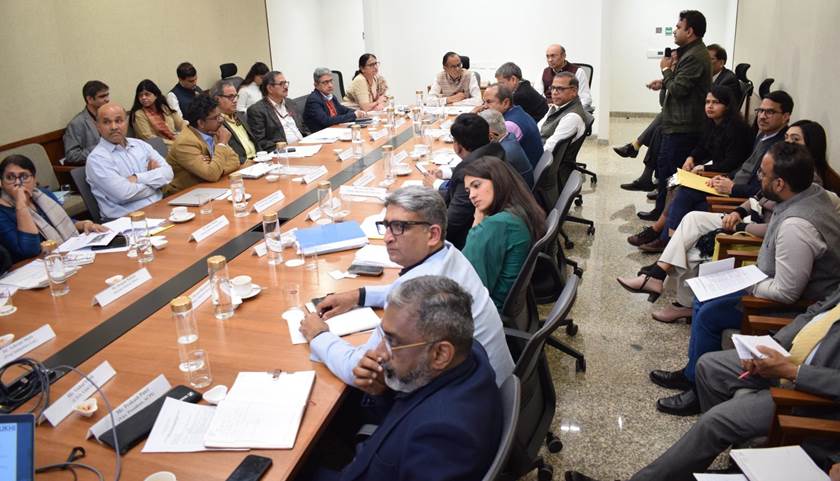
Participants included Principal Secretaries and Secretaries from Consumer Affairs and Agriculture Departments, Presidents, Members and Registrars of State and District Consumer Commissions, senior state officials, NIC representatives, the Chairman and Managing Director of NCCF, and representatives of voluntary consumer organisations.
The workshop concluded with a collective commitment to accelerate digital adoption, strengthen institutional capacity, ensure effective execution of consumer orders and deepen inter-state cooperation. The Department of Consumer Affairs reaffirmed its continued support to Bihar, West Bengal, Jharkhand and Odisha in building a fast, accessible and technology-driven consumer justice ecosystem.