
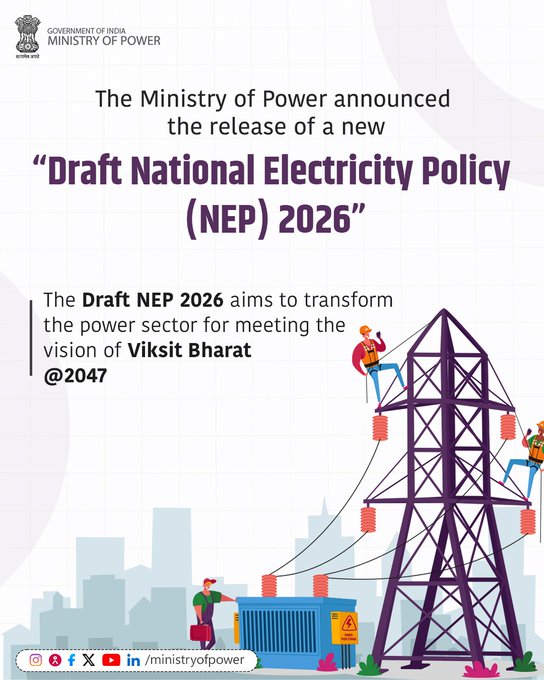
The Ministry of Power has released the Draft National Electricity Policy 2026 for public consultation, outlining a comprehensive roadmap to transform India’s power sector in line with the vision of Viksit Bharat 2047. The draft policy, once finalised, will replace the existing National Electricity Policy notified in 2005.
The first National Electricity Policy, issued in February 2005, focused on addressing core challenges such as demand supply gaps, limited access to electricity and inadequate infrastructure. Since then, India’s power sector has undergone far reaching transformation. Installed generation capacity has increased nearly fourfold with substantial private sector participation, universal household electrification was achieved by March 2021, a unified national grid became operational in December 2013, and per capita electricity consumption reached 1,460 kilowatt hours in 2024–25. The emergence of power markets and exchanges has further improved efficiency and flexibility in power procurement.
Despite this progress, structural challenges persist, particularly in the distribution segment. High accumulated losses, outstanding debt, non cost reflective tariffs and heavy cross subsidisation continue to affect the financial health of utilities and raise industrial tariffs, impacting the global competitiveness of Indian industry.
Against this backdrop, the Draft National Electricity Policy 2026 sets ambitious targets and reforms. It envisages per capita electricity consumption of 2,000 kilowatt hours by 2030 and more than 4,000 kilowatt hours by 2047. The policy also aligns with India’s climate commitments, including a 45 percent reduction in emissions intensity from 2005 levels by 2030 and the goal of net zero emissions by 2070, requiring a decisive shift towards low carbon energy pathways.
The draft policy proposes a wide range of structural and regulatory interventions across the power value chain.
Major interventions proposed in Draft National Electricity Policy 2026
Resource adequacy
Distribution companies and State Load Despatch Centres will prepare advance resource adequacy plans at utility and state levels in accordance with state commission regulations. The Central Electricity Authority will prepare a corresponding national plan to ensure adequacy at the national level.
Financial viability and economic competitiveness
Tariffs are proposed to be linked to suitable indices for automatic annual revision if tariff orders are not issued by state commissions. Fixed costs are to be progressively recovered through demand charges to reduce cross subsidisation across consumer categories. Cross subsidies and surcharges on manufacturing industry, railways and metro railways are proposed to be exempted to enhance economic competitiveness and reduce logistics costs. Regulatory commissions may exempt distribution licensees from universal service obligation for consumers with contracted load of one megawatt and above. The policy also proposes strengthening dispute resolution mechanisms to enable faster resolution and reduce financial burden on consumers.
Renewable energy generation and storage
Renewable capacity addition is proposed through market based mechanisms and captive power plants. Distribution licensees may install storage on behalf of small consumers to enable economies of scale, while bulk consumers may install storage themselves to support distributed renewable energy. Trading of surplus energy from distributed renewables and storage through peer to peer mechanisms or aggregators is proposed. Parity between renewable and conventional sources in scheduling and deviation is targeted by 2030. Market based deployment of storage, promotion of battery energy storage systems, domestic manufacturing of storage components and demand side incentives such as viability gap funding for battery and pumped storage projects are proposed.
Thermal generation
Integration of storage with thermal plants and repurposing of older units for grid support is proposed to enable higher renewable integration. The draft also explores direct utilisation of steam from thermal plants for district cooling or industrial processes to improve efficiency.
Nuclear generation
In line with the SHANTI Act 2025, the policy proposes adoption of advanced nuclear technologies, development of modular and small reactors and use of nuclear power by commercial and industrial consumers, targeting 100 gigawatt nuclear capacity by 2047.
Hydro generation
Accelerated development of storage based hydroelectric projects is proposed for flood moderation, irrigation support, water security and energy security.
Power markets
The draft emphasises a strong regulatory framework for market monitoring and surveillance to prevent collusion, gaming and market dominance.
Transmission
Adoption of advanced technologies and appropriate compensation mechanisms are proposed to address right of way challenges. Parity of transmission tariffs for renewable energy with conventional power is targeted by 2030. A utilisation based framework for allocation of transmission connectivity is proposed to prevent speculative holding.
Distribution
The policy targets reduction of aggregate technical and commercial losses to single digit levels. Shared distribution networks are proposed to enhance competition and efficiency while avoiding duplication. Establishment of a Distribution System Operator is envisaged to facilitate network sharing, integration of distributed renewables, storage and vehicle to grid systems. N minus one redundancy at distribution transformer level is proposed in cities with population above ten lakh by 2032, along with undergrounding of networks in congested urban areas.
Grid operations
Functional unbundling of State Transmission Utilities is proposed, with creation of independent state level entities for State Load Despatch Centre operations and transmission planning. Alignment of state grid codes with the Indian Electricity Grid Code specified by the Central Electricity Regulatory Commission is also proposed.
Cybersecurity
The draft policy calls for establishment of a robust cybersecurity framework and mandatory storage of power sector data within India to ensure data sovereignty and system resilience.
Data sharing
Sharing of operational and market data under a framework prescribed by the Central Government is proposed, along with real time visibility of distributed energy resources to distribution companies and State Load Despatch Centres.
Technology and skill development
The policy targets transition to indigenously developed SCADA systems by 2030 and development of domestic software solutions for all critical power system applications.
With these measures, the Draft National Electricity Policy 2026 presents a comprehensive blueprint for building a future ready, financially viable and environmentally sustainable power sector, capable of delivering reliable and affordable electricity to support India’s long term development goals under Viksit Bharat 2047.