
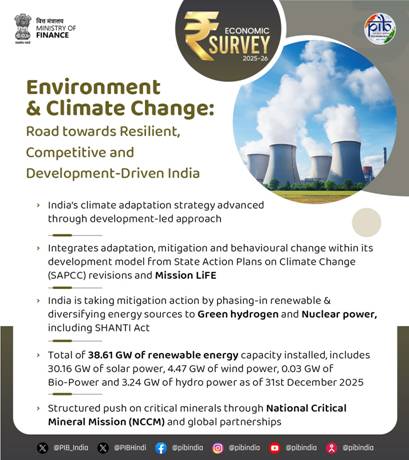
India has adopted a development centred and whole of economy climate strategy that integrates adaptation mitigation and behavioural change within its growth model while prioritising human welfare and macroeconomic stability the Economic Survey 2025–26 said. The Survey was tabled in Parliament by Union Minister for Finance and Corporate Affairs Smt Nirmala Sitharaman.
The Survey said the global climate agenda has reached an inflexion point where ambitious targets face operational constraints capacity gaps and systemic risks. It cautioned that introducing complex systems without buffers redundancy and institutional capacity can weaken resilience and argued that development itself is a powerful form of climate adaptation. For India sustained growth rising living standards and affordable reliable electricity are central to climate action and must be pursued as a comprehensive energy system strategy rather than as isolated climate policy.
Adaptation Anchored In Development
India’s climate adaptation approach is being advanced primarily through development led public investment across core sectors. Domestic spending on adaptation and resilience related activities rose from 3.7 per cent of GDP in FY16 to 5.6 per cent of GDP in FY22. The National Action Plan on Climate Change with its nine missions provides the overarching framework with several missions focused on adaptation including sustainable agriculture and water management.
The Survey said national frameworks provide policy coherence finance and institutional mechanisms while States operationalise actions through sectoral programmes and local institutions. State Action Plans on Climate Change translate national objectives into actionable interventions. As cities expand rapidly the Survey stressed the need to embed climate risk into urban planning infrastructure and service delivery.
Mitigation Through A Balanced Energy Transition
India is pursuing mitigation through diversification of energy sources higher efficiency and a rising share of non fossil fuels while ensuring system stability and energy security. The Survey noted risks seen in parts of Europe where transitions outpaced investments in baseload power transmission and flexibility. India’s approach spans solar wind nuclear green hydrogen battery storage and bioenergy alongside attention to material availability and storage challenges.
India has surpassed the milestone of 50 per cent installed power capacity from non fossil sources which stood at 51.93 per cent at the end of December 2025 supported by record renewable additions. Complementary initiatives include the National Nuclear Mission the Green Hydrogen Mission and the Bio Energy Programme. The Survey identified material supply chains and storage as key constraints to further scale up.
Critical Minerals Shape The Transition
The Survey underscored that the energy transition is increasingly constrained by control over critical minerals such as lithium cobalt nickel copper and rare earths. India’s strategy balances domestic capability building under the National Critical Mineral Mission with international partnerships including the Minerals Security Partnership and the Indo Pacific Economic Framework. Khanij Bidesh India Ltd has acquired 15,703 hectares in Argentina for lithium mining and is pursuing partnerships in Australia and Chile.
In December 2025 India adopted the Sustainable Harnessing and Advancement of Nuclear Energy for Transforming India Act enabling private participation in operations manufacturing and research for peaceful uses of atomic energy.
Carbon Markets And Behavioural Change
The Carbon Credit Trading Scheme adopted in June 2023 is moving from framework to implementation through a dual mechanism combining mandatory compliance and voluntary offsets building on the Perform Achieve and Trade infrastructure. Non obligated entities can register projects to earn carbon credits incentivising mitigation beyond the compliance perimeter.
Mission LiFE Lifestyle for Environment introduced in 2021 links individual and community behaviour with climate outcomes and is described as the behavioural foundation of India’s climate strategy aligning schemes with consumption and lifestyle shifts.
Financing Climate Action Without Fragility
The Survey highlighted a widening global climate finance gap estimated at USD 4 trillion with developing countries most affected. Domestic sources account for around 83 per cent of India’s mitigation finance and 98 per cent of adaptation finance while global flows remain biased towards developed economies and mature sectors.
India’s two pronged strategy focuses on strengthening domestic financial systems and deepening bond markets. Institutions including IREDA NABARD SIDBI Power Finance Corporation and Rural Electrification Corporation support project preparation and bankability. SEBI’s Business Responsibility and Sustainability Reporting framework green bond guidelines and IFSCA’s sustainability linked lending guidance have improved disclosures and investor confidence.
Bond markets are critical for long tenor climate infrastructure. Sovereign green bonds have been used to fund low carbon public assets with cumulative issuance reaching Rs 72,697 crore since FY23 including Rs 15,000 crore in FY26. Urban local bodies including Indore Ghaziabad Ahmedabad and Vadodara have issued municipal green bonds aligned with SEBI norms with potential to unlock USD 2.5–6.9 billion over the next decade. India’s greenium remains intermittent reflecting market design liquidity and credibility.
The Survey called for reform of multilateral development banks towards balance sheet optimisation and risk sharing to mobilise private capital for the Global South using guarantees insurance and blended finance.