
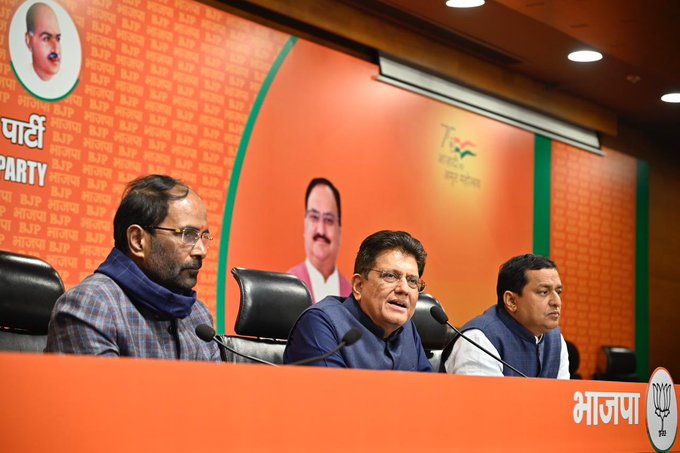
India’s higher education sector holds immense potential to emerge as a major contributor to the country’s export earnings through education services while positioning India as a global destination for quality learning, Union Minister of Commerce and Industry Piyush Goyal said on 6 March 2026.
Addressing the Vice Chancellors Conclave on Reimagining Internationalisation of Higher Education for Viksit Bharat 2047 in New Delhi, Piyush Goyal highlighted the strategic importance of education as a service sector capable of expanding India’s global footprint while strengthening the country’s knowledge economy. The conclave was organised to facilitate dialogue among academic leaders, policymakers and institutions on enhancing the internationalisation of India’s higher education ecosystem.
The minister said that education services represent a significant opportunity for India to increase export earnings while showcasing the country’s academic strengths to the world. He welcomed the initiative taken by the Ministry of Commerce and the Indian Institute of Foreign Trade to examine the global potential of education services and to develop strategies that could help Indian institutions expand their international engagement.
Piyush Goyal noted that the conclave provided an important platform for discussions on international academic partnerships, student mobility, regulatory frameworks and the development of dual degree programmes. Participants also examined emerging trends in global education mobility and explored ways to strengthen the competitiveness of Indian higher education institutions in the global education services market.
Emphasising the changing dynamics of global growth, the minister said developing nations such as India are likely to emerge as the future engines of the world economy. In this context, exposure to India would benefit students from developed countries as they prepare for careers in an increasingly interconnected global economy.
He pointed out that India’s rising economic influence is already reflected in the services chapters of several Free Trade Agreements negotiated by the government. According to him, the nine Free Trade Agreements finalised under the government led by Prime Minister Narendra Modi have largely been concluded with developed economies. These agreements collectively account for nearly two thirds of global trade coverage for India, reflecting a shift in India’s engagement with global markets.
Piyush Goyal observed that India now negotiates trade agreements with confidence and from a position of strength rather than from a defensive or colonial mindset. He said that with India currently contributing nearly 20 percent of global economic growth, the younger generation across the world will increasingly need to engage with and understand countries such as India.
The minister highlighted that a comprehensive reform of India’s education system was undertaken through the formulation of the National Education Policy 2020, which was developed through extensive consultations with educationists and stakeholders across the country and abroad. Nearly three lakh inputs and suggestions were received during the drafting process and were carefully evaluated before finalising the policy framework.
He said the policy has opened new pathways for Indian institutions to aspire to global standards in higher education and expand their international collaborations. The policy allows international universities to establish campuses in India and encourages partnerships between foreign and Indian institutions to offer joint and dual degree programmes.
The minister also underlined the importance of cross border student exchanges that allow Indian students to gain exposure to global education systems while enabling international students to experience India’s academic environment, cultural diversity and societal dynamics.
Piyush Goyal suggested innovative academic models that could attract international students to India, including programmes where students from developed countries spend part of their academic tenure in India while completing the rest of their studies in their home institutions. Such programmes, he said, would allow students to better understand the economic, cultural and social realities of developing nations.
Addressing the academic leadership present at the conclave, the minister described vice chancellors as architects of the country’s future. He said they play a vital role in shaping the intellectual capacity of young Indians and preparing them to address emerging global challenges.
He emphasised that educational institutions must evolve continuously in response to changing technological and economic realities. Teachers and academic leaders must undertake retraining and continuous learning to remain aligned with modern curriculum requirements and future oriented knowledge systems.
The minister stressed that students cannot be adequately prepared for the future through outdated academic frameworks. Universities must remain agile and update their curricula to reflect emerging opportunities in global trade, technology and innovation.
Highlighting the increasing relevance of technology in economic growth, Piyush Goyal said sectors such as artificial intelligence, quantum computing and machine learning will play a decisive role in shaping the future global economy. Educational institutions must integrate these fields into their teaching frameworks if India is to sustain its growth trajectory and emerge as a global technology powerhouse.
He also urged institutions to introduce subjects such as international trade and Free Trade Agreements into their academic programmes so that students understand the opportunities available in the global marketplace.
Piyush Goyal expressed confidence that as Indian universities adopt modern teaching methodologies, upgrade their infrastructure and align their curricula with global standards, more Indian students will choose to pursue higher education within the country instead of studying abroad. At the same time, India will increasingly attract international students.
He said that the current ratio of approximately 28 Indian students studying abroad for every one international student studying in India should be reversed in the coming years. India, he added, has the potential to attract around 1.3 million foreign students to its institutions while significantly reducing the outflow of Indian students seeking education overseas.
The minister concluded by calling for stronger collaboration among academia, government and industry to realise the vision of internationalising India’s higher education system and transforming the country into a global education destination by 2047.
Rakesh Mohan Joshi said the conclave created a collaborative platform for academic leaders to reflect on strategies that would expand India’s global engagement in education while contributing to the national vision of Viksit Bharat 2047. He noted that India has the capacity to emerge as a global hub for quality education and that initiatives such as the Vice Chancellors Conclave would help catalyse partnerships and dialogue for strengthening the internationalisation of Indian higher education.
The event was attended by several prominent academic leaders including Prem Vrat, Santishree Dhulipudi Pandit, T G Sitharam and Anil Sahasrabudhe. Representatives from leading institutions such as Indian Institutes of Management, Jawaharlal Nehru University, Jamia Millia Islamia, University of Southampton, Jamia Hamdard, Central University of Tamil Nadu, North Eastern Hill University, Dr B R Ambedkar University Delhi and Netaji Subhas University of Technology also participated in the discussions along with senior policymakers and global academic representatives.