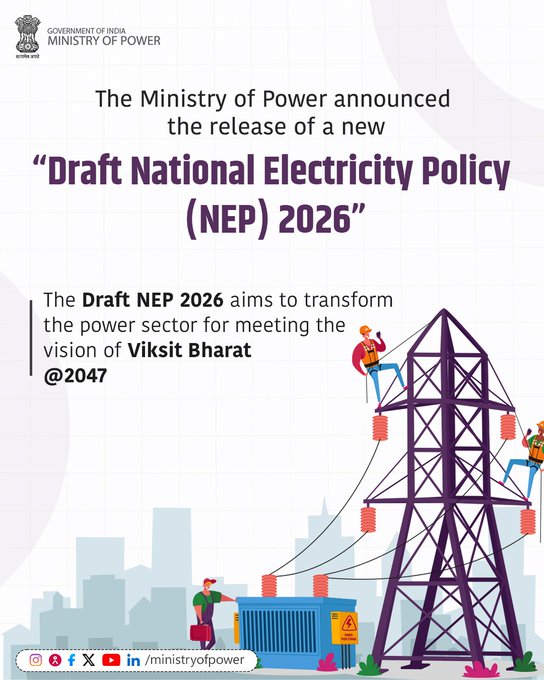

The Government of India has amended the Electricity Rules to strengthen the regulatory framework governing captive power generation, a move aimed at improving ease of doing business, supporting industrial competitiveness and facilitating the transition towards cleaner energy sources.
The Electricity Amendment Rules 2026 modify Rule 3 of the Electricity Rules 2005 relating to Captive Generating Plants. The changes seek to remove interpretational ambiguities, simplify compliance procedures and align the captive power framework with evolving industrial and energy requirements.
Captive power generation has been a key provision under the Electricity Act 2003, enabling industries to generate electricity for their own consumption. The National Electricity Policy 2005 recognised captive generation as an important mechanism to ensure reliable and cost effective power supply for industries, allowing them to manage supply constraints and reduce electricity cost volatility.
Government officials said the amendments are intended to provide greater clarity and flexibility in the framework governing captive power plants so that industries can more easily establish and operate captive generation facilities.
The changes also recognise the increasing shift by industries towards non fossil fuel based energy sources as part of their sustainability commitments and cost optimisation strategies.
Encouraging electricity generation closer to the point of consumption is also expected to reduce transmission losses, improve system efficiency and strengthen the resilience of the power grid.
The amendments have been finalised following extensive consultations with stakeholders from the power sector and industry.
Key features of the amended rules
• Clear ownership definition
Ownership provisions have been clarified to include subsidiaries, holding companies and other subsidiaries of the holding company of the entity establishing the captive generating plant. This recognises modern corporate structures in which power projects are often developed through group entities or special purpose vehicles.
• Uniform verification period
Verification of captive status will now be carried out for the entire financial year to ensure consistency in implementation. For the first or last year of ownership, verification may be conducted for the relevant portion of the financial year.
• Flexibility for association of persons projects
Greater operational flexibility has been introduced for group captive projects established through an Association of Persons. Captive users will be allowed to draw power based on operational requirements while meeting statutory ownership and consumption conditions.
Consumption exceeding the proportionate entitlement of an individual user will not lead to disqualification of captive status for the plant, although such excess consumption will not be counted as individual captive consumption.
Where a member of the association holds 26 percent or more ownership, the proportionate consumption requirement will not apply to that entity and its entire consumption will be treated as captive consumption.
For calculation of proportionate consumption, a captive user along with its subsidiaries, holding company and other subsidiaries of the holding company will be treated as a single entity.
• Nodal agencies for verification
From April 1, 2026, state or union territory governments may designate nodal agencies for verification of captive status in cases of intra state consumption. For inter state captive consumption, verification will be undertaken by the National Load Despatch Centre.
A grievance redressal committee will also be constituted by the appropriate government to address disputes arising from verification decisions.
• Cross subsidy surcharge provisions
Pending verification of captive status, cross subsidy surcharge and additional surcharge will not be levied if captive users submit the prescribed declaration in accordance with procedures issued by the National Load Despatch Centre or the state nodal agency.
If a plant later fails to qualify as a captive generating plant after verification, the applicable charges will become payable along with carrying cost calculated at the base rate of late payment surcharge under the Electricity Late Payment Surcharge and Related Matters Rules 2022.
• Implementation timeline
Certain provisions relating to proportionate consumption in association of persons structures, the verification framework and surcharge treatment will take effect from April 1, 2026, while other amendments have come into force immediately.
The government said the reforms are expected to encourage greater investment in captive and non fossil fuel based power projects while enabling industries to access reliable and cost competitive electricity.
The amendments are also aligned with the broader policy objective of strengthening industrial growth, promoting energy self reliance and supporting India’s long term goal of achieving a developed economy by 2047.