
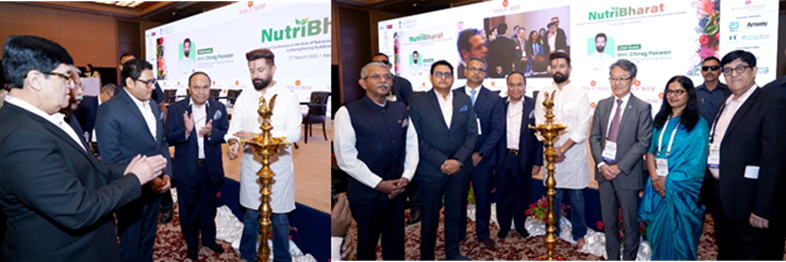
Union Minister of Food Processing Industries Chirag Paswan on Monday called for a strategic transformation of India’s food processing and nutraceutical sectors, urging industry stakeholders to align their growth trajectory with the national goal of achieving nutrition security and building a developed nation by 2047.
Addressing the NutriBharat 2026 National Conference on the Role of Nutraceuticals and Functional Foods in Strengthening Nutrition Security, organised by ASSOCHAM, Chirag Paswan stressed that India has successfully transitioned from food scarcity to food security, and must now focus on ensuring nutrition security for its population.
He said the next phase of development must ensure that citizens, especially future generations, have access to safe, nutritious and high quality food products that address both malnutrition and lifestyle related health challenges. The Minister emphasised that the food processing industry will play a pivotal role in strengthening the country’s nutrition ecosystem and improving public health outcomes.
Chirag Paswan urged stakeholders to develop a clear and time bound roadmap for the sector, outlining milestones for one year, five years and ten years. He called for coordinated efforts between industry, policymakers and regulators to unlock the full potential of nutraceuticals and functional foods in addressing nutritional deficiencies.
Highlighting the importance of quality and global competitiveness, he cautioned that even a single rejected consignment at an international port could adversely impact India’s reputation in global markets. He stressed that adherence to international standards, strict quality control and responsible manufacturing practices must remain non negotiable as India expands its footprint in global food trade.
The Minister also underlined India’s potential to emerge as a global food basket, supported by its strong agricultural base, expanding processing capacity and growing international partnerships. However, he noted that achieving this vision would require sustained innovation, strong regulatory frameworks and a commitment to consumer trust.
Nirmal K Minda, President of ASSOCHAM, highlighted the need to address micronutrient deficiencies and rising lifestyle related diseases through greater collaboration between industry and policymakers. He stressed that strengthening India’s nutrition ecosystem requires integrated efforts across agriculture, processing and health sectors.
Takayuki Hagiwara, FAO Representative in India, pointed to the increasing global importance of nutraceuticals in bridging nutritional gaps and called for the development of resilient and innovative agri food systems that can deliver better nutrition outcomes.
Vivek Chandra, Chairman of ASSOCHAM Food Processing and Value Addition Council, said India is well positioned to become a global hub for processed foods that are aligned with nutrition priorities, provided the sector focuses on quality, scalability and global standards.
Alka Rao, Advisor Science Standards and Regulations at FSSAI, emphasised the importance of science based regulations and highlighted ongoing efforts to develop robust regulatory frameworks for nutraceuticals and functional foods in line with international benchmarks.
Vikram Kelkar, Co Chairman of the Council and Managing Director of Hexagon Nutrition Limited, noted that India’s traditional knowledge systems, including Ayurveda, combined with modern research capabilities, offer a unique advantage in positioning the country as a global leader in nutraceuticals.
Amit Vatsyayan, Partner and Social Sector Leader at EY India, stressed the need for a science driven and agriculture linked nutrition ecosystem supported by digital traceability, strong quality standards and closer partnerships with farmers to ensure the production of globally trusted nutrition products.
During the conference, a joint knowledge paper titled NutriBharat 2047 India’s Nutritional Transition through Nutraceuticals and Functional Foods was released by EY and ASSOCHAM. The report outlines a roadmap for transitioning from a food security approach to a comprehensive nutrition for all framework, focusing on innovation, regulatory alignment and ecosystem development.
The conference brought together policymakers, regulators, industry leaders, researchers and international organisations to deliberate on innovation, regulatory challenges, research collaboration and global opportunities in the nutraceutical and functional food sectors.