
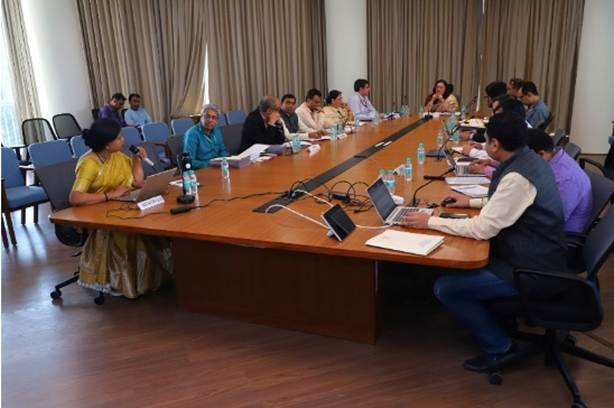
The Ministry of Tribal Affairs has concluded a high level consultative workshop with key line ministries to strengthen convergence driven livelihood frameworks for tribal communities under the Dharti Aaba Janjatiya Gram Utkarsh Abhiyan, a flagship initiative aimed at accelerating inclusive development in tribal regions.
The workshop brought together senior officials and domain experts from the Ministry of Agriculture and Farmers Welfare, the Department of Animal Husbandry and Dairying, the Ministry of Food Processing Industries, the Ministry of New and Renewable Energy and the Department of Fisheries. The deliberations focused on improving the implementation architecture of livelihood interventions and building a coordinated development framework for tribal households.
The initiative is being implemented under the guidance of Jual Oram, Union Minister of Tribal Affairs, and is aligned with the vision of Narendra Modi for holistic and saturation based development of tribal communities. Officials said the programme reflects the government’s commitment to creating sustainable livelihood opportunities and strengthening inclusive growth in tribal dominated regions.
Dharti Aaba Janjatiya Gram Utkarsh Abhiyan represents a shift in tribal development strategy from fragmented programme delivery to a comprehensive community centred and empowerment driven model. The initiative was launched by Narendra Modi on 2 October 2024 in Hazaribagh, Jharkhand, and seeks to bring together the efforts of 17 line ministries and 25 interventions across 63,843 tribal majority villages. The programme is designed to benefit approximately 5.5 crore tribal citizens across the country.
During the consultative workshop, participants examined operational challenges and discussed strategies to develop a structured and outcome driven approach to livelihood planning. The discussions focused on designing standardized and financially viable packages of practices that clearly define eligibility criteria, unit costs, implementation phases, convergence pathways and expected income improvements.
Officials explored integrated livelihood models covering agriculture, small livestock rearing, fisheries development and renewable energy supported micro enterprises. The workshop emphasised the need to move beyond isolated asset distribution and instead develop holistic livelihood ecosystems supported by institutional services, training and market linkages.
The Ministry of Tribal Affairs highlighted the importance of aligning financial and programme resources across sectors so that state governments can implement coherent and well phased development plans. Inputs gathered during the consultations will contribute to the development of a unified monitoring and assessment framework for the Dharti Aaba Janjatiya Gram Utkarsh Abhiyan.
Officials also noted that livelihood interventions in tribal areas must be adapted to local ecological conditions and socio economic realities. Many tribal regions face challenges such as low agricultural productivity, limited extension services and weak market integration. The proposed integrated livelihood architecture aims to address these issues by strengthening income diversification and building sustainable economic ecosystems.
Ranjana Chopra, Secretary in the Ministry of Tribal Affairs, said the workshop marked an important step in institutionalising cross sector collaboration for sustainable tribal livelihoods. She emphasised that coordinated efforts among ministries will help ensure that tribal households receive structured and scalable support rather than fragmented interventions.
Ranjana Chopra also highlighted the need to strengthen coordination between the Ministry of Tribal Affairs and agriculture allied ministries through joint advisories to states. She noted that states should proactively identify innovative and locally relevant proposals tailored to Scheduled Tribe communities, including initiatives that link Forest Rights Act lands, fisheries resources, livestock systems and traditional agro ecological practices with sustainable income generation.
The ministry stated that the convergence driven approach would enable measurable improvements in livelihood security and income generation, particularly in remote tribal areas where economic vulnerabilities remain significant. The outcomes of the workshop will help states adopt uniform yet locally adaptable livelihood models within the Dharti Aaba Janjatiya Gram Utkarsh Abhiyan framework.
Participants also emphasised the need for stronger coordination with key line departments such as agriculture and fisheries to ensure continuous technical support for tribal livelihood initiatives. Officials stressed the importance of developing integrated livelihood clusters capable of generating long term resilience and reliable income streams.
Following the consultations, the participating ministries agreed to work closely with the Ministry of Tribal Affairs to refine intervention templates and strengthen cross sector coordination mechanisms. Based on the workshop outcomes, states will receive detailed guidance to prepare annual action plans that integrate multiple sectoral schemes more effectively.
The ministry said the structured framework under Dharti Aaba Janjatiya Gram Utkarsh Abhiyan will support improved field level convergence, more predictable fund flows and stronger monitoring of income related outcomes for tribal households.
Officials emphasised that the convergence driven livelihood strategy aligns with the national development vision of building an inclusive and self reliant economy by 2047, placing economic empowerment and social inclusion of tribal communities at the centre of India’s development journey.