
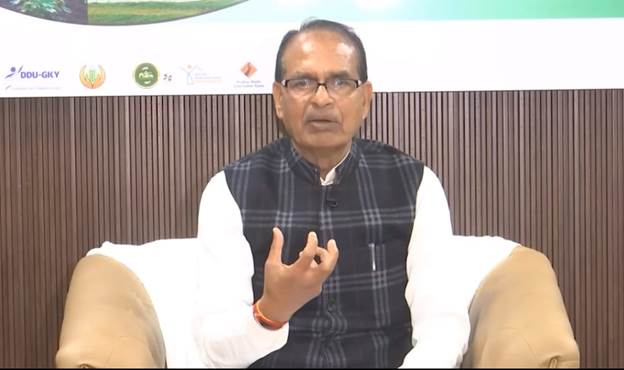
Union Minister for Agriculture and Farmers Welfare and Rural Development Shivraj Singh Chouhan on Tuesday presented a comprehensive account of the government’s rural development and welfare initiatives in the Rajya Sabha, asserting that under the leadership of Prime Minister Narendra Modi, India has developed a new model focused on upliftment of the poor, empowerment of women and transformation of villages.
In a detailed address lasting over one and a half hours, Shivraj Singh Chouhan underscored that the government’s policy framework continues to draw inspiration from Mahatma Gandhi’s ideals, particularly the emphasis on reaching the last person in the queue. He said these principles are deeply embedded in governance and reflected across flagship programmes aimed at inclusive growth and social equity.
Highlighting rural employment, the Minister described Viksit Bharat G RAM G as an upgraded and strengthened version of MGNREGA, designed to balance the interests of farmers and labourers. The scheme provides a statutory guarantee of 125 days of employment, enhanced wage provisions, unemployment allowance and legal safeguards including interest payments in case of delays. He informed the House that the Central Government has made a record budgetary allocation of 95692 crore rupees for the scheme as the Centre’s share.
Addressing concerns raised by opposition members regarding funding patterns, Shivraj Singh Chouhan stated that multiple states including Jharkhand Kerala Punjab Jammu and Kashmir Himachal Pradesh Mizoram Tamil Nadu Telangana Uttar Pradesh Chhattisgarh Madhya Pradesh Bihar Rajasthan Andhra Pradesh Odisha Assam Meghalaya Gujarat Tripura Haryana Nagaland Arunachal Pradesh Uttarakhand Sikkim Goa and Maharashtra have made provisions for the scheme in their respective budgets. He said this reflects broad national acceptance of the programme across political lines.
Expanding on welfare initiatives, the Minister detailed a wide spectrum of schemes that have contributed to socio economic transformation. Under Pradhan Mantri Awas Yojana, crores of permanent houses have been constructed for the poor. More than 11 crore toilets have been built under sanitation programmes, while crores of LPG connections have been distributed through the Ujjwala scheme. Tap water access has been expanded under Har Ghar Jal, and healthcare coverage of up to 5 lakh rupees is being provided through Ayushman Bharat.
He further noted that affordable medicines are being distributed through Jan Aushadhi centres, while over 80 crore people are benefiting from free ration schemes. The government has also facilitated financial inclusion through more than 52 crore Mudra loans and expanded social security through initiatives such as Atal Pension Yojana, PM Garib Kalyan programmes and Kisan Samman Nidhi. Skill India initiatives continue to focus on enhancing employability and entrepreneurship across rural and semi urban regions.
On women’s empowerment, Shivraj Singh Chouhan emphasised the growing impact of the Lakhpati Didi initiative, stating that crores of women are advancing economically through self help groups. Supported by bank linkages and entrepreneurial opportunities, women are participating in initiatives such as Drone Didi Krishi Sakhi Bank Sakhi and Pashu Sakhi. He said the government has set a target of creating six crore Lakhpati Didis, reflecting a large scale push towards financial independence and social empowerment of women.
The Minister highlighted that women who were once engaged in small scale activities are now contributing to leadership roles across institutions ranging from Panchayats to national platforms, signalling a structural shift in gender participation in the economy.
Responding to allegations related to the stoppage of MGNREGA funds in West Bengal, Shivraj Singh Chouhan clarified that the decision was based on administrative and legal grounds rather than political considerations. He cited findings from inspections and social audits that revealed serious irregularities including use of machines instead of labour, contractor driven execution of works, fake job cards, fake muster rolls and financial discrepancies described as an 80 20 split.
He stated that around 11 lakh irregularities had been identified through audits and complaints, and despite repeated advisories, corrective measures were not undertaken by the state authorities. He added that even High Court directives were not complied with, leading to the decision to halt funds under MGNREGA. However, funds under other schemes such as Pradhan Mantri Gram Sadak Yojana PM Awas and agricultural programmes continue to be released to ensure that citizens are not adversely affected.
Drawing a comparison with earlier periods, Shivraj Singh Chouhan said Punjab had received only 858 crore rupees under MGNREGA during the previous UPA government, whereas under the current administration it has received more than 10000 crore rupees, indicating a substantial increase in support.
The Minister also referred to India’s rising global stature, stating that international developments including energy crises and geopolitical conflicts now factor in India’s interests, reflecting the country’s strengthened position on the global stage.
In parallel developments, the government highlighted progress in the agriculture sector. India continues to lead global coconut production with a share of 30.37 percent, producing over 21373.62 million nuts annually across approximately 2165.20 thousand hectares. Around 30 million people, including nearly 10 million farmers, depend on coconut cultivation for their livelihoods.
To further strengthen this sector, a Coconut Promotion Scheme has been announced in the Union Budget 2026 27 with an allocation under a broader 350 crore rupees package for high value agriculture including coconut cashew and cocoa. The scheme aims to enhance productivity by replacing old and non productive trees and introducing improved varieties, though detailed state wise fund allocation is yet to be finalised.
The government has also achieved a significant milestone under its flagship initiative for farmer collectivisation, with 10000 Farmer Producer Organisations registered across the country as of March 1 2026. Of these, 1175 FPOs are entirely women led, with participation of over 23.55 lakh women farmers, indicating strong progress in inclusive agricultural development.
Shivraj Singh Chouhan concluded by expressing confidence that under the leadership of Prime Minister Narendra Modi, India is on an irreversible path towards becoming a prosperous self reliant and developed nation, with strong foundations in rural development agricultural growth and social empowerment.