
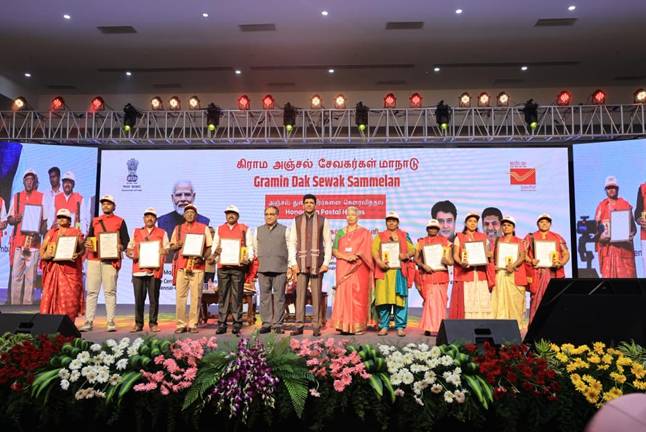
Union Minister of State for Communications Pemmasani Chandra Sekhar said Gramin Dak Sevaks are the foundation of last mile governance in India and play a decisive role in connecting government services with rural communities. Addressing the Gramin Dak Sevak Sammelan in Chennai, he said the postal workforce acts as the first mile of governance rather than the last mile, ensuring that public services reach every village and household across the country.
Pemmasani Chandra Sekhar described Gramin Dak Sevaks as the heartbeat of rural India and said their work extends far beyond traditional mail delivery. He said they deliver parcels, assist citizens in accessing government schemes, facilitate banking services and help people access Aadhaar and passport related services. In many parts of rural India, postal employees also serve as trusted intermediaries by helping villagers read and write letters and maintain communication with the outside world.
The Minister said the history of organised communication in India goes back centuries. During the Mauryan Empire, Emperor Chandragupta Maurya maintained a royal messenger network. In southern India, the Chola, Pandya and Chera kingdoms developed extensive messenger systems across their territories. The modern postal system began taking shape with the establishment of the General Post Office in Calcutta in 1774, while India Post in its current institutional form was established on October 1, 1854.
Highlighting the scale of India Post operations, Pemmasani Chandra Sekhar said the organisation runs one of the largest postal networks in the world. The department currently employs nearly four lakh regular staff and more than 2.5 lakh Gramin Dak Sevaks who operate through over 1.6 lakh post offices across the country.
The Minister said India Post played a historic role in shaping communication and governance in the country. For decades, it carried legal documents, money orders, newspapers and books that helped connect citizens, facilitate economic activity and strengthen democratic discourse. Postal employees often served as the most reliable link between remote villages and the wider administrative and economic system.
Pemmasani Chandra Sekhar also emphasised the changing nature of the logistics sector due to the rapid expansion of digital technologies and e commerce. He said India Post’s parcel revenue currently stands at under ₹1,000 crore, while a single private courier company generates around ₹6,000 crore in revenue.
He pointed out that India’s logistics market today represents an opportunity of about 10 billion dollars, equivalent to nearly ₹90,000 crore, and is expected to expand to 20 billion dollars, approximately ₹1.8 lakh crore, by the year 2031. He urged postal employees to actively participate in capturing this expanding market by improving service delivery and strengthening logistics operations.
The Minister appreciated the performance of the Tamil Nadu postal circle and said it ranks second in the country in terms of overall revenue generation. He said the achievement reflects the dedication and efficiency of postal employees working in the region.
Pemmasani Chandra Sekhar said India Post is undergoing a major transformation under the leadership of Prime Minister Narendra Modi and the guidance of Union Minister for Communications Jyotiraditya Scindia. The Department of Posts is being reshaped from a traditional service department into a modern logistics and service network driven by technology, data and customer centric systems.
As part of this transformation, the government has introduced several initiatives to modernise postal operations. A major technology upgrade is being implemented through the IT 2.0 platform with an investment of nearly ₹5,000 crore. The new system will enable end to end tracking of mail and parcels, real time SMS alerts for customers, UPI enabled digital payments, geotagging of postal assets and integrated digital dashboards for monitoring operations.
The Minister also highlighted the introduction of DigiPIN, a new 10 digit geo coded national addressing system designed to support advanced logistics and digital governance. DigiPIN is expected to improve emergency response services, enable efficient e commerce deliveries, support drone based logistics and enhance smart governance initiatives across the country.
Pemmasani Chandra Sekhar said the government has recognised the contribution of Gramin Dak Sevaks through improved remuneration and a structured incentive system that rewards performance. Additional measures include promotion opportunities, training programmes and improved transfer policies aimed at strengthening the workforce.
He emphasised that India Post operates in regions where private logistics companies often do not reach, including remote tribal areas and difficult terrain. Unlike profit driven courier networks, India Post functions wherever citizens live, ensuring that essential services are available to all communities.
Calling upon postal employees to maintain high standards of service, the Minister urged them to uphold the legacy of India Post by delivering services with dedication and professionalism. He said punctual operations, efficient delivery and active outreach to customers can significantly strengthen both the department and the national economy.
Pemmasani Chandra Sekhar encouraged Gramin Dak Sevaks to recognise their contribution to India’s development journey. He said every savings account opened, every insurance policy issued and every parcel delivered contributes to strengthening governance and economic inclusion.
He concluded by saying that the work carried out by Gramin Dak Sevaks carries not just letters and parcels but also the trust of the nation, and that India Post will continue to play a central role in connecting citizens, expanding services and advancing the vision of Viksit Bharat.