
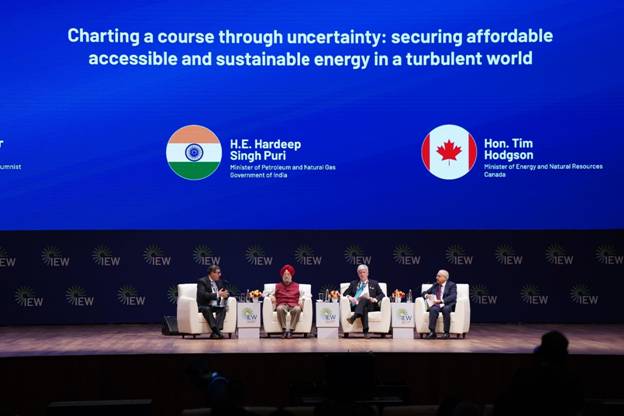
A high-level ministerial panel at India Energy Week 2026 underscored the central importance of energy security, sustained investment and international cooperation amid rising geopolitical uncertainty and accelerating global energy demand. The panel discussion, held on the opening day of the event, focused on the theme “Charting a Course through Uncertainty Securing Affordable Accessible And Sustainable Energy In A Turbulent World”.
The panel brought together Shri Hardeep Singh Puri, Minister of Petroleum and Natural Gas, Government of India, HE Tim Hodgson, Minister of Energy and Natural Resources, Canada, and HE Jassim Al Shirawi, Secretary General of the International Energy Forum. The discussion reflected a shared understanding that global energy systems are facing heightened volatility driven by geopolitical tensions, supply chain disruptions and changing trade dynamics.
Panellists emphasised that rising demand from emerging economies, coupled with the pace of the global energy transition, has placed renewed focus on ensuring energy availability, affordability and sustainability. It was widely acknowledged that there is no single transition pathway suitable for all countries, and that national circumstances must guide policy choices.
Speaking from India’s perspective, Shri Hardeep Singh Puri stated that energy availability is fundamental to economic growth and national resilience. He noted that India has successfully navigated recent global disruptions without shortages by diversifying energy sources, expanding supplier geographies and implementing reforms across the entire energy value chain.
Highlighting India’s ambition to increase the share of natural gas in its energy mix, Shri Puri stressed the need for global collaboration, sustained investment and realistic transition strategies. He reiterated that the global energy transition must be driven by energy addition rather than abrupt replacement, and that stable and predictable markets are in the shared interest of both producers and consumers.
HE Tim Hodgson observed that a more fragmented and mercantilist global trading environment has reinforced the importance of trusted partnerships and diversified supply chains. Emphasising Canada’s role as a major producer of oil, gas and critical minerals, he expressed strong interest in deepening cooperation with India in areas such as LNG, critical minerals, oil supplies and long-term energy trade. He also underlined the responsibility of middle powers to work together to uphold free trade, reliability and non-coercive energy relationships.
Providing a global outlook, HE Jassim Al Shirawi highlighted that rising energy demand is being driven by population growth, urbanisation, industrialisation, digitalisation and improving living standards. He noted that oil and gas will continue to play a critical role even as electrification and renewable energy expand, particularly as feedstocks for industry and petrochemicals.
The IEF Secretary General cautioned that underinvestment, grid constraints, supply chain concentration and market fragmentation could pose serious risks to energy security. He called for sustained dialogue between energy producers and consumers to ensure that the transition is managed in a balanced, orderly and inclusive manner.
The panel concluded that navigating current and future uncertainty will require realism, adaptability and close cooperation among nations. Investments across oil and gas, electricity grids, LNG infrastructure, critical minerals and emerging technologies were identified as essential to ensuring that the global energy transition remains affordable, resilient and equitable.
India Energy Week serves as the country’s flagship global energy platform, bringing together government leaders, industry executives and innovators to advance a secure, sustainable and affordable energy future through dialogue, investment and policy alignment.