
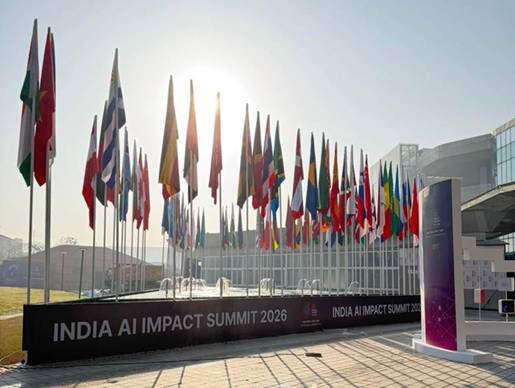
The India AI Impact Summit 2026 commenced at Bharat Mandapam on Sunday, bringing together an unprecedented gathering of global leaders, policymakers, technology pioneers and researchers in what is being described as the first convening of its scale on artificial intelligence in the Global South.
The five day Summit from February 16 to 20 is hosting more than 100 government representatives, including over 20 Heads of State and Government and 60 Ministers and Vice Ministers. More than 500 global AI leaders are participating, comprising chief executive officers, founders, academicians, researchers, chief technology officers and representatives of philanthropic organisations.
Prime Minister Shri Narendra Modi is scheduled to deliver the inaugural address on February 19, outlining India’s vision for inclusive and responsible artificial intelligence and setting the direction for enhanced global cooperation.
The Summit aims to deliberate on the transformative role of AI in advancing inclusive economic growth, strengthening public systems and enabling sustainable development. It seeks to position India as a key platform for shaping the global AI agenda while fostering collaboration across governments, industry, academia and multilateral institutions.
A major highlight of the Summit is the culmination of three flagship Global Impact Challenges titled AI for ALL, AI by HER and YUVAi. Designed to promote inclusive, responsible and development oriented artificial intelligence, the challenges were launched to accelerate scalable and high impact AI solutions aligned with national priorities and global development objectives.
The three challenges collectively attracted more than 4,650 applications from over 60 countries, reflecting robust international participation. After a rigorous multi stage evaluation process led by domain experts, policymakers and industry leaders, the top 70 teams across the three categories have been selected as finalists. These teams are presenting their innovations during the Grand Finale and Awards Felicitation Ceremony being held on February 16 and 17 at Bharat Mandapam and Sushma Swaraj Bhawan in New Delhi. Finalists are engaging with policymakers, industry leaders, investors and academia, receiving ecosystem support to scale their solutions nationally and globally.
The Research Symposium on AI and Its Impact, scheduled for February 18 in partnership with the Indian Institute of Technology Hyderabad, serves as the principal academic platform of the Summit. The Symposium has received around 250 research submissions from Africa, Asia and Latin America. It is being graced by H E Mr Alar Karis, President of the Republic of Estonia, Shri Ashwini Vaishnaw, Union Minister for Electronics and Information Technology, and Shri Jitin Prasada, Union Minister of State for Electronics and Information Technology.
The Symposium brings together globally recognised AI pioneers and leading research institutions to deliberate on AI driven scientific discovery, safety and governance frameworks, equitable access to computing infrastructure and collaborative research models across the Global South.
The India AI Impact Summit 2026 is anchored in the conceptual framework of the Seven Chakras and the Three Sutras of People, Planet and Progress. It advances a development oriented approach to artificial intelligence, linking policy dialogue with practical implementation pathways.
Seven thematic working groups are driving the Summit’s deliberations, covering AI for Economic Growth and Social Good, Democratisation of AI Resources, Inclusion for Social Empowerment, Safe and Trusted AI, Human Capital, Science, and Resilience Innovation and Efficiency. These groups are expected to present outcome oriented recommendations aimed at strengthening global partnerships and scaling responsible AI deployment.
By integrating innovation with public purpose and aligning technological advancement with inclusive growth, the Summit marks a transition from dialogue to delivery. It positions India as both convenor and partner in global AI cooperation, supporting shared standards, collaborative frameworks and scalable solutions for public good, while reinforcing its commitment to responsible, inclusive and development focused AI pathways.