
The exhibition at the India AI Impact Summit 2026 has emerged as a dynamic demonstration of how artificial intelligence is transitioning from research laboratories to real world deployment across multiple sectors. With strong public and industry participation, the Expo has brought together more than 300 exhibitors from India and over 30 countries across 10 thematic pavilions, underscoring the expanding global engagement with India’s AI ecosystem.
The exhibition floor at Bharat Mandapam has drawn high footfall from industry leaders, startups, academic institutions, researchers, policymakers, students and international delegates. The scale and diversity of participation reflect growing interest in India’s AI infrastructure, sovereign capabilities and sector specific applications.
From Infrastructure to Deployment
The Summit Expo has positioned itself as a global platform to demonstrate India’s progress in AI infrastructure, sovereign AI models, robotics, supercomputing, education technology, healthcare innovation and fintech security. Exhibitors have presented next generation AI ready infrastructure designed to support high performance computing and data intensive workloads, a critical requirement for large scale model training and deployment.
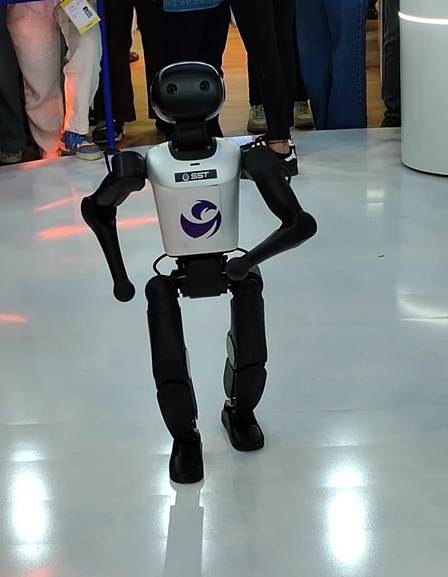
Robotics processors and deployment ready humanoid systems have attracted significant attention, illustrating how physical AI is moving beyond experimentation into industrial use cases. These demonstrations signal the integration of AI with manufacturing, logistics and service environments at scale.
Robotics and Intelligent Manufacturing
Advanced robotics platforms for logistics, manufacturing, retail and smart agriculture are among the prominent highlights of the Expo. Designed to enhance productivity, reduce operational costs and address workforce shortages in high demand sectors, these systems demonstrate the convergence of artificial intelligence, machine vision and automation.
Industry participants have showcased applications that enable predictive maintenance, precision handling and adaptive manufacturing processes, reflecting AI’s increasing role in strengthening industrial resilience and operational efficiency.
AI for Science and Research
Indian and international institutions have used the platform to showcase AI driven breakthroughs in scientific research. Key areas on display include AI driven protein engineering and drug discovery, neuroscience and cognitive systems research, and the use of advanced computing and quantum centric methods to process large scale biological and clinical datasets.
Generative AI and Large Language Models for multilingual and secure applications have also featured prominently. These demonstrations underline AI’s expanding role in biomedical research, diagnostics and data driven healthcare systems, reinforcing the link between scientific discovery and computational capability.
AI in Education and Workforce Upskilling
Leading academic institutions have presented AI enabled education frameworks tailored for both students and working professionals. With tens of thousands of learners enrolled in artificial intelligence and machine learning programmes, the Expo reflects India’s strategic focus on building a future ready workforce.
Interactive modules, virtual laboratories and blended learning models demonstrate how AI is being integrated into curriculum design and skills training. The emphasis on democratising access to AI education aligns with broader national efforts to expand digital capability across regions and socio economic segments.
AI in Finance and Security
Fintech and cyber security applications have drawn strong interest at the Expo. AI tools enabling faster audits, enhanced compliance monitoring, fraud detection and risk assessment are being deployed to improve efficiency and strengthen digital trust. These solutions highlight the growing importance of AI in financial governance and secure digital transactions.
Multilingual AI and Inclusion
A recurring theme across pavilions has been the democratisation of AI resources. Multilingual AI content generation tools, AI solutions tailored for small businesses and professional firms, and modular AI infrastructure adaptable to both urban and remote environments demonstrate inclusive design.
AI powered public service applications such as smart waste management systems and agricultural robotics illustrate how artificial intelligence is being integrated into governance and rural transformation initiatives. The presence of such solutions reinforces the Summit’s focus on inclusive, scalable deployment rather than isolated innovation.
A Convergence Platform
The India AI Impact Summit 2026 Expo has become a convergence point for collaboration, knowledge exchange and partnership building. By bringing together technology developers, sectoral experts and public institutions under one roof, the exhibition has demonstrated that AI is no longer confined to conceptual research or pilot projects.
Instead, artificial intelligence is increasingly embedded in core economic and social systems, driving scientific advancement, strengthening industrial capacity and expanding digital access. The Expo has reaffirmed that AI is emerging as a strategic enabler for economic resilience, innovation and inclusive growth, positioning India as a significant contributor to the evolving global AI landscape.