
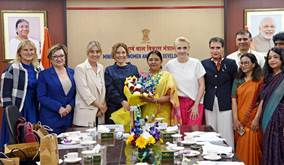
The Ministry of Women and Child Development hosted a 17 member delegation of the European Parliament’s Committee on Women’s Rights and Gender Equality during its official visit to the national capital from February 16 to 20, 2026, reaffirming shared commitment to advancing gender equality and strengthening cooperation for the empowerment and protection of women and children.
The delegation was led by Lina Gálvez, Chair of the FEMM Committee and Member of the European Parliament representing the Progressive Alliance of Socialists and Democrats from Spain. The engagement formed part of ongoing high level exchanges under the India European Union strategic partnership framework.
The delegation was welcomed by Savitri Thakur, Minister of State for Women and Child Development. In her remarks, she emphasised that India attaches great importance to its strategic partnership with the European Union and considers gender equality a core pillar of the Joint India EU Strategic Agenda 2030. She noted that the meeting built upon earlier high level engagements and reflected the shared resolve of both sides to promote inclusive development and women’s rights.
Outlining India’s policy approach, she underlined that gender equality and women’s empowerment are firmly anchored in the country’s constitutional framework and development strategy. She stated that these priorities are central to the vision of Viksit Bharat 2047 articulated under the leadership of Prime Minister Narendra Modi.
The Minister highlighted several key milestones achieved in recent years. She referred to the Nari Shakti Vandan Adhiniyam, which provides one third reservation for women in Parliament and State Assemblies, and pointed out that nearly 46 percent of elected representatives in local bodies are women, reflecting sustained progress in grassroots political participation.
She also outlined advancements in girls’ education and increased participation of women in science, technology, engineering and mathematics disciplines, supported by large scale scholarship and capacity building initiatives. Financial inclusion measures were highlighted, including the fact that nearly 70 percent of Mudra loans have been availed by women entrepreneurs and that over 31 crore Jan Dhan accounts are held by women, strengthening economic participation and access to formal banking systems.
On safety and protection, she detailed the implementation of Mission Shakti, expansion of One Stop Centres, operationalisation of fast track courts and dedicated women helplines aimed at providing timely legal, medical and psychological assistance to survivors of violence.
The discussions between the Ministry and the FEMM Committee delegation also covered avenues for deeper cooperation in gender responsive trade, digital inclusion, climate action and people to people exchanges. Both sides recognised that India and the European Union are natural partners in promoting inclusive and sustainable development, particularly in the context of global commitments to equality, human rights and social justice.
The visiting delegation engaged in dialogue on institutional frameworks, legislative measures, social protection systems and best practices in advancing gender equality. The exchange reflected a shared understanding that sustained cooperation, policy innovation and cross regional collaboration are essential to achieving meaningful and measurable outcomes.
The meeting concluded with both sides reaffirming their commitment to strengthening collaboration for the empowerment and protection of women and children. The engagement reinforced India EU cooperation in advancing gender equality as a foundational element of democratic governance and sustainable development.