
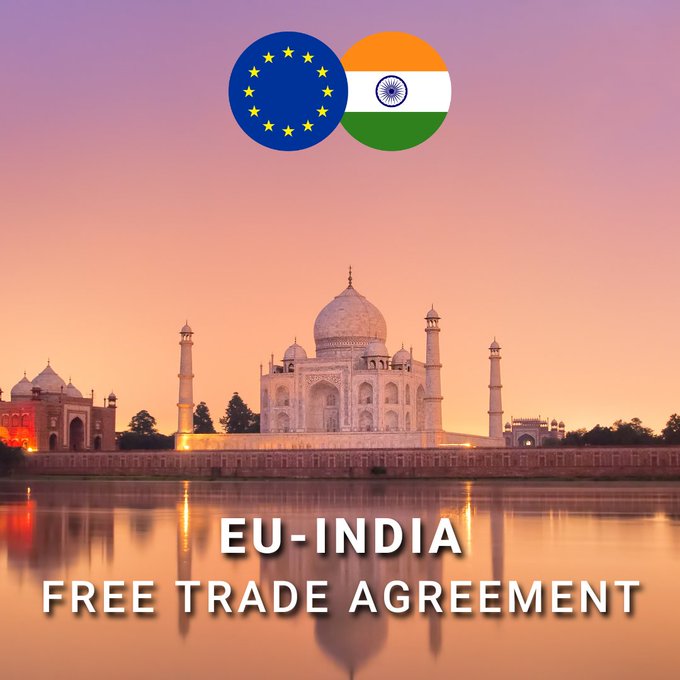
India and the European Union have formally concluded negotiations on a comprehensive Free Trade Agreement, marking a historic milestone in one of India’s most consequential global economic partnerships. Described by global observers as the “mother of all deals”, the agreement redefines India–EU economic engagement and lays a robust foundation for inclusive, resilient and future-ready growth aligned with the vision of India@2047.
The announcement was made at the highest political level, underscoring the strategic intent on both sides to elevate bilateral relations beyond conventional trade cooperation. The agreement was jointly announced by Prime Minister Narendra Modi and European Commission President Ursula von der Leyen, signalling strong political commitment to a modern, rules-based and balanced trade partnership.
Together, India and the European Union represent the world’s fourth and second largest economies, accounting for nearly 25 percent of global GDP and close to one-third of global trade. With a combined market size estimated at over INR 2,091.6 lakh crore, equivalent to USD 24 trillion, the agreement opens transformative opportunities for nearly two billion people across both regions.
The India–EU Free Trade Agreement delivers unprecedented market access for Indian exporters. More than 99 percent of India’s exports by trade value will receive preferential entry into the European Union. Of this, over 70 percent of tariff lines covering more than 90 percent of Indian exports will see immediate elimination of duties, providing a decisive boost to labour-intensive sectors such as textiles, apparel, leather, footwear, gems and jewellery, sports goods, toys, tea, coffee, spices and select marine products. Additional tariff lines will see phased elimination over three to five years, while calibrated tariff reductions and tariff rate quotas apply to a limited set of sensitive products.
These measures are expected to significantly enhance India’s export competitiveness, particularly in sectors currently facing EU import duties ranging from 4 percent to 26 percent. Exports worth approximately INR 2.87 lakh crore, equivalent to USD 33 billion, are poised to benefit directly, strengthening employment generation and deeper integration of Indian businesses, including MSMEs, into European and global value chains.
On the reciprocal side, India has offered tariff concessions covering over 92 percent of its tariff lines, accounting for more than 97 percent of EU exports to India. Nearly half of these tariff lines will see immediate duty elimination, while others will be liberalised in a phased and calibrated manner over five to ten years. Strategic safeguards have been retained for sensitive sectors such as dairy, cereals, poultry, soymeal and selected fruits and vegetables, ensuring that domestic priorities and food security remain protected.
The agreement is expected to have a far-reaching impact on India’s agricultural and processed food sectors. Preferential access for products such as tea, coffee, spices, grapes, gherkins, cucumbers, dried onion, fresh fruits and vegetables and a wide range of processed foods will enhance competitiveness in the EU market. This is projected to strengthen farmer incomes, reinforce rural livelihoods and position India as a trusted premium supplier in Europe.
Beyond goods, the agreement is especially significant for services, which are the fastest-growing component of trade for both economies. India has secured broad and commercially meaningful commitments from the EU across 144 services subsectors, including IT and IT-enabled services, professional services, education, financial services, tourism, construction and other business services. These commitments provide Indian service providers with certainty of market access, non-discriminatory treatment and a stable regulatory environment.
India’s offer in services spans 102 subsectors aligned with EU priorities, enabling European firms to expand investment and high-technology services in India. This mutually beneficial framework is expected to accelerate trade in services, foster innovation and deepen economic integration.
A key pillar of the agreement is a future-ready mobility framework that facilitates the temporary movement of professionals. Provisions cover business visitors, intra-corporate transferees, contractual service suppliers and independent professionals across multiple sectors. The agreement also enables entry and working rights for dependents of intra-corporate transferees and establishes a framework for social security agreements within five years. Enhanced provisions for student mobility and post-study work opportunities further strengthen people-to-people ties.
The agreement also opens new avenues for Indian traditional medicine practitioners. In EU member states where regulation does not exist, practitioners of AYUSH systems will be able to provide services based on qualifications obtained in India. The framework also supports the establishment of AYUSH wellness centres across Europe and encourages greater exchange in traditional medicine services.
Strong provisions on intellectual property rights reinforce TRIPS-consistent protections while safeguarding India’s interests. The agreement recognises the importance of the Traditional Knowledge Digital Library and affirms the Doha Declaration. Enhanced cooperation on sanitary and phytosanitary measures and technical barriers to trade will improve regulatory transparency, streamline compliance and facilitate smoother market access.
Sector-specific gains are expected across engineering goods, chemicals, plastics and rubber, medical devices, marine products, gems and jewellery, textiles and apparel, leather and footwear, furniture, home décor, mines and minerals. In many of these sectors, tariffs of up to 22 percent will be eliminated, unlocking access to some of the largest import markets in the world and strengthening India’s manufacturing and export ecosystem.
The India–EU Free Trade Agreement marks a decisive step in India’s global trade strategy. Alongside agreements with the UK and EFTA, it effectively opens the entire European market for Indian exporters and entrepreneurs. Beyond commerce, the agreement reinforces shared values, supports innovation, empowers MSMEs, women and youth, and positions India as a trusted, forward-looking global economic partner.