

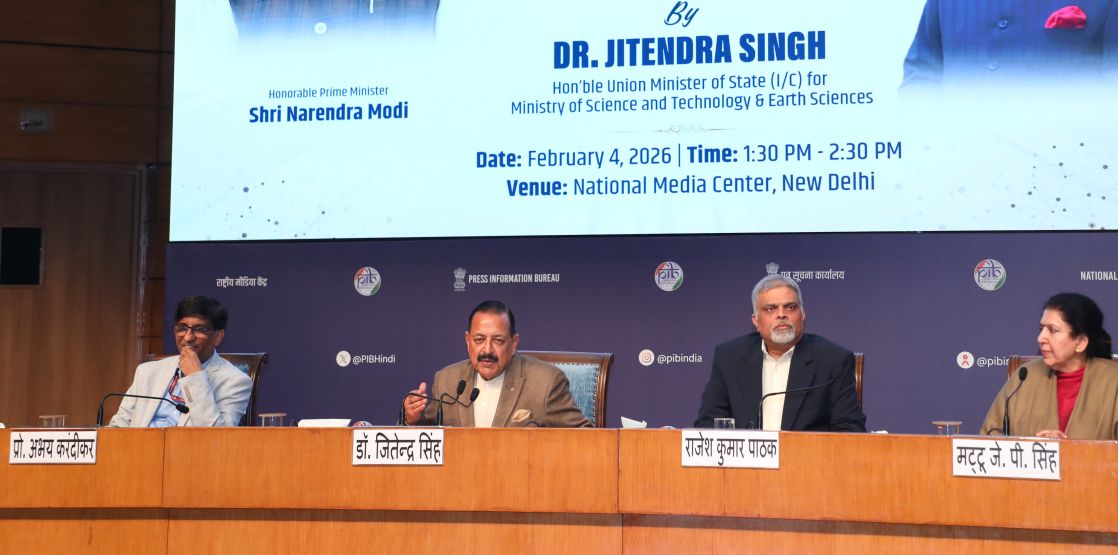
India is accelerating the expansion of its space launch infrastructure while simultaneously strengthening space debris management mechanisms, Union Minister of State Independent Charge for Science and Technology and Earth Sciences and Minister of State in the Prime Minister Office Personnel Public Grievances and Pensions Atomic Energy and Space Jitendra Singh informed the Lok Sabha.
Responding to questions in Parliament, Jitendra Singh outlined a comprehensive roadmap covering new launch facilities, future missions, private sector participation and sustainability measures in outer space operations.
Expansion of Launch Infrastructure
At present, two launch pads First Launch Pad and Second Launch Pad are operational at the Satish Dhawan Space Centre Sriharikota Andhra Pradesh. The First Launch Pad supports PSLV and SSLV missions, while the Second Launch Pad supports PSLV GSLV and LVM3 launches.
The Government has approved the establishment of a Third Launch Pad at Sriharikota in 2025, which will cater to next generation launch vehicles of ISRO. The facility is targeted for completion by 2029 to 2030, with the first developmental flight of the Next Generation Launch Vehicle planned during 2031 to 2032.
In addition, a new SSLV Launch Complex is being developed at Kulasekarapattinam in Tamil Nadu to support launches to Sun synchronous polar orbit, particularly for earth observation missions. The new facility is expected to be commissioned during 2026 to 2027, with operational launches beginning from 2027 to 2028.
For the 2026 to 2027 period, three PSLV and three SSLV missions are planned from the First Launch Pad, while two GSLV and two LVM3 missions are scheduled for communication and navigation satellites.
The Minister clarified that there is currently no proposal to establish additional launch sites elsewhere in the country.
Policy Reforms and Private Sector Participation
Following space sector reforms announced in June 2020, private entities are now permitted to undertake end to end space activities including development of launch infrastructure. The Indian National Space Promotion and Authorization Centre has been established under the Department of Space to regulate and promote non governmental participation.
Foreign Direct Investment has been permitted in the space sector, including launch infrastructure, under guidelines notified in April 2024. The Indian Space Policy 2023 framework, supported by detailed norms and procedures issued by IN SPACe, provides clarity on authorisation, accountability, national security and sustainable operations.
Financial Outlay on Launch Infrastructure
The government has made significant investments in launch infrastructure and related facilities over the past five years.
Financial Allocation and Utilisation for Space Infrastructure Projects Rs in crore
Project Name 2020-21 Actual 2021-22 Actual 2022-23 Actual 2023-24 Actual 2024-25 Actual 2025-26 Actual Feb 2026
Second Vehicle Assembly Building 999.94 0.00 0.00 0.00 0.00 0.00
Solid Propellant Space Booster Plant 5499.88 6299.99 3899.98 2106.13 499.39 13.84
PSLV Integration Facility 5499.70 3679.14 3246.07 711.41 930.91 5.31
Launch Pad for SSLV 78.74 15549.63 1172.99 36.78 13896.56 148.65
Third Launch Pad 0.00 0.00 0.00 0.00 0.00 0.80
LVM3 Infrastructure Augmentation 0.00 0.00 0.00 0.00 0.00 2.33
Space Debris Status and Mitigation Measures
Jitendra Singh also provided details on space debris management. As of March 2026, India has 129 trackable space debris objects in orbit. These include 23 defunct satellites in low earth orbit, 26 in geostationary orbit, 40 PSLV rocket bodies, 4 GSLV rocket bodies, 3 LVM3 rocket bodies and 33 debris fragments from the PSLV C3 mission.
Breakup of Indian Space Debris
Category Number
Defunct Satellites LEO 23
Defunct Satellites GEO 26
PSLV Rocket Bodies 40
GSLV Rocket Bodies 4
LVM3 Rocket Bodies 3
PSLV C3 Debris 33
Total 129
The government has aligned its debris mitigation practices with international guidelines issued by the Inter Agency Space Debris Coordination Committee and the United Nations Committee on the Peaceful Uses of Outer Space.
The Debris Free Space Mission launched in 2024 aims to achieve zero debris generation by all Indian space actors by 2030. Measures include ensuring extra fuel margins for de orbiting spacecraft and launch vehicles and planning post mission disposal during the design phase.
Technological Advancements and Monitoring Systems
India has made significant progress in debris monitoring and removal technologies. The NETRA project with a sanctioned cost of 509.01 crore has incurred an expenditure of 67.77 crore till February 2026 and supports space situational awareness capabilities.
The SSA control centre under NETRA is operational and provides collision avoidance recommendations, atmospheric re entry predictions and tracking data analysis. Indigenous phased array radar systems for multi object tracking are also being developed.
India achieved a major milestone in 2025 through the SpaDeX mission, demonstrating autonomous rendezvous docking and undocking capabilities. Robotic arm and manipulator technologies were also successfully tested on the PS4 orbital experimental module platform, laying the groundwork for future active debris removal missions.
The Indian Space Research Organization continues to collaborate with international agencies including NASA ESA and JAXA for space debris mitigation through joint research workshops and operational coordination.
The Indian Space Situational Assessment Report is released annually to monitor debris and ensure transparency.
Jitendra Singh said the government remains committed to expanding launch capabilities while ensuring long term sustainability of outer space activities through strong regulatory frameworks, advanced technologies and international cooperation.