
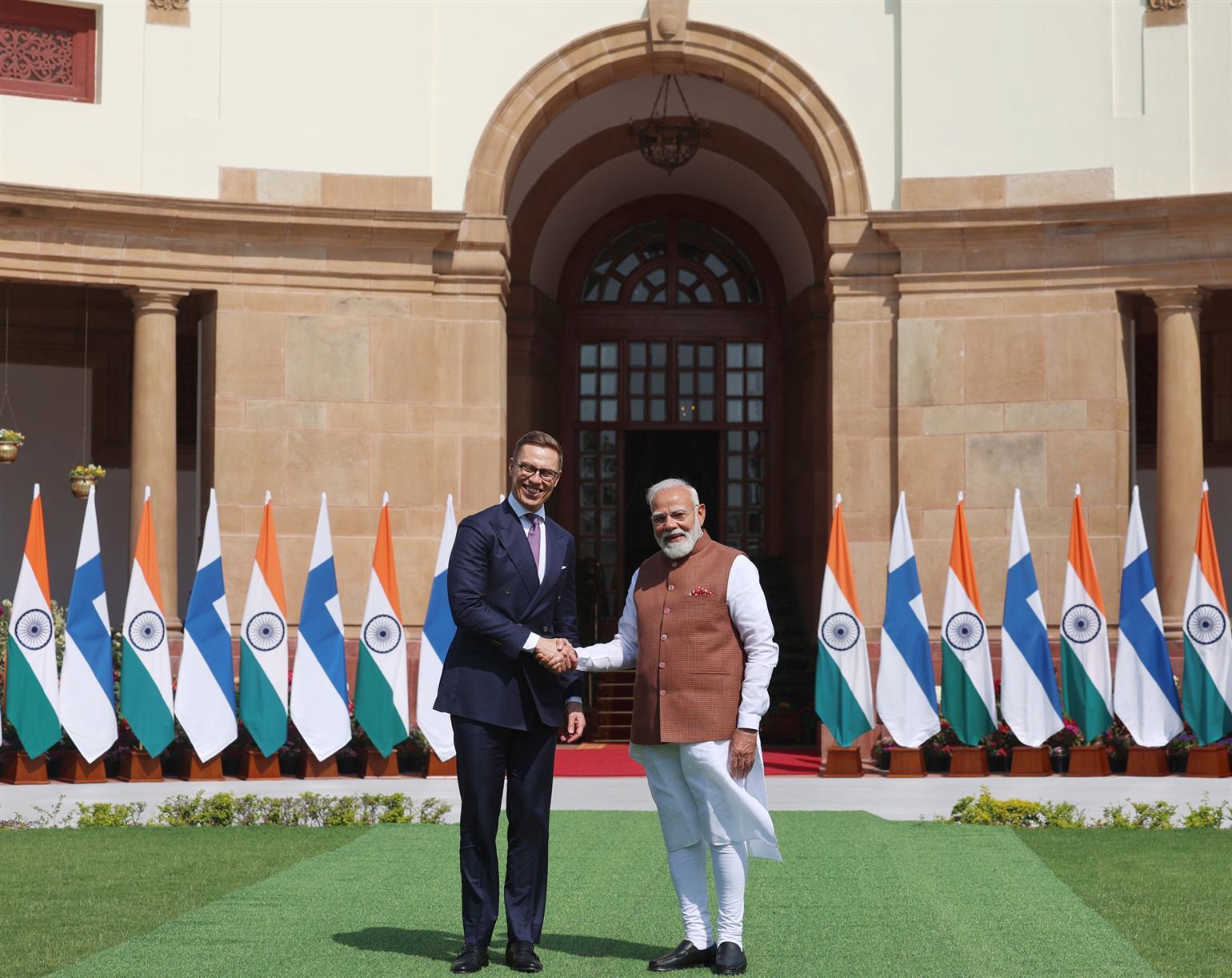
India and Finland have elevated their bilateral relations to a Strategic Partnership in Digitalization and Sustainability during the state visit of Finland President Alexander Stubb to India from 4 to 7 March 2026, marking a major step in expanding cooperation across technology, trade, sustainability and global governance.
The visit, the first to India by Alexander Stubb in his current capacity as President of Finland, took him to New Delhi and Mumbai. He was accompanied by Sari Multala, Minister of Climate and the Environment of Finland, Matias Marttinen, Minister of Employment of Finland, along with a high level delegation of officials and business leaders representing various sectors.
The visit took place at the invitation of Prime Minister Narendra Modi. President Alexander Stubb also attended the eleventh edition of the Raisina Dialogue in New Delhi on 5 March 2026 as Chief Guest and delivered the inaugural keynote address after the event was opened by Narendra Modi. The visit follows the earlier trip to India by Petteri Orpo, Prime Minister of Finland, who participated in the AI Impact Summit held in February 2026.
During the visit, President Alexander Stubb was received at Rashtrapati Bhavan by President Droupadi Murmu. Narendra Modi and Alexander Stubb held wide ranging bilateral discussions covering strategic cooperation, global challenges and economic engagement. Narendra Modi also hosted a luncheon in honour of the visiting leader.
Both leaders reaffirmed the deep and longstanding friendship between India and Finland, emphasizing that the relationship is built on shared democratic values, respect for rule of law and a common commitment to international peace and security. They reiterated support for a rules based international order and multilateral cooperation with the United Nations at its core.
The leaders also stressed the urgency of accelerating progress towards the Sustainable Development Goals and strengthening international collaboration to address major global challenges such as climate change and biodiversity loss.
They welcomed the landmark Free Trade Agreement between India and the European Union concluded during the India EU Summit on 27 January 2026 and recognized the significant opportunities it presents for expanding trade and investment flows between India and Finland as well.
Building on previous engagements such as the India Finland Virtual Summit of March 2021 and interactions between the two prime ministers during the India Nordic Summits held in Stockholm in 2018 and Copenhagen in 2022, the leaders emphasized their commitment to deepening cooperation across sectors.
As part of the visit, the two countries agreed to elevate their bilateral relationship to a Strategic Partnership in Digitalization and Sustainability, reflecting their shared interests in technology innovation, sustainable development and economic growth.
Trade and investment emerged as key pillars of the partnership. Both leaders called upon businesses from both countries to utilize the new opportunities created by the India EU Free Trade Agreement. They agreed on an ambitious target of doubling bilateral trade between India and Finland by the year 2030.
The leaders also noted the growing interaction between Indian and Finnish business communities, including the large Finnish business delegation accompanying the president. They expressed confidence that the India Finland Business Summit and CEO interactions scheduled in Mumbai on 7 March 2026 would further strengthen investment and technology partnerships.
Cooperation between startup ecosystems was also highlighted as an important area of collaboration. Indian startups have been actively participating in Slush in Helsinki, one of Europe’s largest startup events, while Finnish startups have taken part in Startup Mahakumbh in New Delhi. Initiatives such as the Indo Finland Startup Corridor are expected to further strengthen these innovation linkages.
Digital transformation and emerging technologies were identified as central pillars of the new strategic partnership. The two countries agreed to intensify cooperation in areas including artificial intelligence, fifth and sixth generation telecommunications, high performance computing, quantum computing and digital public infrastructure.
The leaders discussed India’s experience with digital public infrastructure including the Unified Payments Interface and explored possibilities for cooperation in building inclusive digital ecosystems.
To strengthen institutional collaboration in the digital sector, the leaders agreed to establish a cross sectoral Joint Working Group on Digitalization that will identify priority areas and facilitate concrete actions to advance digital cooperation.
The leaders also welcomed joint research initiatives between India’s Department of Science and Technology and Business Finland, focusing on advanced research and development projects in semiconductors, 6G technology and energy systems.
Collaboration in sixth generation telecommunications technology received particular emphasis. The leaders took note of cooperation between the Bharat 6G Alliance and the University of Oulu in Finland and welcomed further efforts to strengthen bilateral collaboration in future telecommunications technologies.
In the field of advanced computing and artificial intelligence, both sides acknowledged ongoing discussions between the Centre for Development of Advanced Computing in India and the Finnish IT Centre for Science regarding high performance computing research cooperation.
The leaders also recognized space technology as an emerging area of partnership with strong potential for future collaboration between Indian and Finnish private sector companies.
Sustainability and climate cooperation formed another central pillar of the discussions. Both sides emphasized opportunities for collaboration in clean energy technologies including green hydrogen, energy efficiency, smart grids, biofuels and low carbon energy systems.
The leaders agreed to establish a Joint Working Group on Sustainability that will bring together relevant stakeholders to advance cooperation in sustainable development and climate action.
They also welcomed progress under the Memorandum of Understanding on renewable energy cooperation covering areas such as bioenergy, waste to energy technologies, power storage solutions and renewable energy systems including wind, solar and small hydro power.
Both countries acknowledged the renewal of the Memorandum of Understanding on Environmental Cooperation and highlighted collaboration under international initiatives such as the Leadership Group for Industry Transition. The partnership will also expand cooperation in circular economy practices, sustainable water management and environmental monitoring.
President Alexander Stubb expressed appreciation to India for hosting the World Circular Economy Forum later in 2026, a global platform originally initiated by Finland to promote sustainable resource use and circular economy solutions.
The leaders also discussed collaboration in meteorology and environmental research. Ongoing cooperation between the Finnish Meteorological Institute and the Indian Meteorological Department in aerosol monitoring and air quality forecasting was highlighted.
They also welcomed the establishment of a Virtual Research Center involving the Finnish Meteorological Institute and the Indian Institute of Technology Madras, along with ongoing collaborative research projects valued at more than eleven million euros.
The discussions also covered water resource management. Finland has been working with Indian and Nordic stakeholders through the Indo Nordic Water Forum to promote new technologies and best practices in water management and wastewater recycling.
Cooperation in official statistics was strengthened through the signing of a Memorandum of Understanding to promote the exchange of best practices, methodologies and technical expertise between statistical institutions in both countries.
Another significant outcome of the visit was the signing of a Memorandum of Understanding on Migration and Mobility Partnership. Finland has emerged as an important destination for Indian professionals particularly in the technology and innovation sectors. The agreement will create a framework for orderly and mutually beneficial mobility of skilled professionals, students and researchers.
Both leaders also emphasized the importance of people to people connections including exchanges among students, researchers, professionals and business communities. They highlighted growing cooperation in education including teacher training and the establishment of schools and early childhood education institutions based on the Finnish education model in India.
The leaders also noted ongoing discussions on a bilateral audiovisual co production agreement that could expand cooperation in film production and gaming industries.
On global issues, both leaders reaffirmed their commitment to strengthening India European Union relations. They welcomed the Joint India EU Comprehensive Strategic Agenda adopted earlier in 2026 and emphasized that the India EU Free Trade Agreement will deepen economic cooperation and diversify supply chains.
They also reaffirmed support for the India EU Trade and Technology Council and noted the importance of the India EU Security and Defence Partnership in addressing shared challenges including maritime security, cyber threats and counter terrorism.
Both leaders highlighted the importance of reforming the United Nations system including comprehensive reform of the United Nations Security Council to better reflect contemporary global realities. Finland reiterated its support for India’s permanent membership in a reformed Security Council.
The two sides also emphasized cooperation in multilateral forums to address global challenges including climate change, human rights, sustainable development and international peace and security.
They reaffirmed their commitment to promoting a free open and inclusive Indo Pacific region based on international law including the United Nations Convention on the Law of the Sea. India welcomed Finland’s interest in participating in the Indo Pacific Oceans Initiative.
The leaders also discussed cooperation in Arctic matters and noted the first India Finland Arctic Dialogue held in January 2026 in Rovaniemi. The dialogue focused on scientific collaboration between Arctic and Himalayan ecosystems and explored opportunities for joint research and academic exchanges.
Both leaders strongly condemned terrorism and violent extremism in all forms including cross border terrorism. They called for stronger international cooperation to combat terrorism financing, prevent misuse of emerging technologies by terrorist groups and strengthen global anti money laundering frameworks.
The leaders also condemned the terrorist attack in Pahalgam in Jammu and Kashmir on 22 April 2025 and the terror incident near Red Fort in New Delhi on 10 November 2025.
On the Ukraine conflict, both sides reiterated support for a comprehensive, just and lasting peace achieved through dialogue and diplomacy in accordance with the principles of the United Nations Charter including sovereignty, independence and territorial integrity.
Concluding the visit, both leaders directed the newly established working groups on digitalization and sustainability to prepare a detailed action plan outlining priority sectors and collaborative initiatives. Progress on these initiatives will be reviewed by the Ministry for Foreign Affairs of Finland and the Ministry of External Affairs of India.
Alexander Stubb expressed appreciation to Narendra Modi for the hospitality and arrangements made during the visit. The leaders reaffirmed their commitment to deepening the partnership based on mutual respect and shared strategic interests.
President Alexander Stubb also invited Narendra Modi to visit Finland, an invitation that was accepted, marking the next step in advancing India Finland relations.