
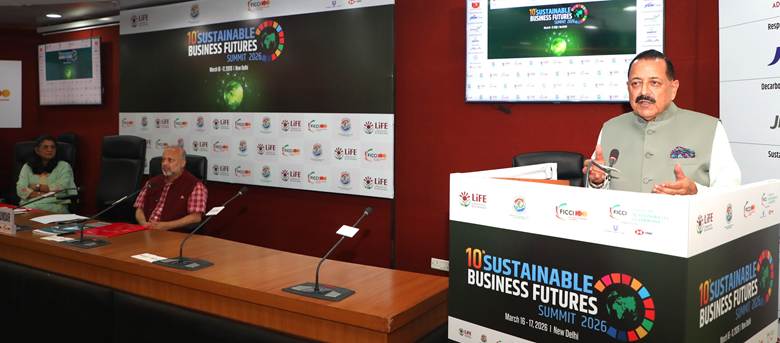
India is poised to play a decisive role in shaping the global transition towards a green and sustainable future, with green infrastructure and clean technologies set to drive the country’s next phase of economic growth, Union Minister of State Independent Charge for Science and Technology, Earth Sciences and Minister of State for PMO, Personnel, Public Grievances, Pensions, Atomic Energy and Space Jitendra Singh said on Tuesday.
Addressing the 10th Sustainable Business Futures Summit 2026, Jitendra Singh emphasised that India’s scale, with a population of 1.4 billion, places it at the centre of the global green transition. He stated that the country’s development trajectory will significantly influence the success of worldwide sustainability efforts, making India both a key stakeholder and a potential global leader in green transformation.
The minister said India stands at a critical juncture where economic expansion and environmental responsibility must advance together. He noted that this phase presents a unique opportunity for the country to emerge as a major driver of sustainable development powered by green technologies, renewable energy systems and innovation-led growth.
Highlighting the role of green infrastructure, Jitendra Singh described it as a foundational pillar for India’s future economy. He pointed out that the global economic landscape is increasingly shifting towards recycling, regeneration and environmentally sustainable industrial practices, and India is actively aligning its policies and investments with these evolving priorities.
He said India’s economic transformation over the past decade has been underpinned by a rapidly growing innovation ecosystem. The country now hosts over two lakh startups, with nearly half originating from Tier II and Tier III cities, reflecting the deepening spread of entrepreneurship and technological adoption beyond metropolitan centres. This expanding innovation base, he noted, will be critical in driving green solutions across sectors.
The minister underlined the importance of building a robust clean energy ecosystem to support emerging sectors such as data centres and artificial intelligence, which require reliable and uninterrupted power supply. In this context, he highlighted the significance of the SHANTI Act, describing it as a landmark reform that opens up the nuclear energy sector to wider participation, including private players, while enabling the development of clean, dependable and scalable energy sources.
Jitendra Singh said India’s green transition strategy is based on an integrated approach combining technological advancement, economic growth and environmental sustainability. This includes the development of next generation energy systems, advanced storage technologies and digitally enabled smart grids capable of integrating multiple energy sources such as solar, wind, nuclear and hydrogen.
He added that the country is also investing in climate modelling, risk assessment tools and advanced construction technologies to ensure that future infrastructure is resilient, efficient and environmentally sustainable. According to him, these measures will support long term planning and reduce vulnerability to climate related risks.
Referring to policy direction under Prime Minister Narendra Modi, the minister reiterated India’s commitment to achieving Net Zero emissions by 2070. He also highlighted the promotion of the Lifestyle for Environment initiative, which encourages sustainable consumption patterns and responsible behaviour at the individual and community level.
Jitendra Singh stressed that the concept of a circular economy is gaining increasing importance in India’s development model. He noted that waste is being redefined as a resource through innovative waste to wealth initiatives, contributing not only to environmental conservation but also to economic value creation and employment generation.
He further said that future infrastructure development must integrate key elements such as climate resilience, sustainable urban planning, clean mobility systems and water security. These areas, he noted, will require coordinated efforts across government agencies, industry stakeholders and research institutions to ensure effective implementation.
Emphasising the need for collaboration, the minister said the era of isolated efforts is over and achieving sustainability goals will depend on strong partnerships across sectors. He called for a collective approach involving policymakers, businesses, scientists and citizens to accelerate the transition towards a green economy.
Jitendra Singh concluded that India’s journey towards a sustainable future is not only essential for domestic growth but also critical for global environmental stability. With its scale, innovation capacity and policy commitment, India is well positioned to lead the transition to a greener, cleaner and more resilient world.