
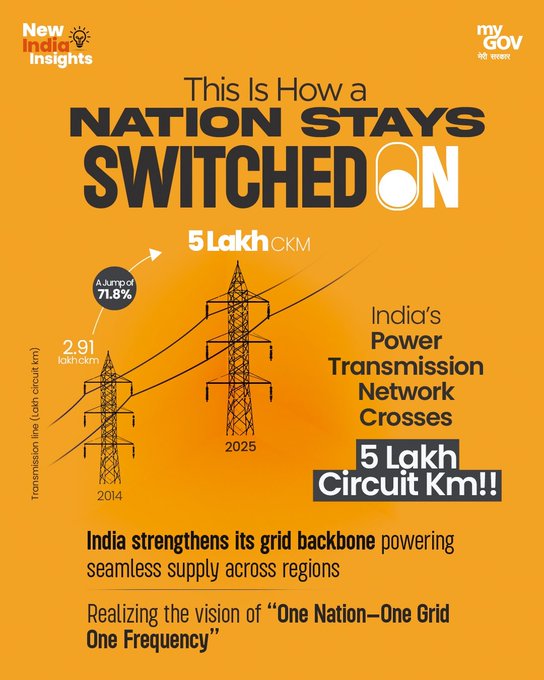
India’s power sector achieved a major infrastructure milestone with the national power transmission network crossing five lakh circuit kilometres of transmission lines at voltage levels of 220 kV and above, alongside a transformation capacity of 1,407 GVA. This landmark achievement underscores the rapid expansion and strengthening of the country’s electricity grid to support rising demand and the accelerated integration of renewable energy.
The milestone was attained on 14 January 2026 with the commissioning of a 765 kV transmission line spanning 628 circuit kilometres between Bhadla II and Sikar II substations. This high-capacity corridor has been developed to facilitate the evacuation of renewable energy from the Rajasthan Renewable Energy Zone. With the commissioning of this line, an additional 1,100 MW of renewable power can now be transmitted from the Bhadla, Ramgarh and Fatehgarh solar power complexes, significantly enhancing clean energy flow into the national grid.
India operates the world’s largest synchronous national grid, enabling seamless electricity transfer across states and regions. Since April 2014, the transmission network has recorded a growth of 71.6 per cent, with the addition of approximately 2.09 lakh circuit kilometres of transmission lines at 220 kV and above. During the same period, transformation capacity has increased by 876 GVA, reflecting sustained investment in grid infrastructure and capacity augmentation.
The inter-regional power transfer capacity has now reached 1,20,340 MW, strengthening the ability to move electricity efficiently across regions and fully realising the vision of “One Nation One Grid One Frequency.” This capability has played a critical role in balancing regional supply-demand variations, improving grid stability, and ensuring uninterrupted power availability across the country.
To further support future requirements, a significant pipeline of transmission projects is under implementation. Inter-State Transmission System projects are expected to add around 40,000 circuit kilometres of transmission lines and 399 GVA of transformation capacity. In parallel, Intra-State Transmission System projects under execution are projected to contribute an additional 27,500 circuit kilometres of lines and 134 GVA of transformation capacity. Together, these projects will substantially enhance grid resilience, reliability and evacuation capability.
The continued expansion of transmission infrastructure is central to India’s clean energy ambitions, particularly the national target of achieving 500 GW of non-fossil fuel-based power generation capacity by 2030. A robust and well-connected transmission network is essential to absorb large volumes of renewable energy, manage variability, and deliver power efficiently to consumption centres.
Crossing the five lakh circuit kilometre mark reflects the Government’s sustained focus on building a reliable, secure and future-ready power transmission system. The achievement reinforces India’s commitment to providing affordable and dependable electricity while enabling large-scale renewable energy integration to support long-term economic growth and energy security.